Claudius Galen
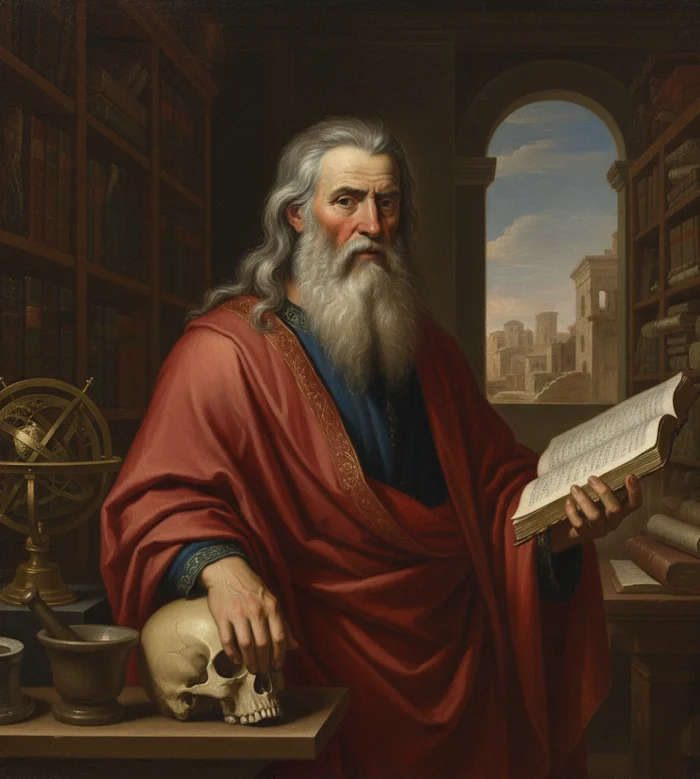
In his works, the renowned scholar and physician of Ancient Rome, Claudius Galen, managed to lay the theoretical foundations of medicine and anatomy for fifteen centuries ahead. In the Middle Ages he was called nothing less than “divine”.
Who was Galen?
Claudius Galen was born around 130 AD in the city of Pergamon. To our days, only ruins remain of this city. But Pergamon entered the history of humanity, having given the world one of the greatest physicians and scientists, and also thanks to parchment invented here. In this city there was also one of the richest libraries, which rivaled in its completeness with the Alexandrian Library.
The father of Claudius Galen, Nicon, a wealthy man, was a famous architect, well versed in mathematics and philosophy. Striving to give his son as broad an education as possible, he first studied with him himself, and then invited prominent Pergamene scholars to be his teachers.
Galen prepared to become a philosopher and zealously studied the philosophical works of Aristotle, Theophrastus and other Greek and Roman thinkers. But here chance intervened. One dream of Galen’s was unfavorably interpreted—and he became a physician, although all his life he continued to engage in philosophy and retained an interest in it. He said that “a good physician must be a philosopher”.
Beginning of the journey
When Galen turned 21 years old, his father died. Having received a large inheritance, Galen set off on a long journey. In Smyrna he studied anatomy and philosophy, in Corinth—natural science and the properties of medicines, in Alexandria, where he stayed for 6 years—anatomy again.
Galen traveled for almost 7 years. Having returned to Pergamon, he became a physician in a school of gladiators, where for four years he engaged in surgery. Gladiator fights in the Roman Empire were a favorite spectacle. They took place in huge circuses. Sometimes up to a hundred gladiators fought in such battles. Many fights ended in death or serious wounds, therefore Galen did not remain without work, bandaging wounds, stopping bleeding, treating dislocations and fractures. This work became for Galen a real school of medical art. Later he wrote: “I often had to guide the hand of surgeons, little encouraged in anatomy, and thereby save them from ruinous disgrace”.
At 34 years old, Galen moved to Rome, where he received the position of court physician to Emperor Marcus Aurelius. Treating patients from the Roman nobility, he did not refuse help to the poor either. The fame of the brilliant and skillful physician was so great that in Ancient Rome coins were put into circulation with the image of Claudius Galen.
Work with anatomy
At the insistence of his friends, Galen opened a course of lectures on anatomy, which he read in the Temple of Peace. Not only physicians came to these lectures, but also curious townspeople. Galen demonstrated the dissection of dogs, pigs, bears, ruminants, and sometimes monkeys, for the first time applying vivisection. He did not conduct dissection of human corpses. Not objecting to cruel and bloody gladiator fights for the amusement of the public, Galen’s contemporaries considered the dissection of human bodies for scientific purposes sacrilege. So that Galen could study human anatomy perhaps only on wounded gladiators and executed bandits.
These prohibitions were one of the reasons for numerous errors in the works of Galen and his contemporaries. Is it easy to describe the structure of the human body without having free opportunity to study it? All the more significant are the discoveries made by Galen.
Great discoveries
In one of his works he described about 300 human muscles, many of them—for the first time. Galen proved that not the heart, but the brain and spinal cord are “the center of movement, sensitivity and mental activity”. After a huge number of experiments with animals on cutting nerves, Galen made the conclusion that “without a nerve there is neither a single part of the body, nor a single movement called voluntary, nor a single sense”.
Cutting across the spinal cord, he showed the disappearance of sensitivity of all parts of the body lying below the place of the cut.
The arteries of a dead body are empty, therefore for a long time it was believed that in a living organism a mysterious “pneuma” moves through them, and not blood. Galen, having refuted the teaching about pneuma, proved that blood is found in the arteries. True, he considered the center of blood circulation to be not the heart, but the liver.
Galen’s books about medicine
Galen’s manuscripts occupied almost 500 scrolls (long strips of parchment rolled into a tube). Of his 400 works, only about a hundred have reached us. Besides the views of Galen himself, we learn from them about the names and discoveries of his contemporaries, whose works were lost in the darkness of centuries or burned in fires in book repositories.
Galen’s most famous compositions are “On the purpose of parts of the human body” and “On anatomy”. Galen considered the true teacher of an anatomist to be not books, but nature itself: “He who wants to contemplate the creations of nature must not trust compositions on anatomy, but must rely on his own eyes, engaging in anatomizing out of love for science”.
Claudius Galen laid the foundation for pharmaceutical science—pharmacology. He devoted a whole 11 books to it. He taught how to extract active substances from plants. “Galenic preparations” are still called tinctures and ointments prepared by certain methods.
Galen lived more than 70 years and died around 200 AD. His long life, despite weak health in youth, was explained by the habit of abstinence and diet. He wrote: “Rise from the table slightly hungry, and you will always be healthy”.
Galen did what no scientist-physician before him had attempted to do. He created a complete system of medical knowledge, encompassing all sections of medicine.
For a millennium and a half, Galen’s works were the only source of knowledge on anatomy. Georges Cuvier wrote about Galen: “He deserves admiration as a naturalist and physician. This was a brightly philosophical and generalizing mind”. And he added: “Galen is much higher than Aristotle as an anatomist, physiologist and physician. He is the first true anatomist”.
Source: Encyclopedia for children, Biology, 1993, License nr. 062284.