Key takeaways on Lepiota Brunneoincarnata
- This mushroom contains deadly amatoxins, similar to those in the infamous death cap, making it highly poisonous and responsible for fatalities in Europe and Asia.
- It often resembles edible species like the fairy ring champignon or grey knight mushroom, leading to accidental poisonings in grassy areas.
- Primarily found in warmer parts of Europe and western Asia, with emerging reports in eastern China, though distribution can vary by local climate and habitat.
- Ingestion can cause delayed gastrointestinal distress followed by severe liver and kidney damage, with outcomes ranging from full recovery to death depending on dose and prompt treatment.
- While supportive care like silibinin and N-acetylcysteine may help, liver transplantation is sometimes necessary in severe cases, highlighting the importance of early intervention.
Overview
In the shadowy underbelly of mycology, few species evoke as much caution as Lepiota brunneoincarnata. This diminutive fungus, with its deceptively charming appearance, stands as a stark reminder of nature’s dual-edged sword—beautiful yet potentially fatal.
Discovered in the late 19th century by Swiss mycologists Robert Hippolyte Chodat and Charles-Édouard Martin from roadside specimens in Geneva, it has since been linked to tragic poisonings across continents. Often mistaken for edible varieties due to its habitat in familiar grassy locales, this mushroom demands respect and knowledge.
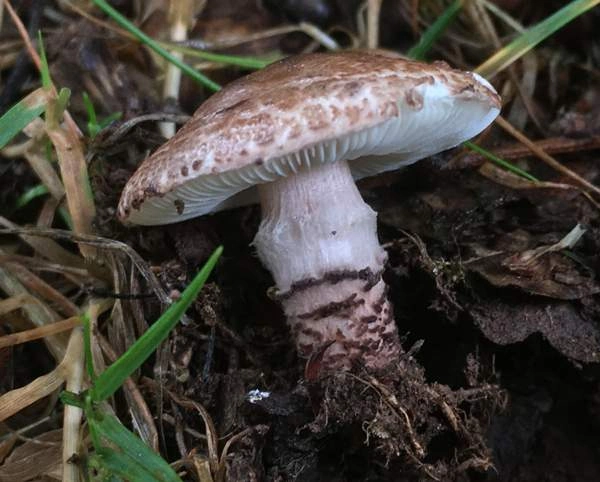
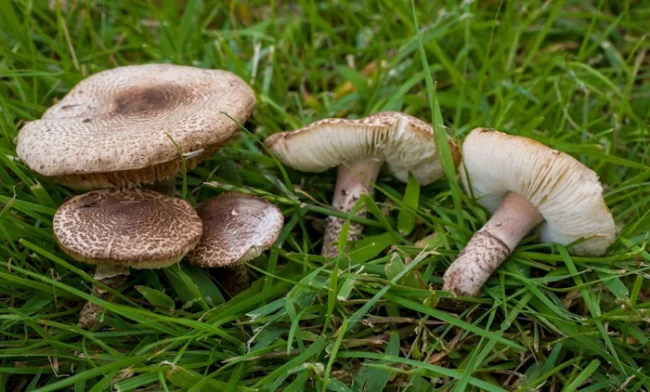
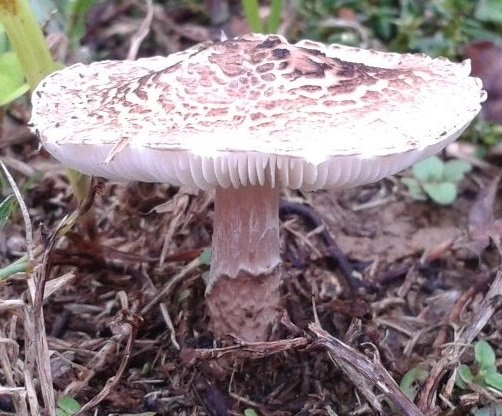
To recognize it, look for a cap that’s initially dome-shaped and pinkish-brown, breaking into scales as it matures, with free white gills and a stem featuring a subtle ring and darker scales below. Always confirm with spore prints or expert analysis, as it can be confused with safer look-alikes.
At its core, Lepiota brunneoincarnata is a basidiomycete fungus in the Agaricaceae family, part of the larger Agaricales order that includes many familiar mushrooms like button caps and portobellos. Classified as saprobic (feeding on decaying organic matter) or occasionally mycorrhizal (forming symbiotic relationships with plant roots), it plays a quiet ecological role in nutrient cycling within ecosystems. However, its notoriety stems not from benevolence but from its toxicity: it is unequivocally poisonous, harboring lethal compounds that have claimed lives in documented incidents from Spain to Iran.
Commonly dubbed the “deadly dapperling,” a name that nods to its elegant, scaled cap reminiscent of dapper attire, it goes by several scientific synonyms reflecting historical taxonomic debates: Lepiota barlae, Lepiota barlaeana, Lepiota patouillardii, and Lepiota patouillardi. These aliases arise from early descriptions by mycologists like Pierre Augustin Clément Patouillard and Giovanni Battista Barla. In lay terms, it’s sometimes lumped with other “dapperlings” or “parasol-like” mushrooms, but such generalizations can be dangerous given the genus’s mix of edible and toxic species.
Unlike its benign cousins, L. brunneoincarnata is strictly off-limits for consumption. Genetic studies place it close to other amatoxin-laden relatives like Lepiota subincarnata, underscoring a shared evolutionary path toward chemical defense. Its presence in urban and rural settings amplifies risks, as foragers might confuse it with delicacies like the fairy ring champignon (Marasmius oreades) or grey knight (Tricholoma terreum).
Geography and distribution: where the deadly dapperling grows
Lepiota brunneoincarnata favors temperate climates, emerging predominantly in Europe and western Asia, with sporadic reports pushing its range eastward. In Europe, it’s most prevalent in warmer southern regions—think Mediterranean countries like Spain, France, Italy, and Tunisia—but records extend northward to Britain, Ireland, and Germany, where it’s considered rare. Asian sightings include Turkey, Israel, Pakistan, Iran, and even eastern China, particularly in Yunnan Province, suggesting adaptability to varied subtropical influences.
Habitat-wise, it shuns dense forests for open, grassy expanses: fields, parks, gardens, broadleaf woodlands, mixed forests, and even sand-dune grasslands. This preference for anthropogenically modified areas heightens human encounters. Seasonally, fruiting bodies appear from July to November in cooler locales like Britain, aligning with late summer rains that spur growth. Climate change may expand its footprint, as warmer conditions could encourage northward migration, but current data remains patchy, relying on citizen science platforms like iNaturalist for updates.
Anatomy
Identifying Lepiota brunneoincarnata requires keen observation, as its features overlap with both toxic and edible kin. Here’s a meticulous guide to its morphology, drawn from field guides and microscopic analyses.
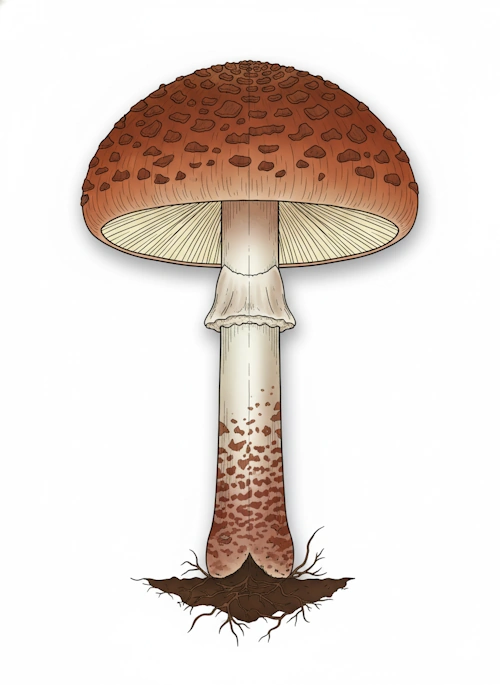
- Cap (Pileus): Measuring 2.5 to 6 cm in diameter, it starts hemispherical or bell-shaped, maturing to broadly convex or nearly flat with a slight central umbo (bump). The surface is pinkish-brown to reddish-brown when young, fading to pale pinkish-tan, covered in fine woolly or felty scales that form irregular concentric rings. A prominent, unbroken dark brown scale often crowns the center, while the margin remains inrolled and slightly fibrillose. The flesh beneath is white but reddens upon bruising or cutting—a key diagnostic trait.
- Gills (Lamellae): Free from the stem (not attached), crowded, and creamy-white to off-white, with thick edges and occasional forking. Shorter intermediary gills (lamellulae) are present. Cheilocystidia (sterile cells on gill edges) are cylindrical or club-shaped, aiding microscopic confirmation.
- Stem (Stipe): Slender and cylindrical, 2.5 to 5 cm tall and 0.5 to 0.9 cm wide. The upper portion is smooth and pinkish-tan, while the lower half, below an indistinct woolly ring (annulus), sports dark brown fibrous scales on a paler background. The base may bulb slightly but lacks a volva (cup-like structure seen in some Amanitas).
- Flesh and sensory traits: Thick and firm, the flesh emits a faint fruity or unripe fruit odor, with a mild taste—though tasting is emphatically discouraged. When cut, it oxidizes to reddish hues.
- Microscopic features: Spores are ellipsoidal to oval, smooth, measuring 6–10.2 μm long by 3.5–5.5 μm wide, and dextrinoid (staining red-brown in Melzer’s reagent). The spore print is white, distinguishing it from rust-spored genera.
- Growth pattern: Typically in small troops or solitary, emerging from soil amid grass or leaf litter.
To differentiate: Compare with Lepiota subincarnata (more pinkish, smaller spores), Lepiota cristata (larger, stinkier), or edibles like Macrolepiota procera (much bigger parasol shape). Always use multiple keys; apps or experts can help, but err on caution.
The toxins of Lepiota brunneoincarnata
The peril of Lepiota brunneoincarnata lies in its cyclopeptide toxins, chiefly amatoxins such as α-amanitin, β-amanitin, and γ-amanitin—compounds shared with deadly Amanitas. These are thermostable, surviving cooking, drying, or freezing, and even small amounts (as little as half a cap) can be lethal. Concentrations vary; one study detected 123.5 μg/g α-amanitin and 45.7 μg/g β-amanitin in fresh samples. Unlike phallotoxins in some mushrooms, amatoxins dominate here, focusing damage on internal organs.
Amatoxins insidious mechanism involves inhibiting RNA polymerase II, a vital enzyme for transcribing DNA into mRNA, thereby halting protein synthesis. This cytotoxic effect targets high-turnover cells: hepatocytes in the liver, proximal tubular cells in kidneys, and intestinal mucosa. Absorbed rapidly from the gut, toxins circulate via the bloodstream, concentrating in the liver where they trigger apoptosis (programmed cell death) and necrosis. The delay in symptoms stems from this: initial GI irritation from direct contact, followed by systemic fallout as protein-deficient cells fail.
Symptoms: a step-by-step progression
Poisoning unfolds in phases, mimicking less severe issues at first, which can delay help.
- Latent phase (0-6 hours): No symptoms; toxins absorb silently.
- Gastrointestinal phase (6-12 hours): Sudden onset of severe nausea, vomiting (88% of cases), abdominal pain (50%), and watery diarrhea. Dehydration ensues from fluid loss, with possible malaise and weakness.
- Apparent recovery phase (12-24 hours): Symptoms subside temporarily, lulling victims into false security.
- Hepatorenal phase (1-3 days): Liver damage manifests as jaundice (icterus), elevated enzymes (ALT/AST skyrocketing), fatigue, lethargy, and decreased consciousness. Kidney involvement brings hematuria, oliguria (reduced urine), edema, and rising creatinine/BUN. Coagulopathy (bleeding risks) from liver failure, plus hemolytic signs (low hemoglobin, high LDH).
- Advanced phase (3+ days): Fulminant organ failure—coma, multiorgan collapse, death if untreated.
Variations occur; some cases show neurological effects like confusion, or skin peeling/hair loss in prolonged survival.
Damage at the cellular and organ level
The assault is multifaceted. In the liver, amatoxins cause massive hepatocyte necrosis (10-30% in severe cases), steatosis (fatty buildup, 40-70%), inflammation, and ductular proliferation.
Kidneys suffer acute tubular necrosis, interstitial edema, inflammatory infiltration, and glomerular fibrosis, potentially leading to chronic insufficiency even in survivors.
Intestinal mucosa sloughs, exacerbating dehydration.
Systemic effects include coagulopathy (prolonged PT), anemia, thrombocytopenia, and possible encephalopathy from toxin buildup.
Mortality hovers at 10-30%, with survivors facing long-term scars like renal impairment.
| Phase | Key Symptoms | Lab Indicators | Potential Damage |
|---|---|---|---|
| Latent (0-6 hrs) | None | Normal | Toxin absorption begins |
| GI (6-12 hrs) | Nausea, vomiting, pain, diarrhea | Dehydration markers | Mucosal irritation, fluid loss |
| Recovery (12-24 hrs) | Symptom relief | Mild enzyme rise | Ongoing cellular stress |
| Hepatorenal (1-3 days) | Jaundice, fatigue, hematuria | High ALT/AST, bilirubin, creatinine | Liver necrosis, kidney necrosis |
| Advanced (3+ days) | Coma, bleeding, edema | Coagulopathy, anemia | Multiorgan failure, chronic issues |
When to call 911
Act swiftly: if ingestion is suspected—even without symptoms—contact poison control or emergency services immediately. GI onset (nausea post-6 hours) signals urgency; don’t wait for liver signs. Bring mushroom samples for ID.
In regions like the US, call 1-800-222-1222; globally, seek local equivalents.
High-risk groups (children, elderly) warrant extra caution.
Can you survive Lepiota poisoning?
No specific antidote exists, but multimodal care can save lives.
- Decontamination: Gastric lavage and multiple-dose activated charcoal within hours to bind toxins.
- Supportive care: IV fluids for rehydration, antiemetics (ondansetron), proton-pump inhibitors (pantoprazole), and antibiotics if needed.
- Pharmacological help: Silibinin (from milk thistle) blocks amanitin uptake; N-acetylcysteine (NAC) as antioxidant; high-dose penicillin G to compete for toxin transport. Efficacy varies—studies show mixed results.
- Advanced therapies: Hemoperfusion/plasma exchange to remove circulating toxins; dialysis for renal failure; continuous renal replacement therapy in persistent cases.
- Last resort: Liver transplantation for fulminant failure, though post-op mortality remains high (e.g., 2/3 in one series).
Outcomes hinge on dose (100g can devastate the liver), timeliness, and health status. Case studies show full recovery with prompt care, but delays lead to tragedies like the 2010 Tunisian family deaths or 2018 Iranian outbreak.
Sources
- Lepiota brunneoincarnata, Deadly Dapperling mushroom
- Severe Hepatotoxicity in Mushroom Poisoning by Lepiota brunneoincarnata…
- Acute hepatic and kidney injury after ingestion of Lepiota brunneoincarnata: Report of 2 cases
- Lepiota Mushrooms: Identification Guide
- Deadly Dapperling (Lepiota brunneoincarnata)
- Mushroom Toxicity: Background, Pathophysiology, Etiology