Niels Bohr
The quantum revolutionary who changed everything we know about reality
When I think of the giants of physics, Einstein always comes first. But in many ways, Niels Bohr was the more important architect of our modern world. While Einstein was the solitary genius, Bohr was the ‘Godfather’—the man who built the family that uncovered the quantum universe.
His life story reads like a novel about ideas colliding with reality, about friendship and rivalry, about a man who could see patterns in nature that no one else could glimpse.
Early years
Born in Copenhagen on October 7, 1885, Niels Henrik David Bohr arrived into a world of privilege and intellect. His father, Christian Bohr, was a respected physiology professor who turned the family dinner table into an arena for debate. His mother, Ellen Adler Bohr, came from a wealthy Jewish family prominent in banking and politics.

The Bohr household buzzed with professors, students, and thinkers arguing about everything from philosophy to science late into the night.
Young Niels wasn’t the stereotypical prodigy. He spoke slowly, carefully, often pausing mid-sentence to reconsider his words.
His younger brother Harald, who would become a brilliant mathematician, seemed the quicker wit.
But Niels possessed something else: a relentless curiosity paired with an almost stubborn refusal to accept conventional answers. He would worry at a problem like a dog with a bone, turning it over and over until he found something everyone else had missed.
The brothers were inseparable growing up. They played soccer together—Niels as goalkeeper, Harald as a midfielder so talented he would later play for the Danish national team and win a silver medal at the 1908 Olympics. That detail alone shatters the myth of the cloistered scientist.
Bohr loved sports, loved the outdoors, loved the physical world as much as the abstract one.
Niels Bohr as a student
At the University of Copenhagen, Bohr started in mathematics and philosophy before settling on physics. He was a methodical student rather than a flashy one.
For his master’s thesis, he studied the surface tension of water by creating vibrations in a stream of liquid, a painstaking experimental work that required building his own apparatus. His father’s physiology laboratory became his workshop.
Already, you could see the pattern that would define his career: Bohr didn’t just theorize, he thought deeply about what experiments meant, about the relationship between what we measure and what actually exists.
The young physicist’s doctoral dissertation tackled the electron theory of metals, using the latest ideas from Maxwell’s electromagnetic theory. It was solid, respected work, but it also revealed something crucial about Bohr’s mind. He kept running into contradictions between classical physics and experimental results. Where others shrugged and pushed forward, these inconsistencies gnawed at him.
Something fundamental was wrong with the picture physicists had of matter and energy, and Bohr couldn’t let it go.
Working with electrons
In 1911, newly married to Margrethe Nørlund, Bohr headed to Cambridge to work with J.J. Thomson, the discoverer of the electron.

The match was disastrous. Thomson had little interest in this earnest Dane who spoke halting English and questioned established ideas.
But fate intervened. Bohr met Ernest Rutherford, the boisterous New Zealander who had just proposed that atoms consisted of a tiny, dense nucleus surrounded by orbiting electrons.
Bohr moved to Manchester to work with Rutherford, and the two formed an instant bond. Rutherford was all thunder and confidence; Bohr was quiet deliberation. Yet they shared an instinct for the jugular questions in physics.
Rutherford’s atomic model had a fatal flaw: according to classical physics, those orbiting electrons should radiate energy continuously and spiral into the nucleus in a fraction of a second. Atoms should be impossible.
Since atoms obviously existed, something was terribly wrong.
New atomic model
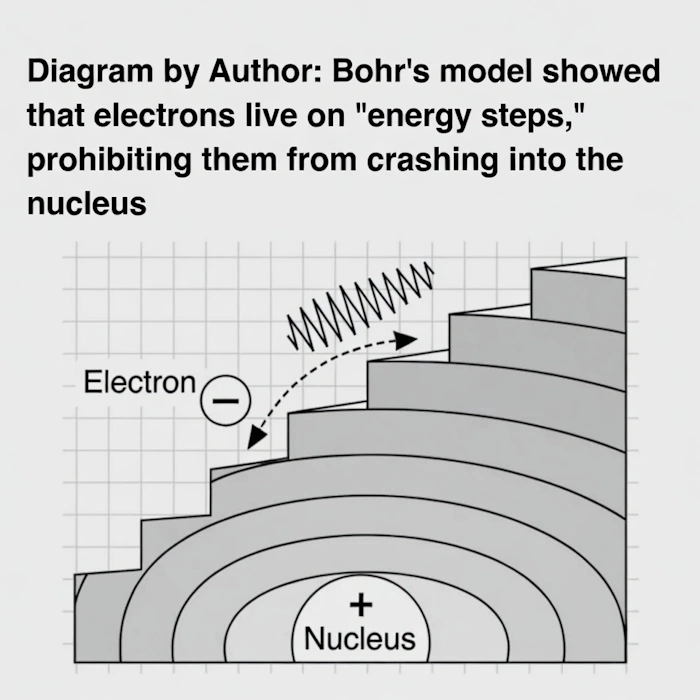
Back in Copenhagen in 1913, Bohr made his great leap. He proposed something that seemed crazy: electrons in atoms could only exist in certain specific orbits, at certain specific energy levels. They couldn’t exist in between. An electron could jump from one orbit to another, absorbing or emitting a specific amount of energy as it did so, but it couldn’t gradually transition. The energy came in packets—quanta.
My Analogy: The Quantum Staircase
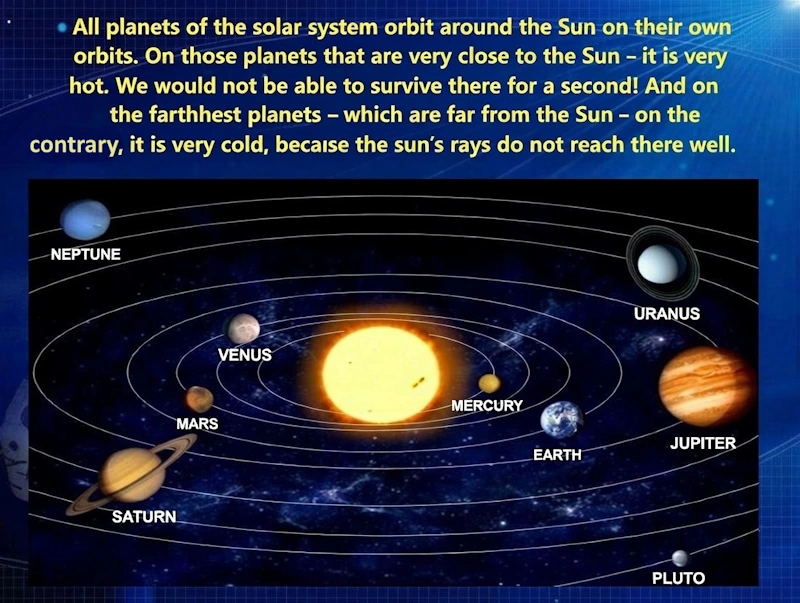
Think of the atom not like a solar system (where a planet can orbit anywhere), but like a staircase.
An electron can stand on Step 1 or Step 2.
-
It cannot stand in the empty space between the steps.
-
To move up, it needs exactly enough energy to jump the gap. This “all-or-nothing” jump is what we call a Quantum Leap. This simple idea killed classical physics.
This explained everything. Why atoms were stable. Why they emitted light at specific wavelengths. Why hydrogen’s spectral lines followed that mysterious mathematical pattern called the Rydberg formula.
Bohr had taken Planck’s quantum hypothesis and Rutherford’s nuclear atom and fused them into something genuinely new.
The papers he published that year rank among the most important in physics history.
The response was mixed. Some physicists immediately recognized the brilliance.
Others thought Bohr had gone too far, abandoning the rigor of classical physics for ad hoc rules.
Einstein admired the audacity but worried about the theoretical foundation.
But experiments kept confirming Bohr’s predictions. His model worked.
The Institute for Theoretical Physics
After World War I, Bohr returned to Copenhagen with a mission: to build an institute that would become the center of the quantum revolution.
The Institute for Theoretical Physics opened in 1921, funded by the Carlsberg brewery fortune and Danish government support. It became a pilgrimage site for young physicists from around the world.
A sprawling mansion converted to research, with offices, laboratories, and a library where the newest papers circulated before publication.
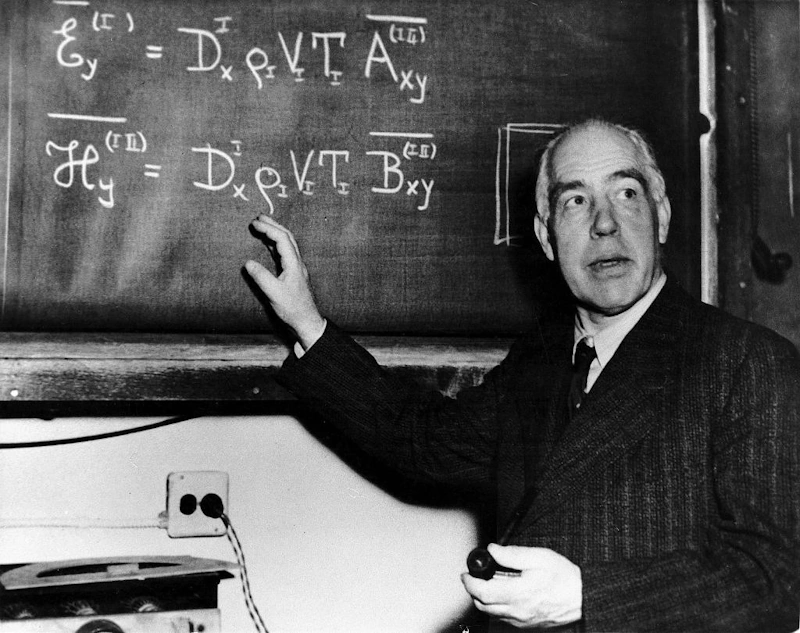
Bohr presided over it all, but not as a distant authority. He worked alongside his students and visitors, arguing, questioning, erasing blackboards and starting over.
His English never quite smoothed out, and he had a habit of speaking in paradoxes that could madden or enlighten depending on the listener.
The institute attracted the best minds of a generation. Werner Heisenberg arrived in 1924, Wolfgang Pauli and Paul Dirac visited. And also – Otto Frisch, George Gamow, Lev Landau—the roll call reads like a who’s who of twentieth-century physics.
Bohr had a gift for asking the right questions at the right moment. He didn’t necessarily provide answers; he created an environment where answers could emerge.
Students remember long walks with Bohr through the Copenhagen streets, the older man speaking slowly, carefully, testing ideas, never satisfied with glib responses. He wanted physics that meant something, that corresponded to reality, not just equations that happened to work.
Two models of quantum mechanics
By the mid-1920s, quantum mechanics was in crisis. The old Bohr model had done its job, but newer experiments revealed a stranger reality.
Heisenberg developed matrix mechanics, a purely abstract mathematical framework that abandoned any picture of what atoms “looked like.”
Schrödinger proposed wave mechanics, describing particles as waves governed by a wave equation.
The two approaches gave the same answers but seemed philosophically incompatible.
Then came the real earthquake. In 1927, Heisenberg proposed his uncertainty principle: you cannot simultaneously know both the position and momentum of a particle with perfect precision. This wasn’t a limitation of measurement technology; it was fundamental to reality itself.
Bohr seized on this insight and expanded it into what he called complementarity. Different experiments reveal different, seemingly contradictory aspects of quantum systems. Light behaves like a wave in some experiments, like a particle in others. You can’t see both aspects simultaneously, but both are necessary for a complete description. The observer and the observed are inseparable. Measurement doesn’t just reveal properties; it actualizes them.
This interpretation—the Copenhagen interpretation, as it came to be known—became the dominant way physicists understood quantum mechanics.
But it came at a cost: abandoning the idea that particles have definite properties independent of observation. Reality at the quantum level is fundamentally probabilistic, fundamentally uncertain.
Not everyone could accept this. Einstein, who had helped birth quantum theory with his work on the photoelectric effect, became its most prominent critic.
Bohr vs Einstein
Thus began one of the great intellectual duels in science history: Bohr versus Einstein, stretching from the late 1920s through the 1930s.
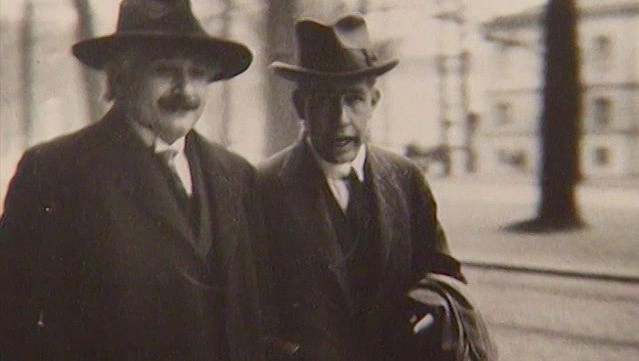
They clashed most famously at the Solvay Conferences, those legendary gatherings where the greatest physicists met to debate the foundations of their field.
Einstein would arrive with thought experiments designed to show contradictions in quantum mechanics.
Bohr would pace sleeplessly through the night, working through the logic, and by morning would have found the flaw in Einstein’s reasoning.
The most famous exchange came in 1930. Einstein proposed a box filled with radiation, with a shutter that could open briefly to release a single photon. By weighing the box before and after, you could measure the photon’s energy. By timing when the shutter opened, you could measure when it escaped. Doesn’t this violate the uncertainty principle?
Bohr spent a tormented night on the problem. Then he realized: Einstein had forgotten his own general theory of relativity. The act of weighing the box in a gravitational field introduces a time uncertainty. When Bohr showed Einstein his error, even Einstein had to smile at the irony. His own relativity theory had saved quantum mechanics.
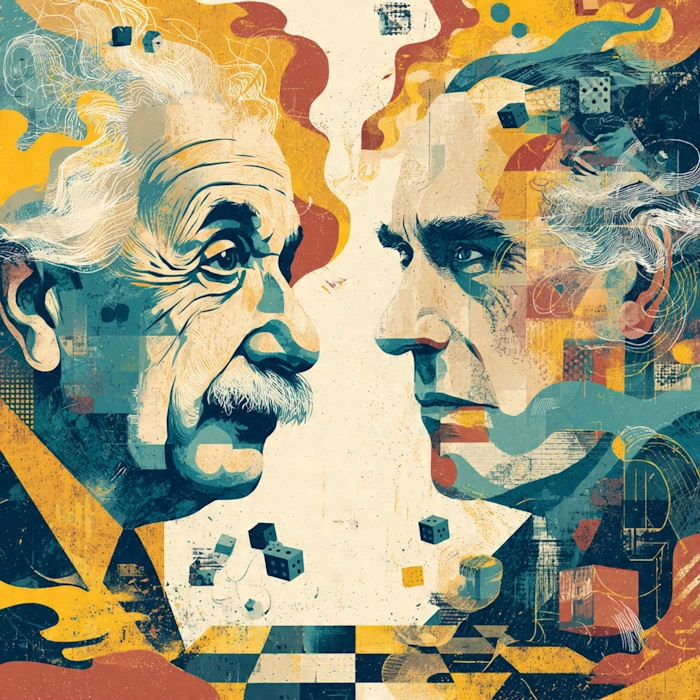
But Einstein never accepted Bohr’s interpretation. “God does not play dice with the universe,” that was his famous phrase. Bohr supposedly replied: “Einstein, stop telling God what to do.” That exchange, perhaps apocryphal, captures the essence of their disagreement.
For Einstein, quantum mechanics must be incomplete; there must be hidden variables determining outcomes. For Bohr, indeterminacy was fundamental, irreducible, real.
Throughout these debates, Bohr never treated Einstein as an enemy. He revered Einstein as perhaps the only physicist whose insight matched his own. Their arguments were conducted with mutual respect and even affection. When Einstein fled Nazi Germany, Bohr helped many German-Jewish physicists escape and find positions abroad.
Too late recognition
In 1932, Heisenberg received the Nobel Prize for the creation of quantum mechanics. Many felt Bohr had been snubbed.
Then in 1933, Dirac and Schrödinger shared the prize.
Only in 1922 had Bohr himself received the Nobel “for his services in the investigation of the structure of atoms and of the radiation emanating from them”—recognition for his 1913 model, but before the full quantum revolution.
The 1930s brought new triumphs. Working with his assistant Fritz Kalckar and later with George Placzek, Bohr developed the compound nucleus model of nuclear reactions.
When a neutron hits a nucleus, Bohr proposed, it doesn’t interact with individual particles but gets absorbed into the whole nucleus, which enters an excited state before decaying.
This model explained a wealth of experimental data and became central to understanding nuclear physics.
Beginning of a nuclear era
Then came the discovery that would change everything: nuclear fission. In late 1938, Otto Hahn and Fritz Strassmann in Berlin found that bombarding uranium with neutrons produced barium, an element with about half uranium’s atomic weight. The nucleus was splitting.
In January 1939, Lise Meitner and Otto Frisch (Bohr’s nephew) provided the theoretical explanation, and Frisch performed confirming experiments in Bohr’s Copenhagen lab.
Bohr was about to leave for America when he learned the news. On the ship crossing the Atlantic, he and Leon Rosenfeld worked out more details. Upon landing, they shared the discovery with American physicists.
The reaction was immediate: if fission released energy and additional neutrons, a chain reaction might be possible. Bombs. Power plants. The atomic age had arrived.
Bohr understood the implications with crystal clarity. He quickly worked out that only the rare isotope uranium-235, not the common uranium-238, would sustain a chain reaction.
This meant building a bomb would be extraordinarily difficult, requiring separation of isotopes—a massive industrial undertaking.
He estimated it would take years and enormous resources, making such weapons unlikely to affect the current war.
Patriot and pacifist
When Germany invaded Denmark in April 1940, Bohr chose to remain in Copenhagen, trying to maintain the institute’s work under occupation.
It was a dangerous time. Bohr was half-Jewish by Nazi racial laws, famous, and outspoken. He sheltered refugees and tried to help Jewish physicists escape.
He also refused to meet with Heisenberg when his former student visited Copenhagen in 1941, now working on German nuclear research. That meeting, when it finally happened, went disastrously. What was said remains disputed to this day, but the friendship never recovered.
By 1943, Bohr’s position became untenable. The Danish resistance smuggled him to Sweden in a fishing boat, then the British flew him to Britain in a military aircraft. He reportedly nearly died during the flight when he failed to put on his oxygen mask at high altitude, but arrived safely.
From Britain, he went to America, joining the Manhattan Project under the code name “Nicholas Baker.”
At Los Alamos, Bohr served as an elder statesman more than a working physicist. The younger scientists revered him. Robert Oppenheimer called him “Uncle Nick” and sought his counsel on both technical and ethical questions.
Richard Feynman remembered being terrified before meeting the great man, then being disarmed by Bohr’s genuine interest in his ideas. Bohr had a way of making young physicists feel their thoughts mattered.
But Bohr was deeply troubled by what they were creating. He understood that atomic weapons would change international relations fundamentally.
After the war, he became convinced that only complete openness about nuclear weapons, including sharing information with the Soviet Union, could prevent an arms race. It was an idealistic position that came from a genuine belief that science belonged to all humanity.
He tried to convince Churchill and Roosevelt. The meetings were disasters. Churchill found Bohr incomprehensible—that halting, careful speaking style served poorly in political audiences.
Churchill reportedly complained that Bohr’s speaking had “put soot in his soul.” Roosevelt was more polite but equally unmoved.
The politicians saw atomic weapons as tools of national power, not problems requiring international cooperation.
After the war, Bohr returned to Copenhagen and threw himself into advocating for peaceful uses of atomic energy and international control of nuclear weapons.
He helped establish CERN, the European nuclear research organization, believing international scientific collaboration could help prevent future wars. In 1950, he published an open letter to the United Nations calling for an “open world” with free exchange of information.
The Cold War made his position increasingly difficult. He was caught between East and West, trusted by neither. The Americans investigated him as a potential security risk for his openness advocacy. The Soviets viewed him with suspicion as a Western scientist. But Bohr never wavered in his conviction that science should serve all humanity.
Later work: searching for quantum physics in living beings
His later scientific work continued to surprise. In the 1950s, he became interested in biology, particularly the question of whether quantum effects played a role in living systems.
He argued for a principle of complementarity in biology similar to his quantum complementarity: you cannot simultaneously study an organism as a living system and reduce it to pure physics and chemistry. The act of detailed physical analysis destroys the living quality you’re trying to understand.
This idea influenced a generation of molecular biologists, including Max Delbrück, who moved from physics to biology partly inspired by Bohr’s ideas.
Whether Bohr was right about quantum effects in biology remains debated, but his insistence that different levels of description might be complementary rather than reducible has proven prescient.
Legacy of Niels Bohr
Right to the end, Bohr remained active. He continued working on foundational questions in quantum mechanics, trying to make his interpretation clearer, more precise.
On November 18, 1962, Bohr died suddenly of heart failure at his home in Copenhagen. He was seventy-seven years old. At the time of his death, he was working at his blackboard, sketching diagrams for a new paper on quantum mechanics. It was a fitting end for a man who had spent his life drawing pictures of invisible realities, trying to make the quantum world comprehensible.
His legacy is almost impossible to overstate. The Bohr model of the atom, though superseded by full quantum mechanics, remains how most people visualize atomic structure.
The Copenhagen interpretation, whatever its philosophical problems, is still the working interpretation most physicists use.
The institute he built trained multiple generations of physicists and remains a premier research center.
But perhaps his greatest legacy is less tangible: a style of doing physics that emphasizes deep conceptual understanding over mathematical formalism alone, that insists on asking what equations mean rather than just solving them, that values collaboration and debate, that recognizes science as a profoundly human activity.
Quantum mechanics revolutionized physics and technology. Without it, we wouldn’t have semiconductors, lasers, MRI scanners, or computers. The device you’re reading this on exists because Bohr and his colleagues uncovered the quantum rules governing matter and energy. But Bohr’s quantum mechanics also revolutionized philosophy, forcing us to reconsider the nature of reality, causality, and knowledge itself.
Sources
Books
- French, A.P. and Kennedy, P.J. (eds.) (1985) Niels Bohr: a centenary volume. Cambridge, Mass.: Harvard University Press.
- Rhodes, R. (1986) The making of the atomic bomb. New York: Simon & Schuster.
- Pais, A. (2000) The genius of science: a portrait gallery. Oxford: Oxford University Press.
Scholarly articles and biographical memoirs
- Rosenfeld, L. and Kellogg, R.H. (1970) ‘Niels Bohr’, in Dictionary of scientific biography. New York: Charles Scribner’s Sons. Available at: https://mathshistory.st-andrews.ac.uk/Biographies/Bohr_Niels/
- Royal Society (1963) ‘Niels Henrik David Bohr, 1885-1962’, Biographical memoirs of fellows of the Royal Society, 9, pp. 36-53. Available at: https://royalsocietypublishing.org/doi/10.1098/rsbm.1963.0002
Official archives and institutions
- Niels Bohr Archive (no date) Niels Bohr Archive collections. Copenhagen: University of Copenhagen. Available at: https://nbarchive.ku.dk/
Online biographical sources
- NobelPrize.org (1922) ‘Niels Bohr – biographical’. Available at: https://www.nobelprize.org/prizes/physics/1922/bohr/biographical/
- Encyclopaedia Britannica (2024) ‘Niels Bohr’. Available at: https://www.britannica.com/biography/Niels-Bohr
- Wikipedia (2024) ‘Niels Bohr’. Available at: https://en.wikipedia.org/wiki/Niels_Bohr
- MacTutor History of Mathematics Archive (no date) ‘Niels Bohr (1885-1962)’. University of St Andrews. Available at: https://mathshistory.st-andrews.ac.uk/Biographies/Bohr_Niels/
- PBS (no date) ‘Niels Bohr’, A science odyssey: people and discoveries. Available at: https://www.pbs.org/wgbh/aso/databank/entries/bpbohr.html
- The Atomic Heritage Foundation (no date) ‘Niels Bohr’. Available at: https://www.atomicarchive.com/resources/biographies/bohr.html
- Famous Scientists (2019) ‘Niels Bohr biography’. Available at: https://www.famousscientists.org/niels-bohr/