What it is
Pholiota squarrosa is a basidiomycete fungus in the Strophariaceae family, often found in dense clusters on or near trees. It derives nutrients from decaying or living wood, contributing to nutrient cycling in forests but sometimes acting as a secondary pathogen on weakened trees.
Common names
It is known by several names, including shaggy scalycap, shaggy Pholiota, scaly Pholiota, hairy scalycap, dry scalycap, and rough scalycap, reflecting its textured surface.
Detailed description
Pholiota squarrosa, a striking member of the fungal kingdom, captivates mycologists and foragers alike with its rugged, scale-covered form that evokes images of ancient forest guardians. This species, often encountered in clustered formations at the base of trees, embodies the intricate balance of decay and renewal in woodland ecosystems.
As a saprobic and potentially parasitic fungus, it breaks down lignin in wood, facilitating nutrient release back into the soil while occasionally exploiting weakened hosts. Its presence signals both ecological vitality and, at times, tree stress from injury or prior infections.
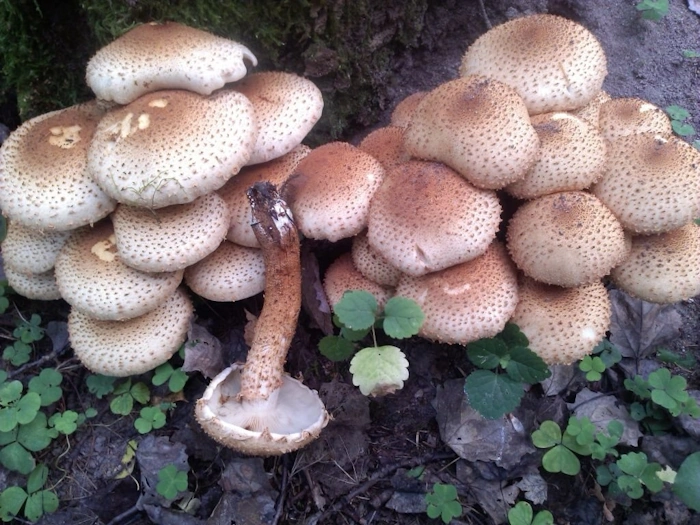
Pholiota squarrosa stands out in the diverse world of mushrooms for its unmistakable shaggy appearance, which arises from a universal veil that fragments into prominent scales during development. This fungus typically emerges in late summer through autumn, forming dense tufts that can span up to 30 cm across, often appearing to sprout from the ground but actually connected to buried roots or heartwood. Its ecological role is multifaceted: as a white rot fungus, it primarily decomposes dead wood by enzymatically degrading lignin to access cellulose, but it can also act as a secondary parasite on living trees compromised by bacteria, fungi, or physical damage.
This dual nature makes it a subject of interest in forest pathology, where it may exacerbate decline in species like sugar maple or beech. Observations note subtle variations in form—caps near deciduous trees tend to be more rounded, while those near conifers may appear slightly conical—though these are not universally confirmed and may reflect environmental influences rather than genetic differences.
Nomenclature and naming history
The mushroom’s nomenclature reflects its textured exterior across languages and regions. Commonly called the shaggy scalycap in English, it highlights the “shaggy” or woolly scales that adorn its surfaces. Other English variants include shaggy Pholiota and scaly Pholiota, emphasizing its genus and scaliness.
Historical and regional names, such as hairy scalycap, dry scalycap, rough scalycap, or scaly scalycap, further underscore its dry, abrasive feel.
The scientific name derives from Latin: “Pholiota” from the Greek “pholis” meaning scale, and “squarrosa” meaning scurfy or with upright scales. First described in 1770 by Georg Christian Oeder as Agaricus squarrosus, it was later sanctioned by Elias Magnus Fries in 1821 and reclassified into Pholiota by Paul Kummer in 1871. Synonyms include Agaricus floccosus, Lepiota squarrosa, Agaricus verruculosus, and Dryophila squarrosa, illustrating the evolving understanding of fungal taxonomy over centuries.
Geography and habitat
Geographically, Pholiota squarrosa boasts a broad, cosmopolitan distribution, thriving in temperate and boreal zones across multiple continents. It is prevalent in Europe, from Britain and Ireland—where it fruits from August to November, often in beech-dominated areas—to mainland countries like the Netherlands, where it colonizes ancient timber structures.
In Asia, it appears in regions including Japan, while North America hosts it from Canada southward to Mexico, with Mexican populations restricted to coniferous forests. This wide range underscores its adaptability to diverse climates, though it favors moist, forested environments.
Habitat preferences lean toward mixed or deciduous woodlands, but it occasionally ventures into coniferous stands or urban settings like parks and tree-lined streets.
Fruiting bodies emerge from mid-July to early October, with peak abundance in late August to September, growing in groups, bundles, or colonies on deadwood, living trunks, roots, or stumps.
Primary hosts include hardwoods such as oak (Quercus spp.), maple (Acer spp.), lime (Tilia spp.), birch (Betula spp.), aspen (Populus tremula), beech (Fagus spp.), and fruit trees like apple (Malus domestica) and pear (Pyrus communis); conifers like spruce (Picea spp.) and pine (Pinus spp.) are less common.
Its annual recurrence and non-rarity make it a familiar sight for mushroom hunters, though it is frequently mistaken for the edible honey fungus (Armillaria mellea) due to similar clustering—a confusion easily resolved by spore print color (rusty brown versus white).
Anatomical features
Macroscopic characteristics
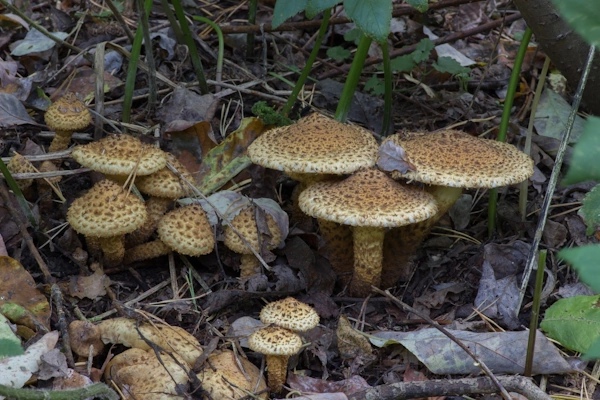
Anatomically, Pholiota squarrosa presents a robust and detailed morphology that aids in precise identification. The cap, ranging from 3–12 cm in diameter (occasionally up to 20 cm), begins as hemispherical or bell-shaped in youth, progressing to convex and eventually flat or broadly umbonate with age. Its surface is dry and velvety, not sticky even in wet weather, featuring a pale yellow to ochre background overlaid with numerous upturned, pointed, or recurved scales in ochre-brown to tawny hues, arranged in concentric rings that give a shingle-like effect. The margin remains inrolled initially but may crack or fissure in maturity.
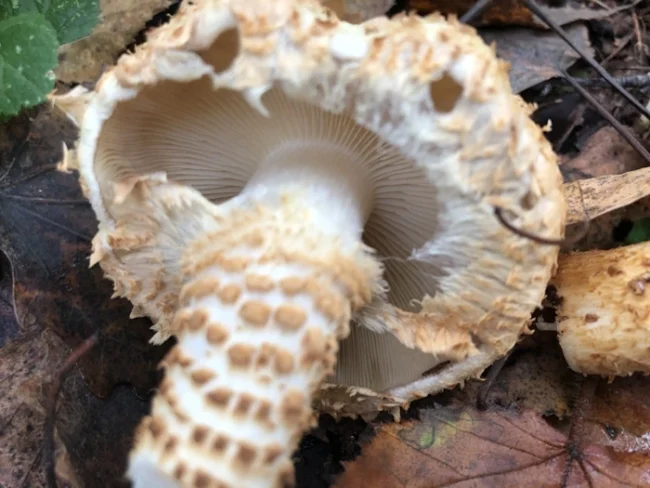
Beneath the cap, the gills are crowded, thin, and adnate (attached to the stem) or slightly decurrent with a tooth-like extension; they start pale yellowish or cream, transitioning through greenish-yellow to rusty brown or cinnamon as spores mature, with smooth edges and a waxy texture when fresh.
The stem measures 4–20 cm in length and 0.5–3 cm in thickness, cylindrical or slightly narrowed at the base, solid when young but developing a cavity with age; it mirrors the cap’s coloration, turning rusty-brown and woody at the base for toughness. A prominent ring or ring zone from the partial veil divides the stem: above, it is smooth and lighter (pale yellow); below, it is densely covered in similar ochre-brown scales that point downward.
The flesh is thick and fleshy in the cap—white, whitish, or slightly yellowish, soft and springy—while in the stem it is denser, yellowish to reddish at the base, and fibrous. Odor varies widely: young specimens may emit a pleasant mushroomy scent with hints of decayed wood, garlic, lemon, radish, onion, or skunk, intensifying to stale or unpleasant in age, especially at the stem base. Taste in the cap is mild and mushroom-like, reminiscent of unripe avocado, but indistinct or bitter in the stem.
Microscopic characteristics
- Microscopically, the spores are elliptic to ellipsoidal, smooth-walled, and nonamyloid, measuring 5.5–9 × 3.5–5 μm (typically 6–8 × 3.7–5 μm), with an apical germ pore; the spore print is consistently cinnamon or rusty brown.
- Basidia are club-shaped, four-spored, 16–25 × 5–7 μm.
- Cystidia include pleurocystidia (clavate to subfusiform, up to 45 × 14 μm) and cheilocystidia (fusoid-ventricose or clavate, up to 43 × 15 μm).
- The pileipellis comprises interwoven hyphae with terminal elements, and clamp connections are present. Chemical tests show no reaction to KOH on the cap.
These features distinguish it from lookalikes like Pholiota squarrosoides (sticky cap, no odor, smaller spores 4.5–6.5 × 3–4 μm) or Leucopholiota decorosa (white gills and spores). Ecologically, it supports wildlife: red squirrels consume it for protein, and decaying bodies host Drosophila flies.
Edibility and toxicity concerns
The edibility of Pholiota squarrosa remains a contentious topic, evolving from historical acceptance to modern caution. Until the mid-1980s, it was classified as an edible mushroom of third category in some guides, valued for its abundance despite a tough texture and bitter taste. However, documented poisonings in Europe prompted reclassification: many sources now deem it inedible, while others label it mildly poisonous.
Symptoms include gastrointestinal distress—vomiting, diarrhea, and cramps—often delayed by 10 hours, with rare cases mimicking coprine (disulfiram-like) syndrome when paired with alcohol, though coprine itself is absent. Clinical studies have not identified definitive toxins, but heat-resistant lectins persist through cooking, potentially causing stomach upsets or erythrocyte inhibition.
Unique compounds like squarrosidine and pinillidine, phenylpropanoid derivatives, inhibit xanthine oxidase and may aid the fungus in overcoming plant defenses via reactive oxygen species modulation. While some foragers report consuming it without issue—perhaps due to individual tolerance or misidentification—experts universally advise against experimentation, prioritizing safety over culinary curiosity. Its bitter, radish-like flavor and fibrous consistency further deter use.
Identification comparison table
To organize key identification traits and comparisons, the following table summarizes Pholiota squarrosa alongside common lookalikes:
| Feature | Pholiota squarrosa | Pholiota squarrosoides | Armillaria mellea (Honey Fungus) | Leucopholiota decorosa |
|---|---|---|---|---|
| Cap Size | 3–12 cm (up to 20 cm) | 4–15 cm | 2–6 cm | 1–3 cm |
| Cap Texture | Dry, scaly with upturned tawny scales | Often sticky between scales | Smooth or slightly scaly | Delicate brown scales on white |
| Gills | Adnate, yellowish to rusty brown | Whitish to rusty brown (no green) | White, adnate | White, adnexed with scalloped edges |
| Stem | 4–20 cm, scaly below ring | Similar, but less pronounced scales | Slender with thin ring | Smooth or lightly scaly |
| Odor | Garlic/radish variable | Pleasant or none | Mild | Not distinctive |
| Spore Print | Rusty brown | Rusty brown | White | White |
| Edibility | Inedible/poisonous | Edible but not recommended | Edible (after cooking) | Inedible |
| Habitat | Tree bases, hardwoods/conifers | Similar, on wood | Tree bases/roots | Decaying hardwood logs |
Research and ecological significance
Beyond basics, Pholiota squarrosa offers intriguing avenues for research. Its ability to produce antioxidants like xanthine oxidase inhibitors suggests potential pharmaceutical applications, such as in gout treatments, though toxicity precludes direct use. In ecology, it exemplifies fungal succession in forests, often following primary decomposers.
Foragers should note its confusion risks and always verify with spore prints. As climate shifts, monitoring its distribution could reveal impacts on boreal ecosystems.