Rubroboletus satanas: the Devil’s bolete
Rubroboletus satanas, commonly known as the Devil’s Bolete or Satanic Bolete, is a striking and notorious mushroom belonging to the Boletaceae family. This species earns its ominous names from its vivid red stem base, pale cap, and potent toxicity, which can cause severe gastrointestinal distress. First described in 1835 by German mycologist Harald Othmar Lenz, it was originally named Boletus satanas before being reclassified into the Rubroboletus genus in 2014.
While visually appealing and sometimes mistaken for edible boletes, it is a poisonous fungus that foragers must learn to identify and avoid. This article provides a detailed overview of its characteristics, habitat, toxicity, and look-alikes to help readers recognize it safely in the wild.
Found primarily in warm, calcareous woodlands of Europe and parts of Asia, Rubroboletus satanas is rare but unmistakable once you know its key features. It is not native to North America, though similar toxic species exist there. Always remember: mushroom identification should never rely on a single trait. Cross-reference multiple characteristics, and when in doubt, consult an expert or leave it be. Never consume wild mushrooms without absolute certainty.
Physical description
Rubroboletus satanas is a large, robust bolete with a distinctive color palette that sets it apart from many other mushrooms. Unlike gilled fungi, boletes have pores (tiny tubes) on the underside of the cap instead of gills. Here’s a breakdown of its key morphological features:
Cap (Pileus)
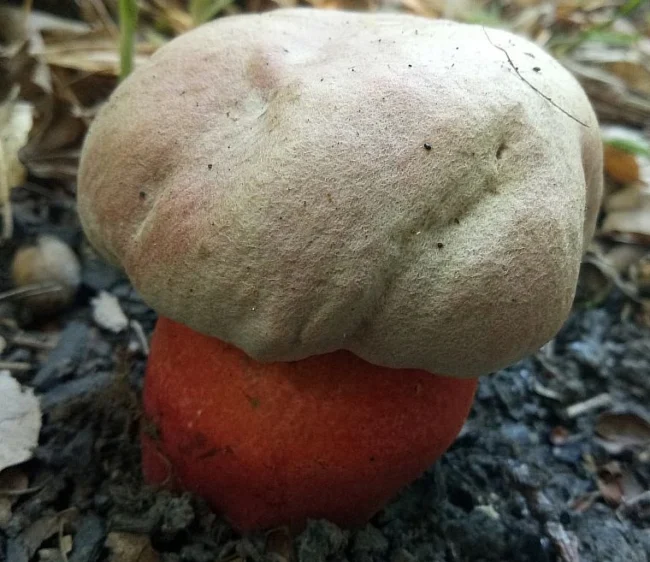
The cap is one of the most prominent features, measuring 8–20 cm in diameter, though it can occasionally reach up to 30 cm in exceptional specimens. It starts hemispherical in young mushrooms, becoming convex and eventually flat-convex as it matures. The surface is dry and matte, often velvety when young but smoothing out with age. Small cracks may appear in dry conditions.
Coloration is typically pale: nearly white, silvery-gray, grayish, or grayish-ocher, sometimes with a subtle olive tint. Importantly, it lacks pinkish or burgundy shades, which helps distinguish it from some similar species. The skin (cuticle) adheres tightly to the flesh and does not peel away easily.
Stem (Stipe)
The stem is massive and bulbous, often appearing disproportionately thick compared to the cap— a hallmark of this species. It measures 6–14 cm in height, with a width of 4–7 cm at the top and swelling to 13 cm or more at the base. The shape is barrel-like or club-shaped, tapering slightly upward.
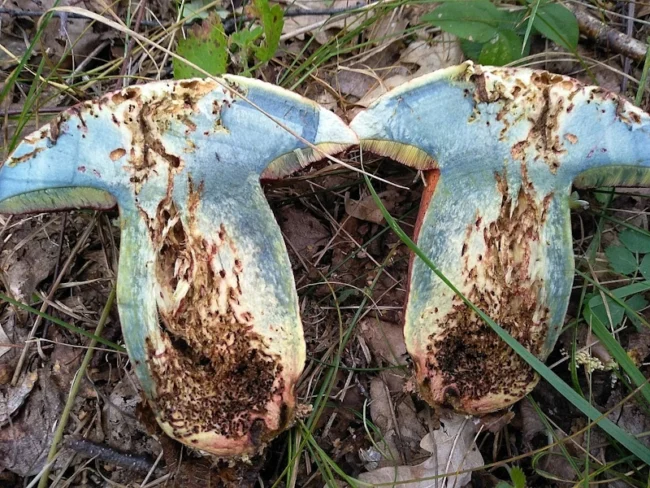
Coloration is vivid and diagnostic: the upper part is creamy to bright yellow or lemon-yellow, transitioning to pinkish-red or carmine-red toward the base. A fine reticulation (net-like pattern) covers the upper stem, either matching the background color or appearing red. When bruised or cut, the stem turns blue, a reaction common in many boletes but particularly noticeable here.
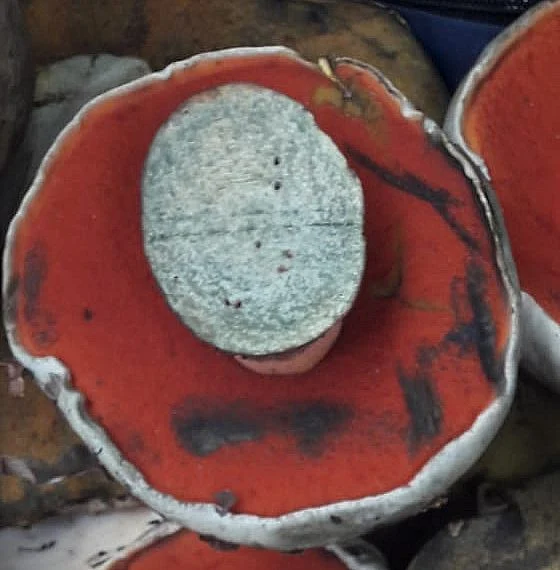
Tubes and pores (Hymenophore)
Instead of gills, the underside features a tubular layer. The tubes are initially yellowish, maturing to orange, red-orange, bright red, or red-brown, with lighter edges. Pores are small and round. A key identification trait is that both tubes and pores turn blue when pressed or damaged—test this gently with a finger or knife edge.
Flesh (Context)
The flesh is dense and firm, pale yellow or lemon-yellow when young, fading to whitish in older specimens. Upon cutting, it slowly turns blue or light blue, though this discoloration may fade over time. The odor is subtle and spicy in young mushrooms but becomes intensely unpleasant in maturity, resembling carrion, rotting onions, or decay. Taste is reportedly sweetish or nutty in some accounts, but do not taste this mushroom—even small amounts can cause poisoning.
Spore print
The spore print is olive or olive-brown. Microscopically, spores are smooth, oval to spindle-shaped, measuring 9.5–16.0 × 3.5–7.5 μm. While spore analysis requires a microscope, the print color can be checked by placing the cap pore-side down on paper overnight.
Habitat and ecology
Rubroboletus satanas is a mycorrhizal fungus, forming symbiotic relationships with the roots of broadleaf trees. It primarily associates with oaks (Quercus spp.), beeches (Fagus spp.), and edible chestnuts (Castanea sativa), and less commonly with hornbeams, hazels, or lindens. This mushroom thrives in old broadleaf or mixed forests with well-drained, calcium-rich (chalky or limestone) soils. It prefers light, open areas with sparse undergrowth, avoiding dense shade or acidic soils.
It grows singly, in small groups, or occasionally in “witch’s rings” (fairy circles). Due to its preference for warm climates, it is more common in southern regions and is sensitive to cold.
In the UK, it is restricted to chalky areas in southern England, often under oaks and beeches.
Distribution
This species is distributed across Southern and Central Europe, Russia, the Mediterranean, the Caucasus, and the Middle East. It favors warmer climates and is absent from North America and northern extremes. Isolated northern finds include the British Isles, Sweden, Latvia, and Belarus.
It is listed as rare or vulnerable in some regions, such as Estonia’s Red Book and parts of Russia.
Fruiting season
Rubroboletus satanas fruits from June to September in most of its range, peaking in late summer. In warmer Mediterranean areas, it may appear earlier or later depending on rainfall and temperature.
Toxicity and edibility
Warning: Rubroboletus satanas is poisonous and should never be consumed. It contains toxins including low levels of muscarine, and possibly glycoproteins like boletatin, aldehydes, and ketones that cause resinoid syndrome (gastrointestinal poisoning).
Symptoms appear within hours: severe vomiting, diarrhea, abdominal pain, headaches, and in extreme cases, limb paralysis, fainting, respiratory issues, or cardiac arrest. While no confirmed fatalities are documented in the UK, poisonings are common worldwide, including frequent cases in Russia and France.
In a 2011 French outbreak, 184 people were poisoned, with many experiencing vomiting (73%), diarrhea (67%), and pain (40%); recovery took 2–4 days with treatment. Even 1–2 grams raw can cause illness. Cooking does not fully detoxify it—claims of “conditional edibility” are dangerous and unfounded.
If poisoning is suspected, seek immediate medical attention. Supportive care like hydration is key.
Similar species
Misidentification is a major risk, as Rubroboletus satanas resembles several other boletes, some edible and others toxic. Always check multiple traits:
- Lurid Bolete (Suillellus luridus): Edible when cooked; smaller, brownish-olive cap; yellow-orange stem; blues to green-black on cut; no strong odor. Mycorrhizal with similar trees.
- Scarletina Bolete (Neoboletus luridiformis): Toxic; dark brown-red cap; yellow-red stem with red dots (no net); quick blueing; prefers acidic soils.
- Rhodoxanthus Bolete (Rubroboletus rhodoxanthus): Toxic; pinkish cap; weak fruity odor; partial blueing.
- Le Gal’s Bolete (Rubroboletus legaliae): Toxic; smaller, pink-burgundy cap; hay-like odor.
- Beautiful Bolete (Suillellus pulchrotinctus): Inedible; grayish-brown cap with pink edge; sour taste.
- Bitter Bolete (Caloboletus calopus): Inedible (bitter); brownish cap; bitter taste; coniferous habitats.
- King Bolete (Butyriboletus regius): Edible; pinkish-red cap; no blueing; no bad odor.
- Pulcherrimus Bolete (Rubroboletus pulcherrimus): Toxic; reddish-olive cap; North American; intense blueing.
- Rooting Bolete (Caloboletus radicans): Inedible (bitter); yellow-olive pores; pleasant odor.
- Wolf Bolete (Rubroboletus lupinus): Smaller; grayish to pink-red cap; no odor.
- Blood-Red Bolete (Rubroboletus rubrosanguineus): Toxic; pink-burgundy cap; coniferous mountains.
Identification tips and safety advice
To recognize Rubroboletus satanas:
- Look for the pale cap without pinks, massive red-based stem with net, red pores that blue on touch, and foul odor in maturity.
- Habitat: Warm, lime-rich broadleaf woods.
- Test: Gentle bruise test for blueing; check odor without tasting.
- Avoid: Any bolete with red pores and blueing in calcareous soils—better safe than sorry.
For safe foraging:
- Use field guides and apps.
- Join mycological groups.
- Never eat raw boletes; many require cooking.
- If unsure, photograph and consult experts.