Key points on Tylopilus felleus
- Tylopilus felleus, commonly called the bitter bolete or bitter tylopilus, is a widespread mushroom in the bolete family, known for its striking appearance but avoided due to its intense bitterness.
- It typically grows in deciduous and coniferous woodlands, forming mycorrhizal associations with trees like oak, beech, pine, and spruce, across regions in Europe, Asia, and North America.
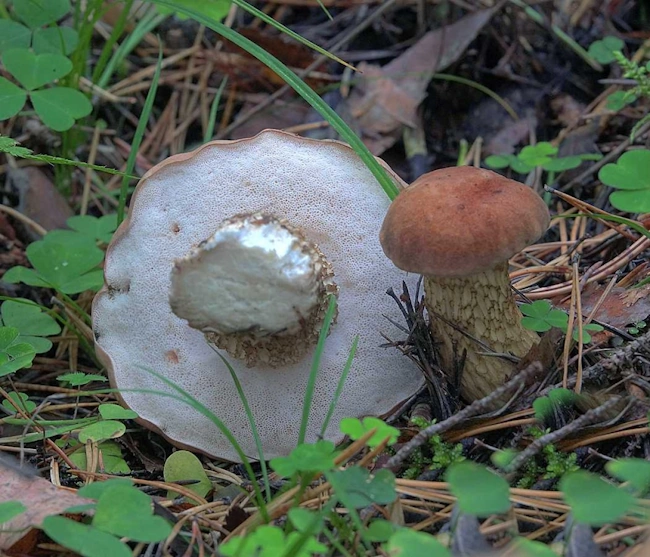
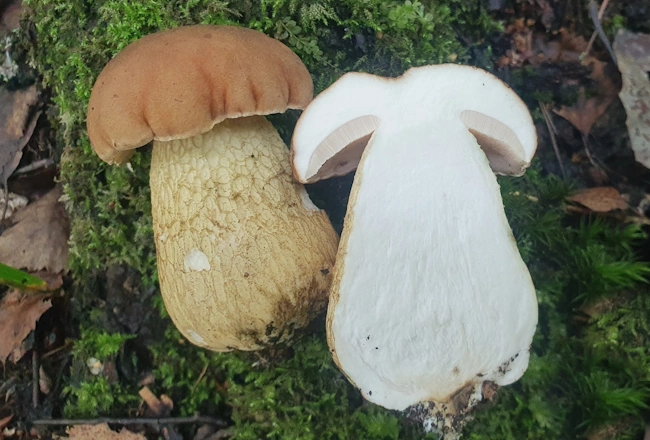
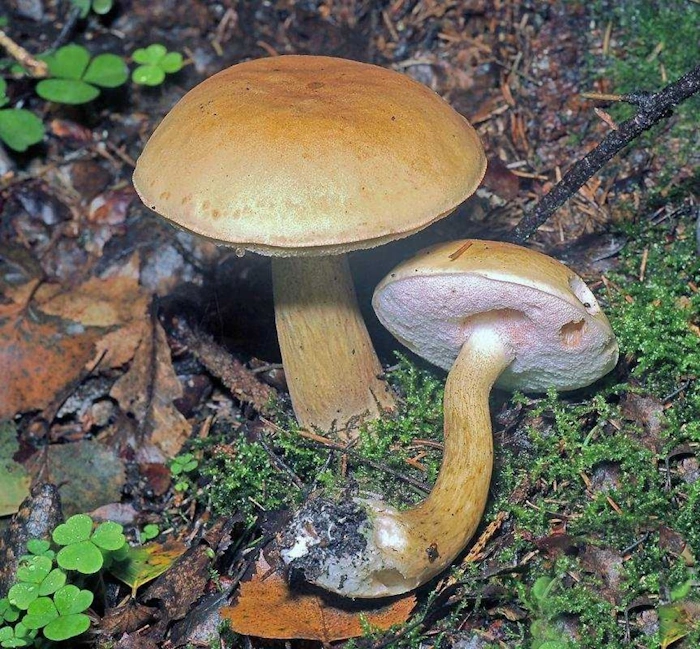
- Features a convex to flat cap (up to 15 cm wide) in brown or tan shades, pinkish pores that bruise brownish, a bulbous stem (7-10 cm tall) with dark brown reticulation, and white flesh that turns spongy with age.
- Easily mistaken for edible boletes like Boletus edulis, but distinguished by its pink-flushed pores, prominent dark reticulation on the stem, and extremely bitter taste that intensifies when cooked.
- Research suggests it is not truly poisonous, but its overwhelming bitterness makes it inedible and can cause mild digestive discomfort if consumed in quantity; the bitterness likely serves as a natural deterrent rather than a toxic mechanism.
- Classified in the genus Tylopilus within the Boletaceae family, it is the type species of its genus, with genetic studies placing it in a clade related to other boletes like porcini.
What is it?
Tylopilus felleus, commonly referred to as the bitter bolete or bitter tylopilus, is a basidiomycete fungus characterized by its poroid hymenophore rather than gills, a hallmark of the bolete group. First scientifically described in the late 18th century, it serves as the type species for the genus Tylopilus, which encompasses several bitter or mildly flavored boletes. Unlike many boletes valued for culinary purposes, T. felleus is primarily noted for its ecological role as an ectomycorrhizal symbiont, forming mutually beneficial relationships with tree roots to facilitate nutrient uptake in forest ecosystems. Its distribution spans temperate regions, where it contributes to soil health and biodiversity, though it is often overlooked due to its unappealing taste.
Where it grows: habitat and distribution
T. felleus exhibits a broad ecological tolerance, thriving in both deciduous and coniferous woodlands on well-drained, acidic soils such as sandy, gravelly, or peaty substrates. It forms mycorrhizal associations primarily with broadleaf trees like beech (Fagus spp.) and oak (Quercus spp.), but also with conifers including pine (Pinus spp.), spruce (Picea spp.), and fir (Abies spp.).
Fruiting bodies can be seen in small groups, or clusters from June to November in the northern hemisphere, with peak abundance influenced by rainfall and humidity. In moist or calcareous areas, it may appear in leaf litter, on decaying wood, or even in tree cavities.
Geographically, the species is widespread: in Europe, it is common but variable in occurrence, particularly in northern regions; in eastern North America, it extends from Canada to Florida and west to Minnesota, including Mexico and Central America; and in Asia, it is reported in Pakistan, China (provinces like Hebei and Sichuan), and Korea.
Variety uliginosus, a recognized variant, prefers mossy, lichen-rich sites under pines in the Great Lakes region. Climate change and habitat alteration could impact its distribution, though it remains relatively abundant in suitable environments.
Tylopilus felleus anatomy
The morphology of T. felleus is typical of boletes but with distinctive features.
- The cap measures 5-15 cm in diameter (up to 30 cm in some North American specimens), starting convex and slightly downy, maturing to flat or broadly convex with a smooth, matte surface in shades of brown, buff, tan, or olive-tinged.
- The hymenophore consists of adnate tubes 2-3 cm deep, with pores (1-2 per mm) that are white initially, turning pinkish with age and bruising carmine, brownish, or rusty-spotted.
- The stipe (stem) is 4-10 cm tall (rarely 20 cm) and 1.5-4 cm thick (up to 6 cm at the base), club-shaped or bulbous, paling upward from tan to whitish, and adorned with a prominent dark brown reticulation resembling fishnet stockings.
- Flesh is thick, white to creamy, pinkish under the cuticle, soft turning spongy, with a faint odor (pleasant or unpleasant) and intensely bitter taste.
- Microscopically, spores are fusoid (11-17 × 3-5 μm), smooth; basidia club-shaped (18-25.6 × 7-10.2 μm); cystidia fusoid with granular contents. Chemical reactions include pinkish with formaldehyde and greyish-green with iron salts on flesh.
How to recognize it
Identification relies on macroscopic and sensory cues to avoid confusion with edibles. Key traits: brown/tan cap without cracking until maturity, pink-flushed pores bruising brownish (unlike yellow in Boletus edulis), strongly reticulated stem (dark net on light background, opposite to B. edulis), white unchanging flesh, and a bitter taste that persists and intensifies upon cooking. Spore print is buff to brownish-pink.
Similar species include B. edulis (milder taste, light reticulation), Boletus badius (blue-bruising flesh), Tylopilus rubrobrunneus (purplish cap), and T. indecisus (less reticulated, edible). A taste test is definitive, though caution is advised. In the field, note habitat preferences to differentiate variants like uliginosus (reddish pigments in microscopy).
The following table compares T. felleus with common look-alikes:
| Feature | Tylopilus felleus | Boletus edulis (King Bolete) | Tylopilus rubrobrunneus |
|---|---|---|---|
| Cap color | Brown to tan, matte | Brown, sticky when wet | Purplish-brown |
| Pore color | White to pink, bruises brownish | White to yellow, no pink | Pinkish, bruises reddish |
| Stem reticulation | Dark brown, prominent | Light, fine | Variable, often weak |
| Taste | Extremely bitter | Mild, nutty | Bitter but milder |
| Edibility | Inedible due to bitterness | Edible and choice | Inedible |
| Habitat | Mixed woods, conifers/broadleaves | Conifers, broadleaves | Hardwoods |
Why it is considered poisonous and how the poison works
Contrary to some popular beliefs, T. felleus is not poisonous in a toxicological sense; it lacks compounds that cause physiological harm or illness. Its reputation as “poisonous” arises from its extreme bitterness, which can spoil meals and induce mild gastrointestinal upset (nausea, vomiting) if consumed despite the taste, particularly in large quantities. The bitter principle, governed by the human gene TAS2R38, activates bitter taste receptors on the tongue, creating an aversive response that deters ingestion— a evolutionary adaptation to mimic toxicity without actual harm.
The specific bitter compound remains unidentified, though studies suggest it involves natural bitter substances similar to those in other fungi, potentially velutinal derivatives or esters, but no definitive isolation has been reported for T. felleus. Unlike true toxins (e.g., in Amanita species), it does not disrupt cellular functions or organs; instead, it exploits sensory perception. In some cultures, it is dried for use as a pepper-like seasoning or stewed in milk to reduce bitterness, and it may have medicinal potential via beta-glucans like tylopilan, which show immunological and cytotoxic effects. Insect infestation is rare, possibly due to the bitterness.
Detailed taxonomy of the species
Tylopilus felleus holds a central position in bolete taxonomy as the type species of its genus. Its classification reflects phylogenetic insights from molecular studies, placing it within a clade of Boletineae alongside genera like Boletus and Xerocomus.
The full hierarchical taxonomy is as follows:
| Level | Classification | Notes |
|---|---|---|
| Kingdom | Fungi | Multicellular eukaryotes, decomposers or symbionts. |
| Division | Basidiomycota | Produces spores on basidia; includes most mushrooms. |
| Class | Agaricomycetes | Largest class of basidiomycetes, with diverse fruiting bodies. |
| Order | Boletales | Pore-bearing fungi, often mycorrhizal. |
| Family | Boletaceae | Boletes with fleshy caps and tubes; includes edible and inedible spp. |
| Genus | Tylopilus | From Greek “tylos” (lump) and “pilos” (cap); mostly bitter species. |
| Species | T. felleus (Bull.) P.Karst. | Binomial from Latin “fel” (bile), for bitter taste; type species. |
Originally named Boletus felleus by Jean Baptiste François Pierre Bulliard in 1788, it was reclassified into Tylopilus by Petter Adolf Karsten in 1881. Synonyms include Boletus alutarius, Dictyopus felleus, and varieties like T. felleus var. minor and var. uliginosus (distinguished by pigmented hymenium in Melzer’s reagent, though variability questions its validity). Genetic analyses (e.g., 2013 studies) confirm its monophyly within Tylopilus, separating it from Australian relatives like T. brevisporus (smaller spores) and T. neofelleus (vinaceous tones). North American populations may represent cryptic species, differing subtly from European types, especially those under introduced conifers. Index Fungorum recognizes var. uliginosus but not as a separate taxon.