William Harvey
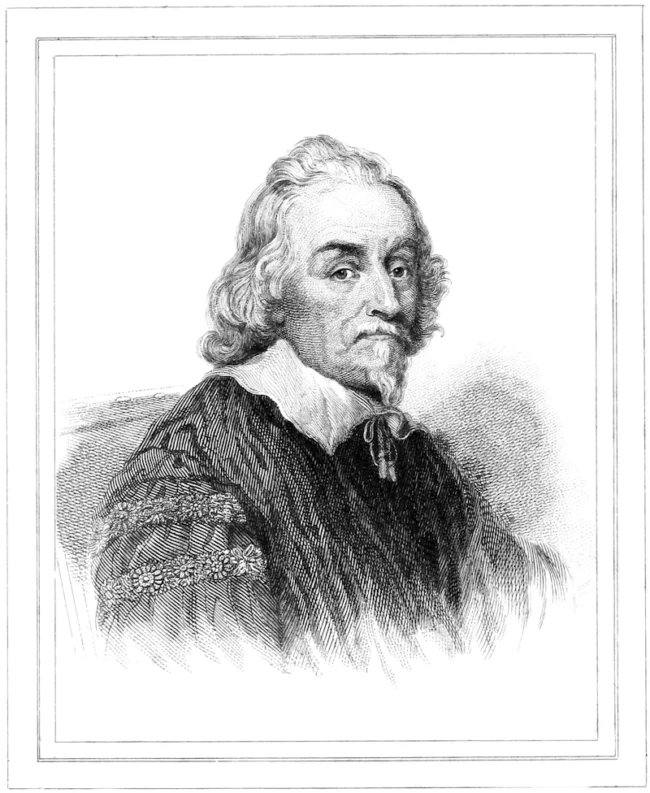
William Harvey and the discovery of blood circulation
As it contracts, the heart sets blood in motion. Through vessels, it circulates throughout the entire body. But until the 17th century, even scientists had no notion of this truth, which is common knowledge today. The great scientific discovery — the discovery of blood circulation — was made by the English physician and biologist William Harvey.
Early life and education
William Harvey was born on April 1, 1578, into the family of a wealthy English merchant.
Twenty-year-old William, having graduated from Cambridge University, set off, according to the custom of that time, to supplement his education in other countries: France, Germany, and then Italy.
In Italy, he enrolled at the University of Padua and at the age of 24 received a doctorate degree there. Even then, Harvey began studying the movement of blood in the body.
The prevailing views on blood movement
What ideas about blood movement prevailed in science at that time?
For almost one and a half thousand years, Galen’s teaching had dominated medicine. According to Galen, the main organ of circulation was not the heart, but the liver, where food constantly turns into blood. From there, blood flows to the heart. In the heart, aerial “pneuma” enters from the lungs and mixes with the blood, spiritualizing it. After which, the blood enters all parts of the body, where it is consumed.
The University of Padua was famous for the fact that half a century before Harvey, such a renowned naturalist as Andreas Vesalius had worked and lectured there. Vesalius pointed out many of Galen’s errors. He determined that the ventricles of the heart are completely separated by partitions. This means that “pneuma” cannot mix with blood. This encroachment on Galen’s unshakeable authority caused strong indignation in medical circles. One of the printed works directed against Vesalius was titled: “Against slander of the anatomical works of Hippocrates and Galen by a certain madman.”
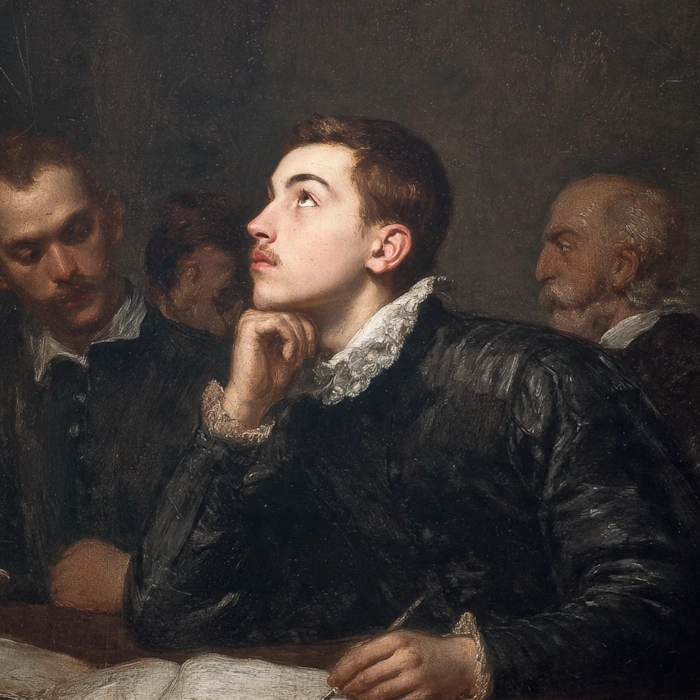
And when Harvey studied and worked at the University of Padua, the famous professor Fabricius of Aquapendente lectured there. He discovered special valves in the veins. The professor did not understand the significance of these valves. Young Harvey became interested in their role.
Harvey’s experimental approach
Many of Harvey’s contemporaries would have competed in speculative guesses regarding the role of the valves. But Harvey, over his lifetime, checked many times and finally clearly expressed the following truth: one can judge the purpose of an organ only by studying its structure in detail.
And now the young scientist decided to conduct experiments, beginning with an experiment on himself. He tightly tied up his arm. Below the ligature, the arm became numb, the veins on it swelled. Then he conducted an experiment on a dog, firmly bandaging its paws. Below the bandage, the veins again swelled. When cut, blood dripped from them. But from a cut on a vein above the bandage, not a drop of blood flowed! The vein there was empty.
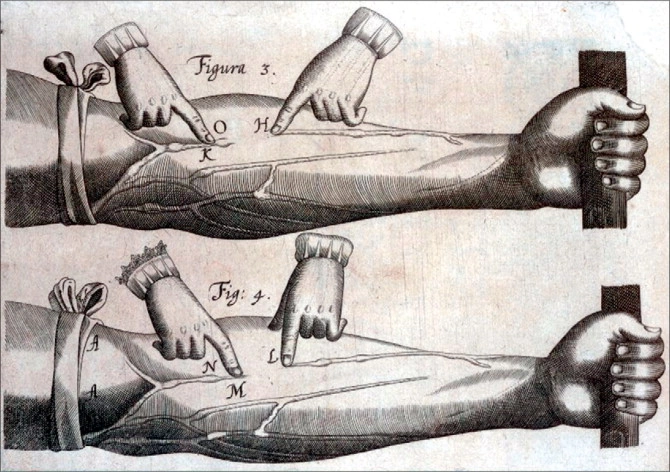
The conclusion seemed obvious: blood in the veins moves only in one direction. The valves prevent reverse flow. But Harvey was not in a hurry to announce his discovery.
Career and continued research
Returning to London in 1607, Harvey began teaching surgery at the Royal College of Physicians, while simultaneously working as chief physician at St. Bartholomew’s Hospital and as court physician to King James I, and after his death — to Charles I.
He did not cease his research in the field of blood circulation. Many years of experiments convinced Harvey of Galen’s error: blood is not consumed in the organs. Harvey proved that the body contains a certain constant amount of blood, which is not large.
Harvey came to the conclusion that the center of circulation is not the liver, as Galen believed, but the heart. The heart moves blood along a closed path. Arteries carry “perfect and nutritious” (as Harvey wrote) blood from the heart, and veins return “depleted and unsuitable” blood to the heart.
The circulatory system
Blood moves in circles, constantly returning to the heart. There are two of these circles. Through the large circle, blood circulates throughout the entire body. In the small circle, blood moves between the heart and lungs. Harvey did not know and could not know what role the lungs play in the body. The science of that time still had no conception of oxygen and its role in the body. Harvey believed that blood was filtered through the lungs for cooling.
The pulmonary circulation was discovered back in the mid-16th century by the Spanish scientist Miguel Servetus. But his “harmful heretical” books, along with Servetus himself, were burned at the stake in 1553. Therefore, his work was unknown to Harvey.
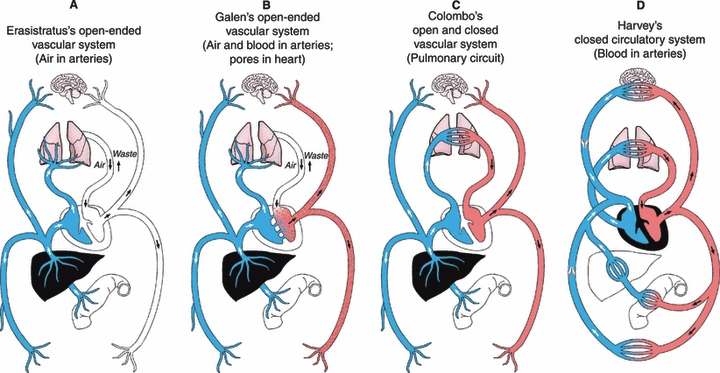
Harvey did not know how blood gets from arteries to veins. He only saw how arteries branch into smaller arteries, those — into even smaller ones. Harvey hypothesized the existence of the finest vessels — capillaries. And their presence was proven, having first seen these vessels under a microscope, by the Italian scientist Marcello Malpighi in 1661, four years after Harvey’s death.
Malpighi was struck by the beauty of the spectacle that opened before him and wrote: “With greater foundation than Homer once did, I can say: truly great is what I see with my own eyes.”
Publication and reception
For a decade and a half, Harvey checked and pondered his discoveries before he first dared to speak about them in a lecture in 1616. But even then he refused to publish their results.
Only in 1628, and even then after long persuasion from friends, did Harvey decide to publish his findings. That year, his book “Anatomical Exercise on the Motion of the Heart and Blood in Animals” was published.
It was written very concisely (72 pages of text) and contained only one (but very illustrative) illustration. In his book, Harvey acknowledged the merits of Aristotle and Galen.
“But,” he wrote,
if we rest content with their discoveries and believe (through our own stupidity, of course) that we ourselves can discover nothing, then, by acting thus, we only diminish the sharpness of our thought and extinguish the lamp that they left us.
In their views on blood movement, Harvey wrote, much is “either incorrect or obscure.”
In his conclusions, Harvey relied on an enormous mass of facts collected by him in the study of 60 different species of animals (among them were mammals, birds, lizards, frogs, fish, crayfish, snails).
Despite the persuasiveness of Harvey’s arguments, the book provoked fierce attacks from all of official medical science. After all, it refuted Galen’s thousand-year-old teaching!
Work on embryology
In 1651, Harvey published his second remarkable book — a small treatise “Research on the Generation of Animals.”
Once again, the scientist, unbroken by many years of persecution, dared to speak out against the generally accepted opinion. Most scientists of that time believed that worms, insects, even frogs and mice could arise spontaneously, from non-living matter. Harvey rejected the idea of spontaneous generation.
He examined embryonic growth in chickens and roe deer. For his experiments, he used so many chicken eggs that, according to his servants, there would have been enough for an omelet for the entire population of England.
Harvey’s observations indicated that the embryos of all animals develop only from an egg.
He formulated this famous rule as an aphorism:
All life comes from an egg” (in Latin — “Omne vivum ex ovo”).
Especially remarkable was Harvey’s guess that even mammals develop from an egg. After all, he could not see the eggs (egg cells) of mammals — only in 1826 did the Russian scientist Karl Baer see such an egg with the help of a microscope.
This work of Harvey laid the foundation for modern embryology.
Later life and recognition
Harvey’s fate after the publication of his book on blood circulation was quite complex.
Doctors and anatomists of the era regarded Galen’s authority as beyond reproach. They mocked Harvey, considering him almost insane, and said with contempt that “everyone now climbs in with their discoveries.” Opponents even nicknamed Harvey “circulator” (since in Latin “blood circulation” is “circulatio sanguineus”). This nickname was quite offensive, because in Latin it means “charlatan, deceiver.”
The Russian scientist Ivan Pavlov called Harvey’s book “not only a fruit of his mind of rare value, but also a feat of courage and self-sacrifice.”
In 1642, civil war began in England, and Harvey, as court physician, left London together with King Charles I (executed during the English Bourgeois Revolution in 1649). Harvey’s property, along with manuscripts of scientific works, remained in London and was burned.
And yet, despite these adversities, as well as attacks and slander, Harvey lived to see the recognition of his correctness. He died at the age of 79, on June 3, 1657, enjoying well-deserved respect.
About not many outstanding biologists and physicians can it be said that, like Harvey, a monument was erected to them during their lifetime. It was placed in the Royal College of Physicians in London.
Sources
- Based on the article “William Harvey” in “Biology. Encyclopedia for children”. License № 062284, 22.02.1993