Theophrastus Paracelsus
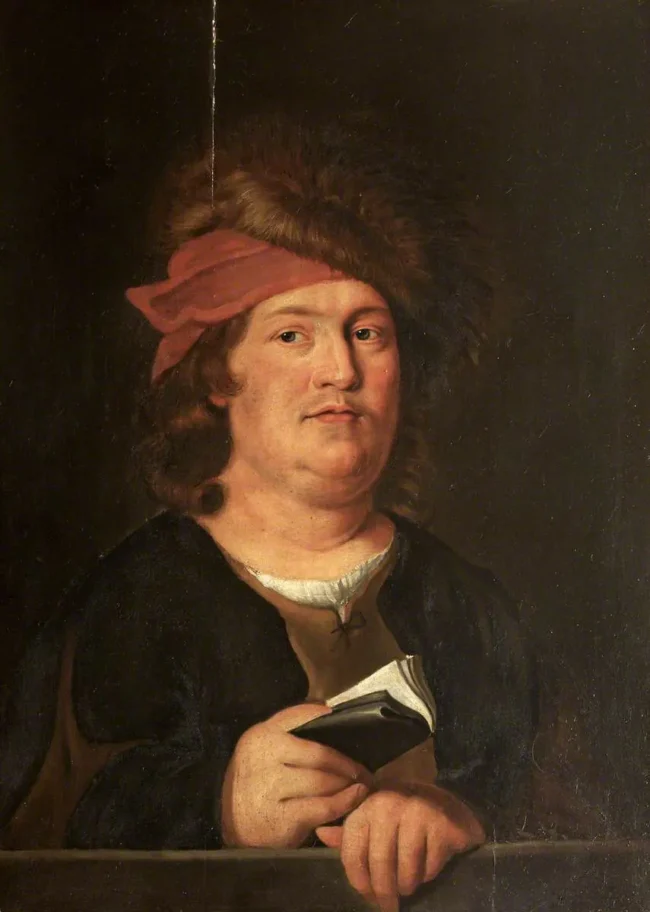
In the work of the outstanding physician and natural scientist of the Renaissance era Theophrastus Paracelsus, as in a drop of water, were reflected not only the achievements but also the delusions of his time.
An exceptionally original figure of the Renaissance era was Theophrastus Paracelsus (November 24, 1493 – September 24, 1541), who was rightfully considered a reformer of medicine. This remarkable man was simultaneously both a genius and a “Baron Munchausen,” a magnificent physician and an alchemist who believed in the existence of the “philosopher’s stone.” He always wrote his name in full – Philippus Aureolus Theophrastus Bombastus von Hohenheim, styling himself as nothing less than “highly educated,” “most widely known,” “incomparable,” “master of arts,” “prince of chemists,” “monarch of medicine,” and so forth. He was never distinguished by excessive modesty, and not a shadow of doubt arose in him regarding his own genius and exceptionality. In defiance of the famous physician of antiquity Celsus, he even began calling himself “Paracelsus,” which means “better than Celsus.”
Early years of Paracelsus
Little is known about his life. He was born near the small town of Einsiedeln in Switzerland. In his childhood years he tended geese and pigs, showing no particular zeal or care for his charges. He studied medicine at the university in Ferrara (Italy), upon completion of which he received a doctorate in medicine. He spent most of his life wandering, never having a family, and died in poverty and loneliness. In his short life he experienced both the joy of friendship and the bitterness of betrayal, the slander of enemies and the admiration of students, joy from successful healings and sorrow from losses.
In his prolonged wanderings through Europe, Paracelsus strove to study and truly understand nature and life, believing that “whoever wants to study nature through and through must walk through all its books with his own feet. What is written is examined letter by letter, but nature is studied from country to country; each country is a new page.”
Turning these pages, Paracelsus visited Russia, Poland, Constantinople, and, as was said, spent several years in Tatar captivity. In 1526 he arrived in Basel (Switzerland) and at the local university received a chair of physics, medicine, and surgery.
Teacher and scientist
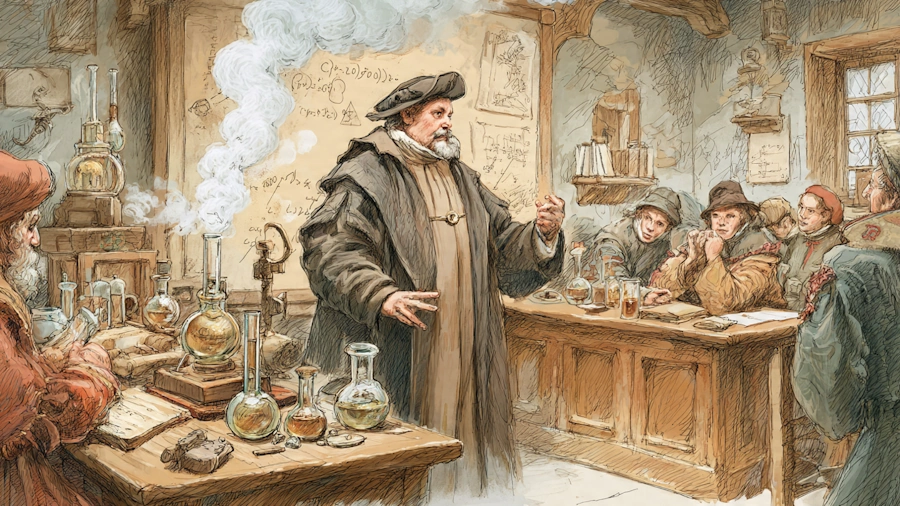
His lectures took place in overflowing auditoriums. He attracted attention not only with his original appearance and the topics of these lectures, but also with his passionate devotion to science and burning enthusiasm. His speech was peppered with vivid examples, fantastic allegories, and mysteriously sounding terms. Contrary to tradition, he delivered lectures in German rather than in Latin. Here is how the well-known contemporary writers, the Vainer brothers, in their novel “Medicine Against Fear” depicted Paracelsus’s first lecture at the University of Basel:
“The assembly hall is overflowing. On the right, at a table draped with a crimson cover, are the city fathers and its most honorable people. On the left -outstanding biologists, the synod of the university. And countless heads of students and auditors… Noise and talk creep through the hall…
I raise my hand, and the noise in the hall subsides, I fill my chest with air and pronounce loudly in German the beginning of my speech, knowing that for the first time from the podium words will be spoken not in dead Latin, but in the living language of living people:
“Most noble, most just, most honorable, most reasonable, most wise and most merciful my lords!..”
A silence of immeasurable muteness floods the hall, everyone’s eyes bulge, and I speak faster to manage to finish my thought before a squall of indignant cries crashes down upon me.
“I intend here to explain what a physician should be, and to explain this in our language, so that my thoughts may be understood by all and conveyed to everyone present here…”
In these lectures Paracelsus spoke about various diseases, methods of treating them, about the structure of the human body. He did not forget about his beloved chemistry. He was the first to point out that chemical processes lie at the foundation of life. He compared the human organism to a retort in which complex chemical transformations take place.
New science – chemistry
Paracelsus became the founder of a new science – medical chemistry, or iatrochemistry (from the Greek word “iatro” – physician). About himself he said: “I am an iatrochemist, for I know equally chemistry and healing.” Alexander Herzen called Paracelsus “the first professor of chemistry since the creation of the world.” For treating diseases Paracelsus used antimony, arsenic, lead, mercury, and gold.
True, it must be noted that he used mercury vapors to treat syphilis without even knowing about the existence of the pathogen of the disease, for which they are deadly. He proceeded from the astrological rule that Venus and Mercury are opposites. Consequently, an ailment arising on amorous grounds, by the will of Venus, should be treated with mercury, whose symbol is Mercury.
Paracelsus said: “Everything is poison, nothing is without poisonousness, and everything is medicine. Only the dose makes a substance poison or medicine.”
One can love good wine, but if one drinks a whole barrel, it can become one’s last. Incidentally, it was precisely Paracelsus who first used the term “alcohol” in reference to wine spirit (in 1526).
Paracelcus and his legacy
Paracelsus left to posterity 14 volumes of his writings. Many of them bear extravagant titles: “The Labyrinth of Physicians,” “The Heaven of Philosophers.” In his writings he often returns to the miraculous properties of the “great elixir,” the “all-healing medicine,” the “panacea of life,” the “red lion” – the philosopher’s stone, which was sought by medieval alchemists. Its solution, brought to the concentration of the so-called “golden drink,” supposedly could not only rid one of all diseases but also completely rejuvenate old men and grant people infinite life. Promising others a life of at least a thousand years, Paracelsus himself did not live to even fifty.
Paracelsus made many enemies for himself among representatives of traditional medicine. On the one hand, he gained a reputation as a magnificent physician, while on the other – as a boastful and self-absorbed ignoramus. Paracelsus recognized no authorities. His rejection of the official medical dogmas of the Middle Ages went so far that he publicly burned his copies of the works of Ibn Sina (Avicenna) and Galen, which served as the main guides for physicians.
In his works Paracelsus expressed curious thoughts about heredity and the development of organisms. He wrote that in fertilization two seeds meet, which carry within themselves the characteristic features of mother and father. But in the offspring these properties do not develop equally, but suppress each other. Thanks to this, in the offspring parental qualities are combined, which is why children are not entirely similar to their parents. Thus Paracelsus in many ways anticipated future discoveries of genetics.
And at the same time in his writings one could find recipes for resurrecting a dead chicken or an account of a means capable of “pulling an eye from its orbit.” And how he described the process of “manufacturing” a little man – a homunculus!
“Take a certain human fluid and leave it to rot first in a sealed pumpkin, then in a horse’s stomach for forty days. It will begin to live, move and stir, which is easy to notice. What results still in no way resembles a human, but is transparent and without body. But if then daily, secretly, carefully and prudently one feeds it with human blood and preserves it for forty weeks in constant uniform warmth in a horse’s stomach, then a real living child will result, having all limbs, like a child born of a woman, but only of very small stature.”
Today this “recipe” is hard to read without a smile.

But Paracelsus, unlike ordinary alchemists, believed in the progress of science and humanity. “All of us,” he wrote, “become more knowledgeable the longer we live. The greater the number of centuries God teaches us, the more He expands our knowledge. The closer the time of the Last Judgment approaches, the further we go in science, in wisdom, in perspicacity, in reason. For every seed cast into our mind will reach maturity, and those who come last will surpass in everything those who came before us.”
Source
- Biology. Encyclopedia for children. License № 062284, 22.02.1993