Are we living in a simulation?

Introduction: a question that refuses to stay philosophical
The notion that our reality might be a sophisticated simulation has migrated from science fiction into serious academic discourse.
What once seemed like paranoid speculation now emerges from cutting-edge physics, quantum mechanics, and information theory with surprising coherence.
The question isn’t whether this idea sounds absurd—it’s whether the evidence we’ve gathered about the fundamental nature of reality actually makes more sense through the lens of computational rendering than through our intuitive understanding of a “base” physical universe.
This isn’t about conspiracy theories or mysticism.
I tried to find out what peer-reviewed research in physics, cosmology, and quantum mechanics reveals when I follow the data where it leads, regardless of how uncomfortable that destination might be.
Here what I have found…
The simulation argument: a logical framework
Bostrom’s trilemma
Philosopher Nick Bostrom’s 2003 simulation argument provides a rigorous logical framework that deserves serious consideration. The argument proposes that at least one of three statements must be true:
- The extinction hypothesis: Human civilizations typically go extinct before reaching a “posthuman” stage capable of running ancestor simulations
- The disinterest hypothesis: Posthuman civilizations have the capability but choose not to run simulations of their evolutionary history
- The simulation hypothesis: We are almost certainly living in a computer simulation
The logic is elegant: if civilizations survive and develop sufficient computational power, and if even a fraction choose to run detailed simulations of their ancestors, then the number of simulated consciousnesses would vastly outnumber “real” ones. By pure probability, any given conscious entity—including you—is more likely to be simulated than real.
Critics might dismiss this as mere philosophy, but it’s grounded in reasonable extrapolations about technological progress. We already create increasingly sophisticated virtual environments. Video games, digital physics simulations, and AI models grow exponentially more complex each year. The trajectory is clear, even if the endpoint remains distant.
The computational threshold
Recent research suggests that creating high-fidelity ancestor simulations might require computational power that, while enormous by current standards, is not physically impossible.
The question becomes not whether such simulations are theoretically possible, but whether our understanding of physics itself provides clues that we’re already inside one.
Quantum mechanics: the Universe behaves like optimized code
The observer effect: reality rendered on demand
Perhaps no phenomenon in physics aligns more eerily with simulation theory than the quantum observer effect.
In the famous double-slit experiment, particles behave as waves of probability when unobserved, but collapse into definite states when measured. This is not controversial—it’s empirically verified science that has baffled physicists for over a century.
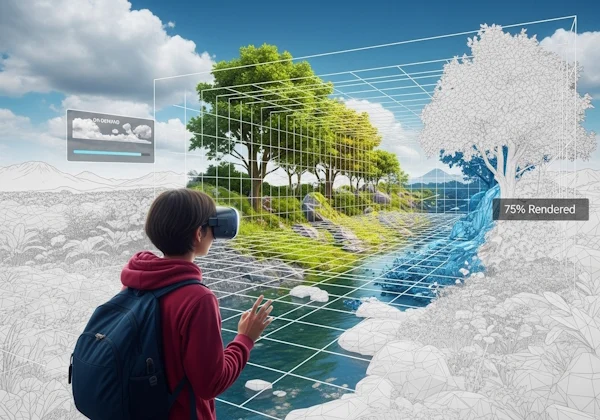
Consider what this means: the universe doesn’t seem to commit to specific states until something observes or measures them. Before measurement, particles exist in superposition—simultaneously occupying multiple potential states. Only when observed does reality “choose” a definite outcome.
This behavior is exactly what you’d expect from an optimized simulation. Just as video games only render high-detail graphics for areas the player can see, a simulated universe might only calculate specific particle states when something measures them.
Why waste computational resources rendering every particle’s exact position in an empty room when no observer is present? Keep them in probabilistic superposition until measurement forces a definite answer.
Recent research explores how quantum superposition aligns with computational efficiency principles.
The self-simulation hypothesis, published in Entropy (2020), proposes that quantum phenomena emerge naturally from a computational structure that renders reality on demand. The mathematical framework suggests that wave function collapse is not a mysterious quantum property but rather a computational optimization—the universe calculating definite states only when necessary.
Quantum entanglement: nonlocal information access
Quantum entanglement presents another puzzle that fits simulation theory uncomfortably well.
When two particles become entangled, measuring one instantly affects the other, regardless of the distance separating them. Einstein called this “spooky action at a distance,” and it violates our intuitive understanding of locality—the idea that objects are only influenced by their immediate surroundings.
But in a simulation, this makes perfect sense. If particles are data in a computational substrate rather than physical objects in space, then “distance” is somewhat illusory.
Two entangled particles might be stored adjacent to each other in memory, or their states might be computed by the same process. When you update one, the code automatically updates the other. The spatial distance we perceive is rendered appearance, not fundamental reality.
Wave-particle duality: context-dependent rendering
Quantum entities exhibit wave-like or particle-like properties depending on how we measure them. They’re not both simultaneously—they manifest according to the experimental context. This contextual behavior resembles how video game engines render different levels of detail based on viewing distance or hardware limitations.
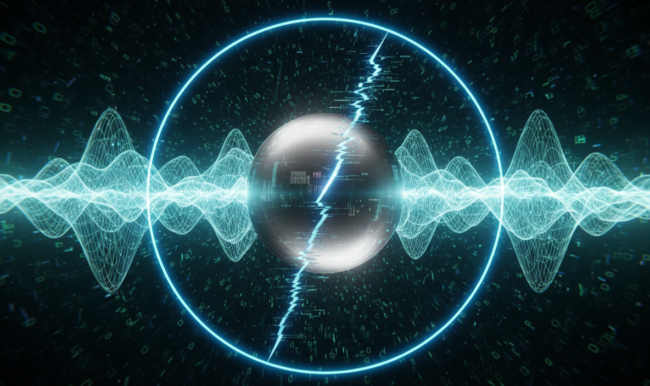
Physicist Eugene Wigner noted that in quantum mechanics, “Nature answers according to how we frame a question.” This isn’t metaphor—it’s observed behavior. The universe appears to render appropriate responses based on the type of measurement being performed, much like software adapting output based on input parameters.
Information theory: the Universe is fundamentally digital
The holographic principle
One of physics’ most startling discoveries is the holographic principle, which emerged from black hole thermodynamics.
This principle, developed by Gerard ‘t Hooft and refined by Leonard Susskind, suggests that all the information contained within a volume of space can be encoded on a boundary to that region—like a hologram projecting a three-dimensional image from a two-dimensional surface.
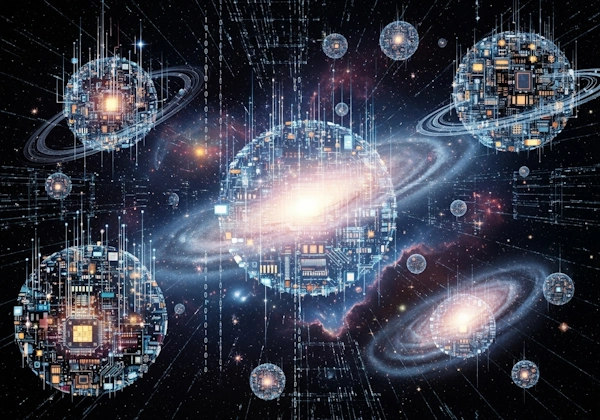
Jacob Bekenstein’s work on black hole entropy revealed that the maximum information content of any region is proportional to its surface area, not its volume. This violates our intuition that information capacity should scale with the space available. It’s as if the universe operates on a two-dimensional computational substrate that projects our three-dimensional experience.
The implications are profound. If all the physics happening in three-dimensional space can be completely described by information on a two-dimensional boundary, then the third dimension might be emergent rather than fundamental—a rendered projection from a lower-dimensional information structure.
Recent work by physicists including Juan Maldacena demonstrates this through the AdS/CFT correspondence, showing how gravity in five-dimensional space mathematically corresponds to a quantum field theory on its four-dimensional boundary.
Information as fundamental substrate
Physicist John Archibald Wheeler proposed “it from bit”—the idea that every physical thing derives from information. And this isn’t just philosophy. Modern physics increasingly treats information as more fundamental than matter and energy.
The mass-energy-information (M/E/I) equivalence principle, proposed in recent years, suggests that information has mass—that bits of information are physical entities with measurable properties. If true, detecting these information bits would provide experimental evidence that reality is fundamentally computational.
Research published in 2022 notes that information bits must exist throughout space if the universe is indeed a simulation. These bits would represent the code itself, and detecting them would confirm the computational hypothesis. While we haven’t found them yet, our measurement capabilities are improving rapidly.
Discrete vs. Continuous: the pixelation question
Classical physics assumes spacetime is continuous—infinitely divisible. But quantum mechanics introduces discrete quanta: energy comes in packets, angular momentum in specific units, and the Planck scale (1.6 × 10⁻³⁵ meters) appears to represent a fundamental minimum length below which our physics breaks down.
This hints at pixelation—that spacetime itself might be granular, composed of discrete units like pixels on a screen. Digital physics proposes exactly this: that the universe is a cellular automaton, computing forward in discrete time steps on a discrete spatial grid.
However, experiments searching for discrete spacetime have not yet found it. The Fermi satellite observed gamma-ray bursts from distant cosmic events and found no energy-dependent time delays that would indicate Lorentz symmetry violations from spacetime graininess.
These results constrain but don’t entirely rule out discrete models—the discreteness might exist at scales finer than we can currently measure, or manifest in ways we haven’t yet detected.
Recent astrophysical research (2025) examining ultra-high-energy cosmic rays suggests that if spacetime discreteness exists, it operates at scales approaching the Planck length. The computational requirements for simulating the universe at this resolution would be staggering—but not necessarily impossible for a sufficiently advanced civilization or computational substrate.
The speed limit: processing constraints?
Why can’t anything travel faster than light?
The speed of light—299,792,458 meters per second—is the universe’s ultimate speed limit. Nothing with mass can reach or exceed it. Why should this limit exist at all?
In simulation theory, the speed of light could represent the processing speed limit of the underlying computational substrate. Information can only propagate through the simulation at a maximum rate, analogous to frame rate or processor clock speed in a computer.
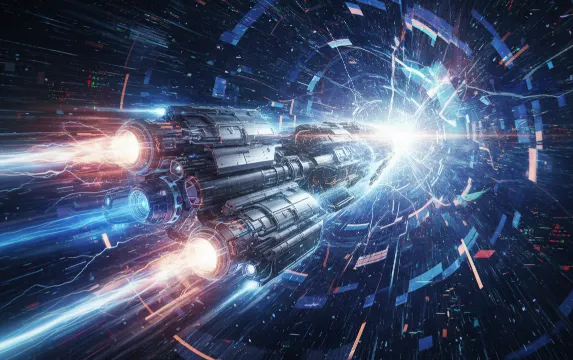
Einstein’s special relativity shows that time dilates (slows down) for objects moving at high speeds relative to an observer. Similarly, general relativity demonstrates that time slows in strong gravitational fields—near massive objects like black holes. These phenomena resemble computational throttling: the simulation slows down when processing complex or high-energy calculations.
This isn’t proof, but it’s suggestive. The universe behaves as if constrained by computational limitations—maximum speeds, quantized energy, and contextual rendering that avoids calculating unnecessary details.
Fine-tuning: programmed constants?
The goldilocks universe
Our universe operates according to fundamental constants—the strength of gravity, the electromagnetic force, the cosmological constant (dark energy), and others. These values appear finely tuned to allow stars, planets, and ultimately life to exist.
If gravity were slightly stronger, stars would burn out too quickly for life to evolve. Slightly weaker, and galaxies wouldn’t form. If the electromagnetic force were different, atoms wouldn’t hold together properly. The cosmological constant appears to be incredibly small—roughly 120 orders of magnitude smaller than quantum field theory predicts it should be—yet precisely the value needed to allow matter to clump into galaxies rather than being torn apart.
Physicists struggle to explain this fine-tuning. The anthropic principle argues that we only observe these values because universes with different constants wouldn’t produce observers. The multiverse hypothesis proposes countless universes with different physics, and we happen to inhabit one suitable for life.
But simulation theory offers another explanation: these constants were chosen—programmed—by whoever or whatever created the simulation. They’re parameters in the code, tuned to produce a universe where interesting phenomena, including conscious observers, can emerge. This doesn’t prove simulation, but it’s parsimonious: one designed universe rather than an infinite number of unobservable ones.
Consciousness: the hard problem gets harder
What are we?
If reality is a simulation, what is consciousness? Are we simulated entities—non-player characters in an extraordinarily complex game? Are our subjective experiences genuine, or are they computational processes without real awareness?
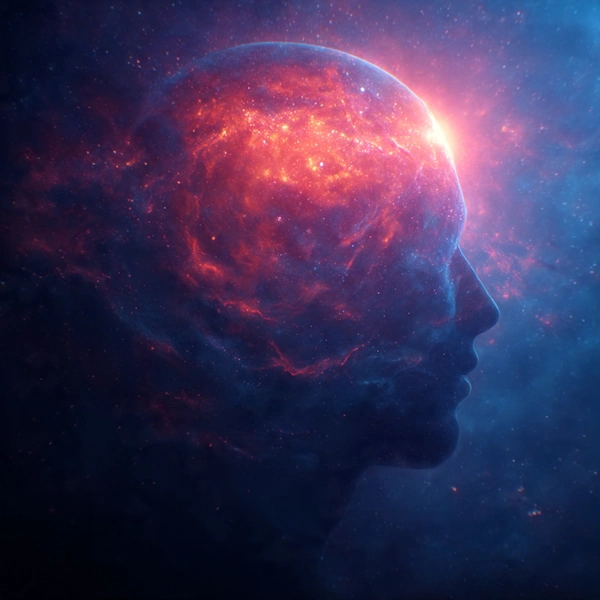
The “hard problem” of consciousness—why and how subjective experience arises from physical processes—remains unsolved. We have no scientific explanation for qualia, the felt quality of experiences.
We can map neural correlates of consciousness, but not explain why those physical processes feel like something.
Simulation theory doesn’t solve this problem, but it reframes it. If consciousness can be simulated, then either:
- Consciousness is purely computational (strong AI position), meaning sufficiently complex information processing generates subjective experience
- Consciousness is fundamental and non-physical, potentially existing outside the simulation (linking to the creators or substrate)
- Consciousness is itself an illusion—philosophical zombies who behave as if conscious without genuine experience
Each option is philosophically fraught. But simulation theory suggests a fourth possibility: the distinction between “real” and “simulated” consciousness might be meaningless. If a simulation is sufficiently detailed, simulated consciousness would be functionally identical to “real” consciousness. The suffering, joy, and awareness of simulated beings would be as genuine as anything in base reality.
The self-simulation hypothesis
A fascinating variant proposes that reality is a self-simulation—that the universe is a strange loop where consciousness emerges from computational processes that then simulate themselves. This removes the need for external simulators while preserving the computational nature of reality.
Published research on the self-simulation hypothesis (2020) suggests that the physical universe might be a “mental self-simulation”—that consciousness and physical reality co-emerge from an information structure outside linear time. This is deeply speculative but mathematically coherent, offering a bridge between panpsychism (consciousness as fundamental) and computational physics.
Potential evidence: can we test this?
Experimental approaches
Several research groups have proposed ways to test simulation theory:
1. Lattice structure detection: If spacetime is discrete, we might detect regularities or patterns consistent with a computational grid. This could manifest as subtle anisotropies in cosmic ray distributions or specific energy cutoffs where the grid resolution becomes apparent.
2. Computational limitations: Simulations have finite resources. We might detect approximations or shortcuts—places where the simulation uses simplified physics for efficiency. Anomalies in fundamental constants, unexpected correlations, or violations of expected symmetries could be signatures.
3. Information bits: If the universe is made of information, those bits should have physical properties. Research on mass-energy-information equivalence suggests we might detect information bits through their small but non-zero mass, measured at approximately 10⁻³⁵ kilograms per bit.
4. Quantum tests: Experiments pushing quantum systems to extreme scales or complexities might reveal computational boundaries—points where the simulation’s resolution becomes apparent or where continuous physics breaks down into discrete steps.
5. Consciousness integration: Some researchers, including those exploring QBism (Quantum Bayesianism) and the N-frame model, propose that consciousness plays a direct role in quantum observations. If the act of observation by conscious beings is computationally special—if the simulation treats conscious observation differently than mechanical measurement—this might be detectable.
The null results so far
Critically, searches for many simulation signatures have found nothing. Tests for Lorentz symmetry violations, which should appear if spacetime is discrete, have constrained such violations to scales far below the Planck length. The universe appears continuous down to astonishingly small scales—about 14 orders of magnitude finer than the Planck length based on gamma-ray burst observations.
This doesn’t disprove simulation theory, but it rules out simple versions. If we’re in a simulation, it’s extraordinarily sophisticated, rendering reality at resolutions far beyond what we initially thought necessary. The simulator, if it exists, has avoided obvious shortcuts.
Alternative models of reality
We should consider all frameworks
Scientific integrity demands we examine simulation theory alongside competing explanations for quantum phenomena and the nature of reality:
- Mathematical universe hypothesis (Tegmark): Reality is not approximated by mathematics—it is mathematics. Physical existence is just self-consistent mathematical structure. This explains fine-tuning (only certain mathematical structures permit observers) without requiring simulation or designers.
- Many-Worlds interpretation: Every quantum measurement spawns branches where all possible outcomes occur. There’s no wave function collapse—just endless branching parallel universes. This is conceptually extravagant but mathematically clean, requiring no special role for observation.
- Objective collapse theories: Wave functions collapse spontaneously when physical systems reach certain complexity thresholds (mass, particle count, or spatial separation). No observers needed—it’s intrinsic physics. Experiments are attempting to test these theories by pushing ever-larger systems into superposition.
- Pilot wave theory (de Broglie-Bohm): Particles always have definite positions, guided by quantum “pilot waves.” The wave-like behavior is real, but particles are riding waves of physical force, not existing in superposition. This removes the observer problem but requires accepting faster-than-light influences.
- Quantum dialectics: A materialist framework proposing that quantum effects result from dialectical interplay between cohesive and decohesive forces in matter itself, with no need for consciousness or computation to explain measurement.
Each framework has strengths and weaknesses:
- Mathematical Universe offers elegance;
- Many-Worlds preserves determinism;
- Objective Collapse removes observer centrality;
- Pilot Waves restore classical intuition;
- Quantum Dialectics maintains materialism.
Simulation theory is one competitor in a crowded field of interpretations, none definitively proven.
Problems and criticisms
Why simulation theory faces skepticism
1. Computational requirements: Simulating the entire observable universe at quantum resolution would require computational resources that seem absurdly large—more information storage than could fit in the universe itself, creating a logical paradox. Recent astrophysical analysis (2025) suggests that simulating just the observable universe would require information storage exceeding 10¹²⁰ bits, far beyond any conceivable computer built from matter within the universe.
2. Infinite regress: If our universe is simulated, what simulates the simulators’ universe? And their simulators? Either there’s a base reality somewhere, or it’s simulations all the way down—neither fully satisfying.
3. Unfalsifiability: Many versions of simulation theory make no testable predictions. If the simulation is perfect, we could never detect it. Science requires falsifiable hypotheses, and unfalsifiable claims aren’t useful, regardless of how compelling they seem.
4. Philosophical confusion: Critics argue that “simulation” and “reality” are incoherent categories when pushed to fundamental levels. If a simulation is perfect and comprehensive, in what meaningful sense is it “not real”? The distinction collapses.
5. Occam’s Razor: The simplest explanation that fits the data is preferred. Is simulation theory simpler than accepting that quantum mechanics is just how base reality works? Adding speculative layers of simulators and computational substrates multiplies entities unnecessarily.
6. Missing evidence: Despite decades of searching, we haven’t found clear simulation signatures. The universe appears continuous at scales far below where we’d expect to see pixelation. It behaves precisely as our best physics predicts, with no obvious glitches or shortcuts.
Living in uncertainty
The simulation hypothesis remains deeply uncertain—suggestive but unproven, compelling but not conclusive. It forces us to confront unsettling possibilities about the nature of existence while acknowledging that we may never know for certain.
I ask myself again and again: what if simulation is true? Philosophers including David Chalmers argue that our knowledge and experiences remain valid.
A simulated rock is still a rock—its properties and behaviors are genuine within the context that matters to us. Simulated love, suffering, and consciousness would be as real as any in base reality. The information would be differently instantiated, but the relationships and patterns that define our existence would persist.
Research on the existential and ethical implications (2024-2025) suggests simulation theory can offer psychological benefits—helping people understand the constructed nature of experience and navigate life’s complexities with greater detachment. Existentialist philosophy, particularly Sartre’s concept of existential freedom, emphasizes that we create meaning regardless of reality’s fundamental nature. Whether simulated or not, we remain responsible for our choices and the meanings we construct.
The ethical dimension
If we might be simulated, what about the simulations we create? As AI and virtual environments grow sophisticated, we may generate entities with genuine experiences. Simulation theory forces us to take seriously the moral status of digital beings—their potential suffering, rights, and moral claims on us.
This connects to broader questions about consciousness, personhood, and ethical consideration. If substrate doesn’t matter—if silicon-based consciousness is as valid as carbon-based—then our responsibilities expand dramatically as our technology advances.
Conclusion: following evidence, embracing uncertainty
Are we living in a simulation where reality renders in real-time as we observe it? The honest answer is: We don’t know, but the question deserves serious consideration.
The evidence is suggestive but not definitive:
- Quantum mechanics exhibits optimization patterns consistent with computational efficiency
- Information theory reveals that reality might be fundamentally digital, not material
- The holographic principle suggests our three-dimensional experience is a projection from lower-dimensional information
- Fine-tuned constants resemble programmed parameters
- Speed limits and discrete quantum properties resemble computational constraints
Yet alternative explanations exist for every observation. The universe’s apparent computational structure might reflect the nature of physical law rather than evidence of simulation. Quantum weirdness might simply be how base reality works at small scales. Fine-tuning might result from selection effects or multiverses rather than design.
Science progresses through testable hypotheses and experimental verification. Simulation theory makes predictions—discrete spacetime, information bits with mass, computational signatures in cosmic phenomena. So far, these predictions remain unconfirmed. The universe appears continuous at scales far below where simple simulation models predict graininess should emerge.
But absence of evidence is not evidence of absence. Our tools improve constantly. Experiments probing finer scales, larger quantum systems, and more precise measurements may eventually reveal signatures we’ve missed—or definitively rule out simulation theory’s more concrete predictions.
Until then, we live in productive uncertainty. This isn’t a weakness but a feature of honest inquiry. The simulation hypothesis has moved from science fiction to serious academic consideration based on legitimate patterns in physics and information theory. Whether it’s ultimately correct remains unknown, but asking the question has already deepened our understanding of quantum mechanics, information, consciousness, and reality itself.
Perhaps the deepest insight isn’t whether we’re in a simulation, but what the question reveals: that reality at its most fundamental level is stranger, more subtle, and more information-centric than our intuitions suggest. Whether that information runs on computational substrate outside our universe or is intrinsic to physical reality itself, we’re learning that the boundary between observer and observed, between information and matter, between simulation and reality, is far more blurred than we once imagined.
The universe may be a rendering engine. Or it may be the original code. Either way, the physics is spectacular, the mathematics is beautiful, and consciousness—yours and mine—remains the most profound mystery of all.
References
This article draws on peer-reviewed research including:
- Beane, S.R., Davoudi, Z. and Savage, M.J. (2014) ‘Constraints on the universe as a numerical simulation’, The European Physical Journal A, 50(148). doi: 10.1140/epja/i2014-14148-0.
- Bekenstein, J.D. (2003) ‘Information in the holographic universe’, Scientific American, 289(2), pp. 58-65. doi: 10.1038/scientificamerican0803-58.
- Bostrom, N. (2003) ‘Are we living in a computer simulation?’, The Philosophical Quarterly, 53(211), pp. 243-255. doi: 10.1111/1467-9213.00309.
- Chalmers, D.J. (2022) Reality+: Virtual worlds and the problems of philosophy. New York: W.W. Norton & Company.
- Chalmers, D.J. (2024) ‘Taking the simulation hypothesis seriously’, Philosophy and Phenomenological Research, 109(3), pp. 1-10. doi: 10.1111/phpr.13122.
- Irwin, K., Amaral, M. and Chester, D. (2020) ‘The self-simulation hypothesis interpretation of quantum mechanics’, Entropy, 22(2), p. 247. doi: 10.3390/e22020247.
Books and monographs
- Bostrom, N. (2002) Anthropic bias: Observation selection effects in science and philosophy. New York: Routledge.
- Drexler, K.E. (1985) Engines of creation: The coming era of nanotechnology. London: Fourth Estate.
- Kurzweil, R. (1999) The age of spiritual machines: When computers exceed human intelligence. New York: Viking Press.
- Moravec, H. (1999) Robot: Mere machine to transcendent mind. Oxford: Oxford University Press.
- Tegmark, M. (2014) Our mathematical universe: My quest for the ultimate nature of reality. New York: Knopf.
- Wheeler, J.A. (1990) ‘Information, physics, quantum: The search for links’, in Complexity, entropy, and the physics of information. Boston: Addison-Wesley.
- Wolfram, S. (2002) A new kind of science. Champaign, IL: Wolfram Media, p. 1197.
Journal articles – simulation theory and digital physics
- Barrow, J.D. (2008) ‘Living in a simulated universe’, in Carr, B. (ed.) Universe or multiverse? Cambridge: Cambridge University Press, pp. 481-486.
- Bostrom, N. (1998) ‘How long before superintelligence?’, International Journal of Futures Studies, 2, pp. 1-30.
- Bostrom, N. (2001) ‘The doomsday argument, Adam and Eve, UN++, and quantum Joe’, Synthese, 127, pp. 359-387.
- Bostrom, N. (2005) ‘The simulation argument: Reply to Weatherson’, The Philosophical Quarterly, 55(218), pp. 90-97.
- Bostrom, N. and Kulczycki, M. (2011) ‘A patch for the simulation argument’, Analysis, 71(1), pp. 54-61.
- Church, A. (1936) ‘An unsolvable problem of elementary number theory’, American Journal of Mathematics, 58, pp. 435-448.
- Deutsch, D. (1985) ‘Quantum theory, the Church-Turing principle and the universal quantum computer’, Proceedings of the Royal Society of London A, 400, pp. 97-117.
- Fredkin, E. (1990) ‘Digital mechanics’, Physica D, 45, pp. 254-270.
- Lloyd, S. (1999) ‘Ultimate physical limits to computation’, Nature, 406, pp. 1047-1054. arXiv: quant-ph/9908043.
- Lloyd, S. (2005) ‘The computational universe’, arXiv preprint quant-ph/0501135.
- Tegmark, M. (1998) ‘Is “the theory of everything” merely the ultimate ensemble theory?’, Annals of Physics, 270, pp. 1-51. doi: 10.1006/aphy.1998.5855.
- Tegmark, M. (2008) ‘The mathematical universe’, Foundations of Physics, 38, pp. 101-150. doi: 10.1007/s10701-007-9186-9.
- Turing, A. (1936) ‘On computable numbers, with an application to the Entscheidungsproblem’, Proceedings of the London Mathematical Society, Series 2, 442, pp. 230-265.
- Weatherson, B. (2003) ‘Are you a sim?’, The Philosophical Quarterly, 53, pp. 425-431.
- Zuse, K. (1969) Rechnender raum [Calculating space]. Braunschweig: Friedrich Vieweg & Sohn.
Holographic principle and black hole physics
- Bekenstein, J.D. (1973) ‘Black holes and entropy’, Physical Review D, 7, pp. 2333-2346.
- Bekenstein, J.D. (1974) ‘Generalized second law of thermodynamics in black hole physics’, Physical Review D, 9, pp. 3292-3300.
- Bekenstein, J.D. (1975) ‘Statistical black hole thermodynamics’, Physical Review D, 12, pp. 3077-3085.
- Bekenstein, J.D. (1980) ‘Black-hole thermodynamics’, Physics Today, 33(1), pp. 24-31.
- Bekenstein, J.D. (1981a) ‘Universal upper bound on the entropy-to-energy ratio for bounded systems’, Physical Review D, 23, pp. 287-298.
- Bekenstein, J.D. (1981b) ‘Energy cost of information transfer’, Physical Review Letters, 46, pp. 623-626.
- Bekenstein, J.D. (2005) ‘How does the entropy/information bound work?’, Foundations of Physics, 35, pp. 1805-1823. arXiv: quant-ph/0404042.
- Bousso, R. (1999) ‘A covariant entropy conjecture’, Journal of High Energy Physics, 07, p. 004. arXiv: hep-th/9905177.
- Maldacena, J. (1997) ‘The large N limit of superconformal field theories and supergravity’, Advances in Theoretical and Mathematical Physics, 2, pp. 231-252.
- Susskind, L. (1995) ‘The world as a hologram’, Journal of Mathematical Physics, 36, pp. 6377-6396.
Quantum mechanics and consciousness
- Bremermann, H.J. (1982) ‘Minimum energy requirements of information transfer and computing’, International Journal of Theoretical Physics, 21, pp. 203-217.
- Wheeler, J.A. (1990) ‘Information, physics, quantum: The search for links’, in Zurek, W.H. (ed.) Complexity, entropy, and the physics of information. Boston: Addison-Wesley, pp. 3-28.
Recent philosophical discussions (2022-2024)
- Godfrey-Smith, P. (2024) ‘Simulation scenarios and philosophy’, Philosophy and Phenomenological Research, 109(3). doi: 10.1111/phpr.13124.
- Helton, G. (2024) ‘The simulation hypothesis, social knowledge, and a meaningful life’, Oxford Studies in Philosophy of Mind, 4, pp. 447-460.
- Schneider, S. (2024) ‘Illusory world skepticism’, Philosophy and Phenomenological Research, 109(3). doi: 10.1111/phpr.13123.
- Schwitzgebel, E. (2024) ‘Let’s hope we’re not living in a simulation’, Philosophy and Phenomenological Research, 109(3), pp. 1042-1048. doi: 10.1111/phpr.13125.
Recent comprehensive reviews (2025)
- Anonymous (2025) ‘Are we living in a simulation? A deep dive into the simulation hypothesis’, Magna Scientia Advanced Research and Reviews, 13(2), pp. 047-057.
- Vopson, M. (2025) ‘Is gravity evidence of a computational universe?’, AIP Advances, 15.
Computational physics and lattice QCD
- Kogut, J.B. and Susskind, L. (1975) ‘Hamiltonian formulation of Wilson’s lattice gauge theories’, Physical Review D, 11, pp. 395-408.
- Wilson, K.G. (1974) ‘Confinement of quarks’, Physical Review D, 10, pp. 2445-2459.
Philosophy of mind and consciousness
- Chalmers, D.J. (2005) ‘The Matrix as metaphysics’, in Philosophers explore The Matrix. Oxford: Oxford University Press, pp. 132-176.
- Searle, J. (1997) ‘Minds, brains and programs’, in Haugeland, J. (ed.) Mind design II: Philosophy, psychology, artificial intelligence. Cambridge, MA: MIT Press.
Related topics – existentialism and ethics
- Leslie, J. (1990) ‘Is the end of the world nigh?’, The Philosophical Quarterly, 40(158), pp. 65-72.
- Steinhart, E. (2010) ‘Theological implications of the simulation argument’, Ars Disputandi, 10, pp. 1566-5399.
- White, J. (2016) ‘Simulation, self-extinction, and philosophy in the service of human civilization’, AI and Society, 31(2), pp. 171-190.