The Electron Paradox: are electrons particles or waves?
Imagine you are holding a baseball. If you throw it, you know exactly where it goes. It is a solid object. It is a Particle.
Now, imagine splashing a puddle. The water spreads out in rings. That is energy moving through a medium. That is a Wave.
In our material everyday world anything can be either a particle OR a wave. It is never both. A baseball doesn’t ripple, and a splash doesn’t knock over a milk bottle.
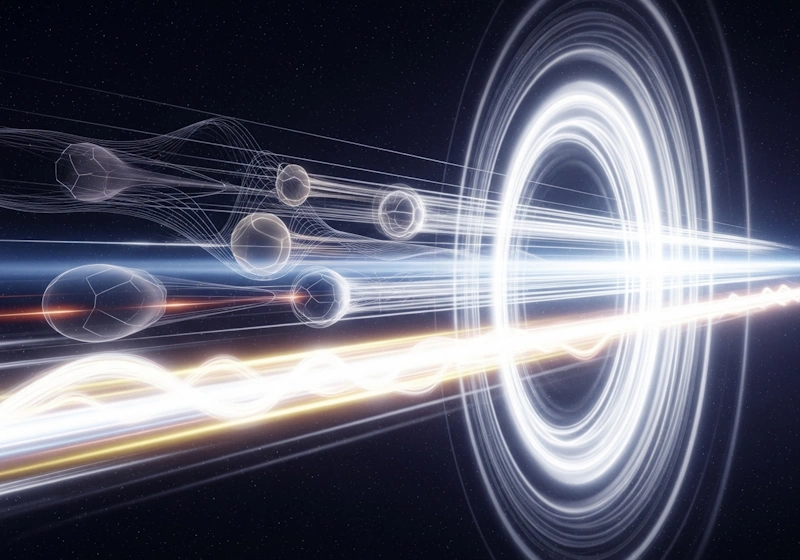
But in the early 20th century, physicists discovered that the building blocks of our universe—specifically Electrons—have a severe identity crisis. They act like solid little balls when we aren’t looking, but the moment we turn our backs, they dissolve into waves.
In this lesson, we will explore the century-long argument over what an electron actually is, and how the answer gave us modern computers and electron microscopes.
INTERACTIVE TOOL: PARTICLE VS WAVE SHOOTER
Double Slit Experiment
Experiment: Toggle between “Marble Mode” (Particle) and “Water Mode” (Wave). See how they behave differently when hitting a wall with two holes.
Part 1: The Classical Case for Particles (The Early Days)
For a long time, science was sure that matter was made of tiny, solid chunks. The evidence was overwhelming.
1. The Discovery (1897)
British physicist J.J. Thomson was playing with cathode ray tubes (vacuum tubes). He found a beam of “stuff” moving from the negative side to the positive side.

- The Test: He used magnets to bend the beam. Waves don’t bend like that; charged particles do.
- The Result: He calculated that these “corpuscles” (electrons) were much lighter than atoms – he had found the first subatomic particle.
2. The Weight (1909)
Then came Robert Millikan with his famous Oil Drop Experiment by suspending tiny drops of oil in mid-air using electricity.
- The Finding: He proved that electric charge didn’t flow like water; it came in discrete, chunky packets. He measured the exact charge of a single electron (1.6×10⁻¹⁹ coulombs).
- The Verdict: By 1910, the jury was out. Electrons were definitely particles. They had mass, they had charge, and they bounced off things like tiny billiard balls.
Part 2: The Plot Twist (Matter Waves)
But nature likes to break the rules.
In 1924, a French prince named Louis de Broglie wrote a PhD thesis that sounded crazy. He asked:
“If waves like light can behave as particles, then why couldn’t particles like electrons exhibit wave-like properties?”
He proposed a formula (λ=h/p) suggesting that everything moving has a wavelength. You have a wavelength. A car has a wavelength. But for big heavy things, the wave is invisible. For tiny things like electrons? It should be huge.
The Smoking Gun: Davisson & Germer (1927)
Two American scientists, Clinton Davisson and Lester Germer, were firing electrons at a nickel crystal at Bell Labs. It was meant to be a standard procedure.

- The Accident: They heated the nickel too much, changing its crystal structure.
- The Shock: When they fired the electrons, the electrons didn’t bounce off like tiny balls. They created a Diffraction Pattern—a series of bright and dark rings.
- The Meaning: Only waves diffract. Stones don’t diffract. The electrons were “rippling” through the crystal lattice.
De Broglie was right. Matter wasn’t solid. It was wavy.
Part 3: Deep Dive — The Double-Slit Paradox (Grades 10-12)
This leads us to the experiment that keeps physicists awake at night: The Double-Slit.
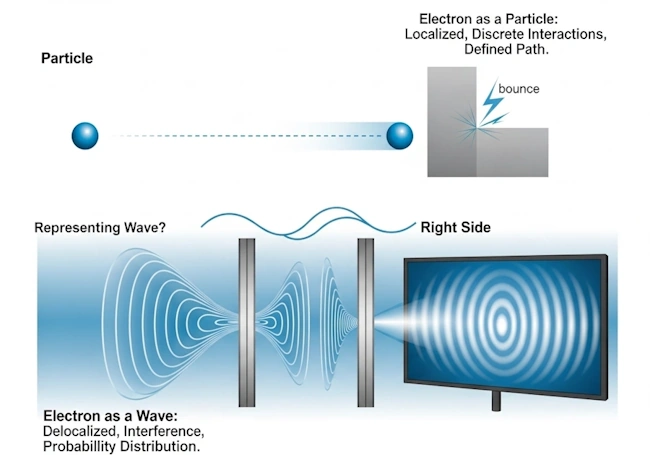
If you fire electrons at a wall with two slits:
- Classical Expectation: You should get two piles of electrons behind the slits. (Like spraying paint through a stencil).
- Quantum Reality: You get an Interference Pattern of many stripes. The electron goes through both slits, interferes with itself like a ghost, and lands on the screen.
The Collapse
As we discussed in the previous lesson (The Copenhagen Interpretation), if you put a camera by the slits to “watch” the electron, the wave behavior vanishes. It snaps back into being a boring particle.
This is the Measurement Problem. The electron doesn’t seem to have a fixed nature; it waits for you to ask it a question.
- Ask “Where are you?” → It acts like a particle.
- Ask “How fast are you moving?” → It acts like a wave.
Part 4: The Math of Uncertainty
To fix this mess, physicist Erwin Schrödinger invented a new kind of math in 1925. He stopped trying to track the electron as a dot and started tracking it as a cloud.
The Wave Function (ψ)
Schrödinger’s equation treats the electron not as an object, but as a Wave Function. This equation tells us the probability of finding the electron in a certain spot.
- It isn’t orbiting the nucleus like a planet.
- It is a buzzing cloud of probability surrounding the nucleus.
Heisenberg’s Uncertainty Principle (1927)
Werner Heisenberg added another rule: he proved you cannot know everything about a quantum object at once.
Δx×Δp≥ℏ/2
Translation: The more precisely you know where a particle is (Δx), the less you know about where it is going (Δp), because nature forbids perfect knowledge.
Part 5: Why Do We Care? (Real World Magic)
You might think, “Okay, electrons are waves. So what?”
Actually, this concept runs your entire life.
1. The Electron Microscope
Regular microscopes use light. But light waves are “fat” (large wavelength). They can’t see things smaller than a virus.
- The Hack: Because electrons behave like waves, we can shorten their wavelength by speeding them up.
- The Result: Electron Microscopes (SEM/TEM) use “electron waves” to see individual atoms. We use the wave nature of matter to see the invisible.
2. Flash Memory & SSDs (Quantum Tunneling)
According to classical physics, if a ball doesn’t have enough energy to roll over a hill, it rolls back.
- Quantum Reality: Because an electron is a “wave,” a small part of it extends through the hill. Occasionally, the electron just teleports to the other side.
- Application: Your USB drive works by trapping electrons behind a wall they shouldn’t be able to cross. We use Tunneling to erase and write data.
3. Chemistry
If electrons were just particles, atoms would collapse. It is the “standing wave” nature of electrons that keeps them stable in their orbitals, allowing chemical bonds to form. You literally exist because electrons are waves.
Teacher’s Note: Quantum Field Theory (The Modern View)
Today, physicists have moved even beyond “Particle vs. Wave.”
We now use Quantum Field Theory (QFT).
Imagine the universe is filled with invisible oceans (Fields). An “Electron” is just a splash (excitation) in the “Electron Field.”
- When the splash moves, it ripples (Wave).
- When the splash hits something, it hits at a single point (Particle).
They are both just different ways of describing a ripple in the fabric of reality.
Summary of Key Terms
- Diffraction: The bending of waves around an obstacle (proof of wave nature).
- Photon: A particle of light.
- Wave Function (ψ): The mathematical description of a quantum state.
- Tunneling: When a particle passes through a barrier it shouldn’t be able to cross.
- Complementarity: The idea that you can see the wave aspect OR the particle aspect, but never both at once.
🎓 Quiz: The Dual Nature of Matter
1. Who first discovered the electron was a particle using cathode ray tubes?
- A) Louis de Broglie
- B) J.J. Thomson
- C) Albert Einstein
- D) Erwin Schrödinger
👉 Click to check answer
He bent the beam with magnets, proving electrons had mass and charge.
2. What accidental experiment proved electrons behave like waves?
- A) The Oil Drop Experiment
- B) The Davisson-Germer Experiment
- C) The Kite Experiment
- D) The Gold Foil Experiment
👉 Click to check answer
They fired electrons at a nickel crystal and saw a diffraction pattern (ripples).
3. Why does an electron microscope see better than a light microscope?
- A) Electrons are brighter
- B) Electron lenses are cheaper
- C) Electrons possess significantly shorter wavelengths compared to light
- D) It uses X-rays
👉 Click to check answer
This allows them to resolve tiny details that visible light waves would just skip over.
4. What technology relies on electrons “tunneling” through barriers?
- A) Car Engines
- B) Flash Memory (SSDs)
- C) Wind Turbines
- D) Toasters
👉 Click to check answer
Electrons tunnel through insulating layers to store data.
5. According to the Uncertainty Principle, what two things can you NOT know perfectly at the same time?
- A) Mass and Charge
- B) Color and Temperature
- C) Position and Momentum
- D) Spin and Flavor
👉 Click to check answer
The more you know where a particle is, the less you know about where it is going.
References & Sources
- Arndt, M., & Hornberger, K. (2014). Testing the limits of quantum mechanical superpositions. Nature Physics, 10(4), 271-277.
- Bohm, D. (1952). A suggested interpretation of the quantum theory in terms of “hidden” variables. I. Physical Review, 85(2), 166-179.
- Bohr, N. (1928). The quantum postulate and the recent development of atomic theory. Nature, 121(3050), 580-590.
- Davisson, C., & Germer, L. H. (1927). Diffraction of electrons by a crystal of nickel. Physical Review, 30(6), 705-740.
- de Broglie, L. (1924). Recherches sur la théorie des quanta (Researches on the quantum theory). Thesis, Paris.
- Feynman, R. P. (1965). The Feynman Lectures on Physics, Vol. III: Quantum Mechanics. Addison-Wesley.
- Heisenberg, W. (1927). Über den anschaulichen Inhalt der quantentheoretischen Kinematik und Mechanik. Zeitschrift für Physik, 43(3-4), 172-198.
- Jönsson, C. (1961). Elektroneninterferenzen an mehreren künstlich hergestellten Feinspalten. Zeitschrift für Physik, 161(4), 454-474.
- Schrödinger, E. (1926). Physical Review, 28(6), 1049-1070.
- Thomson, G. P. (1927). Experiments on the diffraction of cathode rays. Proceedings of the Royal Society of London. Series A, 117(778), 600-609.
- Thomson, J. J. (1897). Cathode rays. Philosophical Magazine, 44(269), 293-316.
- Wheeler, J. A., & Zurek, W. H. (Eds.). (1983). Quantum Theory and Measurement. Princeton University Press.
- Zurek, W. H. (2003). Reviews of Modern Physics, 75(3), 715-775.
- Zeilinger, A. (1999). Experiment and the foundations of quantum physics. Reviews of Modern Physics, 71(2), S288-S297.
- Crease, R. P. (2002). The most beautiful experiment. Physics World, 15(9), 19-20.