The Copenhagen Interpretation: Why Reality Changes When We Look
Introduction: The “Magic” of Physics
If quantum mechanics makes your head hurt, don’t worry. You are in good company. Niels Bohr, one of the founders of the field, famously said that if you aren’t shocked by quantum theory, you haven’t understood it.
In the world of big things—baseballs, planets, cars—physics is predictable. If you throw a ball, you know where it lands. But zoom in to the world of the tiny—electrons and photons—and the rules of reality seem to break:
- Particles can be in two places at once
- They act like waves one second and bullets the next
- They seem to know when you are watching them
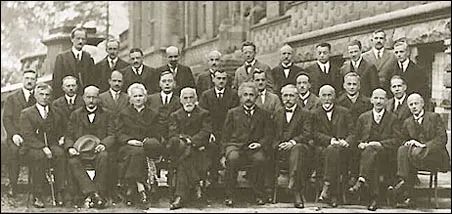
To make sense of this madness, Niels Bohr and Werner Heisenberg came up with a set of rules in the 1920s. We call it the Copenhagen Interpretation. It is the standard way physicists explain the universe, but it suggests something very unsettling: reality might not actually exist until you measure it.
Let’s break down this century-old argument step by step.
Interactive Tool: The Quantum Observer
Pattern: Interference
Experiment: Fire electrons at the wall. Do they make a pattern of two bands (particles) or many bands (waves)? What happens when you turn the “Camera” on?
Part 1: The Cosmic Bet (The Wave Function)
To understand the Copenhagen view, we have to ditch the idea of certainty. Classical physics tells you exactly where a planet is. Quantum mechanics? It only gives you the odds.
In this framework, a particle (like an electron) doesn’t have a fixed address. It doesn’t have a specific speed. Instead, it is described by a mathematical equation called the Wave Function (you’ll see it written as the Greek symbol ψ, or Psi).
Think of it like this: Imagine you lost your keys
Classical Physics: The keys are definitely in the kitchen OR the bedroom. You just don’t know which.
Quantum Physics: The keys are in a “cloud” of probability. They are 30% in the kitchen, 20% in the bedroom, and 50% in the car.
This state—where the particle exists in all possible configurations at the same time—is called Superposition. The wave function encodes this spread of probabilities. It isn’t just that we lack information; the particle literally hasn’t decided where to be yet.
Part 2: The Collapse (Making Up Its Mind)
This is where things get weird. The wave function (ψ) can spread out across the entire universe theoretically. But when you actually look for the electron—when you stick a detector in the room to measure it—you never see a “cloud.” You see a tiny dot. A specific point.
The Copenhagen Interpretation calls this Wave Function Collapse.
- Before you look: The electron is a ghost, smearing out across space
- The moment you measure: Snap. The probability cloud vanishes, and the electron “chooses” a single location
According to Bohr and Heisenberg, this collapse is real and you can’t reverse it. The act of measurement forces the universe to make a decision. Why does it happen? The theory doesn’t actually say. It just accepts that it does happen. It’s like the universe is rolling dice behind your back, and the moment you turn around, the dice freeze on a number.
Teacher’s Note: The “Observer” Myth
You will often hear people say, “Consciousness creates reality.” That is a misunderstanding.
In the Copenhagen view, an “Observer” doesn’t have to be a human with a brain. It can be:
- A camera
- A Geiger counter
- Even a stray photon bumping into the electron
Measurement just means “interaction with the macro world.” If a machine records the data, the wave collapses, even if no human ever looks at the screen.
Part 3: Schrödinger’s Unlucky Cat
In 1935, another physicist named Erwin Schrödinger tried to show just how ridiculous this concept was. He came up with a scenario that has become the most famous meme in science history.
The Box
You take a cat and put it in a sealed steel box. Inside, there is a “diabolical device”: a tiny bit of radioactive material, a Geiger counter, and a flask of poison.
- There is a 50/50 chance an atom decays in the next hour
- If it decays, the counter detects it → smashes the flask → cat dies
- If atom doesn’t decay → nothing should happen → cat stays alive
The Paradox
According to the math of the Copenhagen Interpretation, the atom is in a superposition (decayed AND not decayed). Since the cat’s fate is tied to the atom, the cat must also be in superposition.
Until you open the lid to check, the cat is both dead and alive at the same time.
Schrödinger thought this was absurd. A cat is obviously one or the other. But experiments on atoms show that, mathematically, the “dead/alive” state is real until the box is opened.
Part 4: Complementarity and The Fight with Einstein
Niels Bohr realized that because of this weirdness, we can never see the “whole picture” of the quantum world at once. He called this Complementarity.
It is rooted in Heisenberg’s Uncertainty Principle: the more precisely you measure one thing (like position), the less you can know about another (like momentum).
- If you set up an experiment to see if an electron is a Wave, it will act like a wave
- If you set up an experiment to see if it’s a Particle, it will act like a particle
- But you can never see both natures at the exact same time
“God Does Not Play Dice”
This idea—that reality is fuzzy and probabilistic—drove Albert Einstein crazy. He believed in an objective universe. A moon is there whether you look at it or not, right?
Einstein argued that there must be “Hidden Variables”—secret instructions inside the particles that tell them where to go, which we just haven’t found yet. He famously wrote that “God does not play dice.”
Bohr’s response was legendary: “Stop telling God what to do.”
Bohr insisted there is no “hidden reality” beneath the math. The probability is the reality.
Part 5: The Double-Slit Proof
So, who won? Bohr or Einstein?
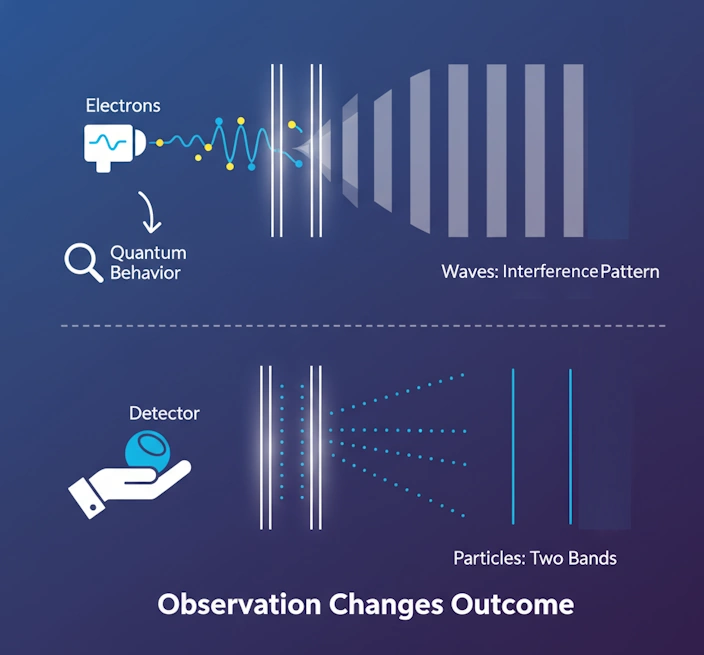
We can settle this in the lab with the Double-Slit Experiment.
Imagine firing electrons at a wall with two slits cut in it. Behind the wall is a detector screen.
Don’t Look
If you fire the electrons and don’t check which slit they go through, they leave an Interference Pattern on the back screen. This is a pattern only waves make. It means the electron went through both slits at once, interfered with itself, and landed.
Look
Now, put a sensor by the slits to beep every time an electron passes. Suddenly, the pattern changes. You get two boring bands on the back screen. The electrons start acting like little bullets (particles).
The moment you gathered information (measurement), you destroyed the wave function. The Copenhagen Interpretation explains this perfectly.
Part 6: Why Does This Matter?
You might ask, “Who cares what electrons do?” You should. This weirdness is the engine behind the modern world.
Real-World Applications
- Computers: Your phone’s processor works because we understand how electrons behave as waves (semiconductors).
- Quantum Computing: We are building new computers that use Qubits. These bits don’t just switch on or off (0 or 1); they exist in superposition (0 and 1 at the same time). This allows them to solve problems a billion times faster than a laptop.
- Cryptography: We use quantum collapse to send messages that cannot be hacked. If a spy tries to “read” (measure) the message, the wave function collapses, and the message destroys itself.
The Bottom Line
The Copenhagen Interpretation isn’t perfect. It has holes. It is vague about what constitutes a “measurement.” It leaves open huge philosophical questions about the nature of existence. Other theories, like the Many Worlds Interpretation (where the cat is alive in one universe and dead in another), have tried to replace it.
But for 100 years, Copenhagen has remained the king. It forces us to accept a humble truth: The universe doesn’t owe us a simple explanation. It is a dance of probabilities, and we are just the observers trying to catch it in the act.
🎓 Quiz: The Copenhagen Interpretation
1. In quantum mechanics, what does the wave function describe?
- A) The exact speed of a particle
- B) The likelihood of locating a particle within a specific state
- C) The sound an electron makes
- D) The path of a planet
👉 Click to check answer
It encodes all possible states as a “cosmic bet” until measured.
2. What happens to the wave function when a measurement is made?
- A) It expands
- B) It disappears forever
- C) It collapses into a single definite state
- D) It doubles in size
👉 Click to check answer
The smear of possibilities becomes one reality.
3. What was Einstein’s main objection to this theory?
- A) The math was wrong
- B) He believed “God does not play dice” (Hidden Variables)
- C) He didn’t like Niels Bohr
- D) He thought atoms didn’t exist
👉 Click to check answer
Einstein argued that the universe must have objective, predictable properties.
4. In the Double-Slit experiment, what happens when you observe the electrons?
- A) They form an interference pattern (Wave)
- B) They stop moving
- C) The pattern vanishes and they act like particles
- D) They bounce back
👉 Click to check answer
The act of measurement forces the electron to choose a single path.
5. What does “Superposition” mean?
- A) A particle is in a fixed position
- B) A particle exists in multiple states at the same time
- C) A particle is moving faster than light
- D) A particle is broken
👉 Click to check answer
Like Schrödinger’s Cat being both alive and dead until observed.
References & Sources
- Bohr, N., 1987. The Philosophical Writings of Niels Bohr: Essays 1932-1957 on Atomic Physics and Human Knowledge. Woodbridge, CT: Ox Bow Press.
- Griffiths, D.J., 2016. Introduction to Quantum Mechanics. 2nd ed. Cambridge: Cambridge University Press.
- Dirac, P.A.M., 1958. The Principles of Quantum Mechanics. 4th ed. Oxford: Oxford University Press.
- Heisenberg, W., 1958. Physics and Philosophy: The Revolution in Modern Science. New York: Harper & Row.
- Faye, J., 2019. Copenhagen interpretation of quantum mechanics. In: The Stanford Encyclopedia of Philosophy (Winter 2019 Edition), ed. by E.N. Zalta. Available at: https://plato.stanford.edu/archives/win2019/entries/qm-copenhagen/ [Accessed 3 June 2025].
- Von Neumann, J., 1955. Mathematical Foundations of Quantum Mechanics. Princeton, NJ: Princeton University Press.
- Schrödinger, E., 1935. The present situation in quantum mechanics. Naturwissenschaften, 23(48), pp.807-812. doi:10.1007/BF01491891
- Bohr, N., 1928. Nature, 121(3050), pp.580-590. doi:10.1038/121580a0
- Heisenberg, W., 1927. 43(3-4), pp.172-198. doi:10.1007/BF01397280
- Einstein, A., Podolsky, B. and Rosen, N., 1935. Physical Review, 47(10), pp.777-780. doi:10.1103/PhysRev.47.777
- Feynman, R.P., Leighton, R.B. and Sands, M., 1965. The Feynman Lectures on Physics, Vol. III: Quantum Mechanics. Reading, MA: Addison-Wesley.
- Nielsen, M.A. and Chuang, I.L., 2010. Quantum Computation and Quantum Information. 10th Anniversary Edition. Cambridge: Cambridge University Press.
- Bell, J.S., 1964. On the Einstein Podolsky Rosen paradox. Physics Physique Fizika, 1(3), pp.195-200. doi:10.1103/PhysicsPhysiqueFizika.1.195
- Everett, H., 1957. “Relative state” formulation of quantum mechanics. Reviews of Modern Physics, 29(3), pp.454-462. doi:10.1103/RevModPhys.29.454
- Wheeler, J.A., 1990. Information, physics, quantum: The search for links. In: Complexity, Entropy, and the Physics of Information, ed. by W.H. Zurek. Boca Raton, FL: CRC Press.
- Aspect, A., Dalibard, J. and Roger, G., 1982. Experimental test of Bell’s inequalities using time-varying analyzers. Physical Review Letters, 49(25), pp.1804-1807. doi:10.1103/PhysRevLett.49.1804