Quantum Retrocausality — Can the Future Change the Past?
Introduction to Quantum Causality: The Time Travel Paradox
In our daily life, time flows like a river—one way.
You drop a glass -> It shatters.
You never see a shattered glass assemble itself and jump back into your hand.
Cause always comes before Effect.
But in the quantum world, this rule might be optional.
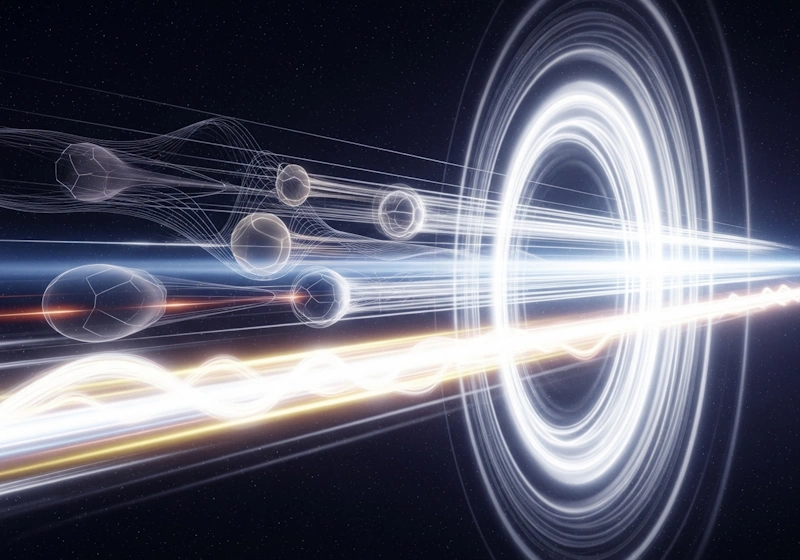
Experiments suggest that a measurement you make today could determine what a particle did yesterday. This concept is called Quantum Retrocausality.
Does this mean we can send messages to the past? No. But it does mean that the past might not be as “set in stone” as we think. In this lesson, we will explore the experiments that broke time.
[INTERACTIVE TOOL: THE QUANTUM ERASER]
Delayed Choice Eraser
Concept: Determining the "which-path" information destroys the interference pattern, even if the choice is made after the particle passes the slits.
Experiment: Fire a photon. It passes the slits. After it passes, choose whether to “Erasing the Path Info” or “Keep It.” Watch how the past pattern changes based on your future choice.
Part 1: The Idea of Quantum Retrocausality (Wheeler’s Delayed Choice)
The story starts with a thought experiment by John Archibald Wheeler in 1978.
In the 1940s, two famous physicists named John Archibald Wheeler and Richard Feynman created something called absorber theory. This theory said that electromagnetic waves (light and similar radiation) actually have two parts:
- one going forward in time
- and one going backward.
In their model, when an electric charge gets speeded up, it sends out a wave going forward, but things in the future send waves back through time that affect the source. This explained energy conservation and got rid of annoying physics problems involving the particle interacting with itself, all without needing backward messages.
Around that same time, a physicist named Olivier Costa de Beauregard suggested a retrocausal answer to a famous physics puzzle called the Einstein-Podolsky-Rosen paradox.
Wheeler asked a simple but disturbing question:
In the Double-Slit experiment, the electron behaves like a Wave (if unobserved) or a Particle (if observed).
The Question: When does it decide? Does it decide when it leaves the gun, or when it hits the detector?
The Cosmic Setup:
Imagine a photon traveling from a distant star billions of light-years away. It has to pass around a galaxy (Gravitational Lens) to reach Earth. It can go Left or Right.
- If we put a detector on Earth today, we force it to choose one path (Particle).
- If we don’t, it takes both paths (Wave).
The Paradox: The photon left the star billions of years ago. By choosing to measure it today, did we force it to choose a path billions of years ago? Did our present choice rewrite the deep past?
Part 2: The Quantum Eraser (Erasing History)
In 1982, Marlan Scully and Kai Drühl took this idea into the lab. They created the Quantum Eraser.
How it works (The Analogy):
Imagine you have two cards: Red and Blue. You shuffle them. You don’t know which is which.
- Entanglement: You create two entangled photons (Signal and Idler). They are linked.
- The Path: The Signal photon goes to the screen. The Idler photon goes to a detector.
If you measure the Idler, you know which path the Signal took. (The pattern disappears and wave collapses -> the photon becomes a Particle).
- The Eraser: Now, imagine you put a “scrambler” (Eraser) in front of the Idler detector. It destroys the information. You can no longer tell which path it took.
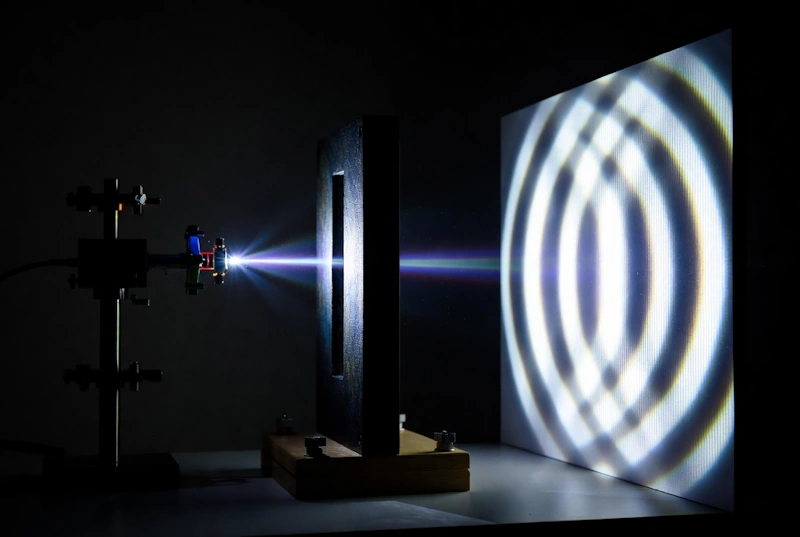
- The Result: The interference pattern comes back on the screen.
The Spooky Part (Delayed Choice):
Olivier Costa de Beauregard proposed that the mysterious instant connection between two distant particles could be explained if influences bounced backward and forward through time in a zigzag pattern. This way, you didn’t need “spooky action at a distance” and it still obeyed Einstein’s rule that nothing goes faster than light, since no actual information traveled backward.

Wheeler expanded on this in 1978 with a detailed idea called the delayed-choice concept. He suggested experiments where you wait until after a particle has already gone through its path before you decide whether to measure it as a wave or as a particle.
In 1999, Kim et al. performed a version where the “Eraser” decision happened nanoseconds after the Signal photon had already hit the screen.
Even though the Signal photon had already landed, the decision to erase the info in the future seemed to determine the pattern it formed in the past.
The “Handshake” Theory
Physicist John Cramer proposed the “Transactional Interpretation.”
He suggests waves travel Forward in Time (Offer) and Backward in Time (Confirmation). A quantum event is a “handshake” between the past and future. The future isn’t changing the past; the future and past are agreeing on the present.
Part 3: Deep Dive — Theories of Time (Grades 11-12)
If retrocausality is real, what does it mean for reality?
1. The Block Universe
This theory suggests that the Past, Present, and Future all exist simultaneously, like a block of ice.
There is no “flowing” time. You are just experiencing “slices” of the block.
In this view, the future affecting the past is no weirder than the left side of a table affecting the right side. They are just connected parts of the same structure.
2. Time Symmetry
The laws of physics (Newton’s laws, Maxwell’s equations, Schrödinger’s equation) work perfectly fine if you run time backward.
If you play a movie of planets orbiting in reverse, it still follows the laws of gravity.
Retrocausality argues that if the laws of physics are symmetric, then time should be able to flow both ways, not just forward.
Part 4: Can We Change the Past? (The No-Signaling Theorem)
Before you start planning to send yourself next week’s winning lottery numbers, there is a catch. It is called the No-Signaling Theorem.
This theorem states that even though quantum particles are connected across time, you cannot use this connection to send a readable message.
Here is exactly why it fails, broken down step-by-step.
1. The “Static” Problem
Imagine you are the receiver in the past. You are watching the detector screen, waiting for a message from the future.
- Future You decides to turn the “Eraser” ON (trying to send a Wave Pattern).
- Future You decides to turn the “Eraser” OFF (trying to send a Particle Pattern).
What do you see in the past? No matter what Future You does, you—in the past—just see a messy, gray blob of dots. It looks like random static or “white noise” on a TV. There are no clear stripes. There are no clear clumps. It just looks like a random pile of electrons.
Why? Because the “Interference Pattern” (The Wave) and the “Clump Pattern” (The Particle) are actually overlapping on top of each other in a way that cancels out. To your eyes in the past, the data looks completely random.
2. You Need the “Decoder Key”
So, how do scientists ever see the pattern? They can only see it after the experiment is over, when they compare the data from the Past (Signal Photon) with the data from the Future (Idler Photon).
Think of the Idler Photon as a Decoder Key.
- The Past Data: A scrambled, unreadable message.
- The Future Data: The key that tells you which dots on the screen belong to the “Wave” and which belong to the “Particle.”
3. The Conclusion
You can only decode the message after the future data arrives to you via normal means (fiber optic cables, computer disks). Since that data travels at the speed of light (or slower), no information ever travels back in time.
The Paradox Resolved:
- Can you change the past? Technically, yes. Your future choice determines the “quantum history” of the particle.
- Can you read the past? No. The past remains a blur of random noise until the future arrives to explain it. You cannot change history; you can only change how the history is sorted later.
[Analogy: The Red and Blue Glasses]
Imagine writing a message in Red Ink and another message in Blue Ink right on top of each other. To the naked eye, it just looks like a purple mess. You can’t read it.
Now, imagine you send a pair of Red Glasses from the future. Once you put them on, the red ink disappears, and you can clearly read the Blue message.
The Quantum Eraser is like sending those glasses. The message was always there (in the past), but it was unreadable until the “context” (the measurement) arrived from the future.
Is Our Past Not Determined?
Does it mean that our past is the one undetermined mess unless we read it?
Yes, you have hit on exactly what the physicist John Archibald Wheeler believed.
This is one of the most profound realizations in quantum physics. The theorem suggests that history is not a solid timeline that sits there waiting for us to look at it.
Instead, the past is a “fog of probability” that only crystallizes into a definite story when we measure it in the present.
The “Great Smoky Dragon” Analogy
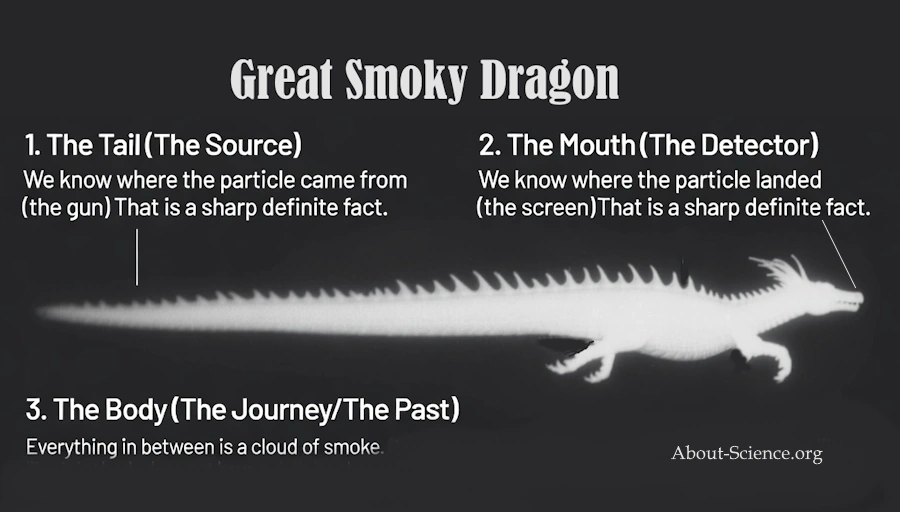
John Wheeler (the man who invented the “Delayed Choice” experiment) used a famous metaphor to explain exactly what you just asked. He called a quantum particle a “Great Smoky Dragon.”
- The Tail (The Source): We know where the particle came from (the gun). That is a sharp, definite fact.
- The Mouth (The Detector): We know where the particle landed (the screen). That is a sharp, definite fact.
- The Body (The Journey/The Past): Everything in between is a cloud of smoke.
It is not just that we don’t know what the dragon’s body looks like. It is that the body does not have a definite shape. The particle didn’t take Path A or Path B. It traveled through a “fog of existence” until the moment it hit the detector.
So, is the past a mess?
It isn’t a “mess” (which implies chaos); it is “Undefined.”
If you play video games, think of it like Procedural Generation.
- In a game like Minecraft, the world behind you (where you aren’t looking) might be saved on the hard drive, but it isn’t “rendered” on the screen.
- In Quantum Physics, the past is un-rendered data. Until you interact with the data in the present, the past has no specific form.
Wheeler’s famous quote:
“The past has no existence except as it is recorded in the present.”
Part 5: Recent Breakthroughs (2017-2023)
Science moves fast. Here is what has happened recently.
2017 (Space Test): Researchers used satellites to perform a delayed-choice experiment over huge distances. It confirmed the effect works even across thousands of kilometers.
2023 (Coherent Light): A study by Zhang et al. showed similar “Eraser” effects using thermal light (heat), suggesting this might not just be a quantum weirdness, but a fundamental property of waves and optics.
Summary of Key Terms
- Retrocausality: A concept proposing that events occurring later in time can exert an influence on events that happened earlier.
- Delayed Choice: An experiment where the measurement method is chosen after the particle has passed the slits.
- Block Universe: The theory that past, present, and future exist simultaneously.
- Absorber Theory: The proposal by Feynman and Wheeler that electromagnetic waves propagate not only into the future but also backward toward the past.
🎓 Quiz: Time and Quantum Mechanics
1. Which physicist originated the “Delayed Choice” thought experiment?
- A) Albert Einstein
- B) John Archibald Wheeler
- C) Erwin Schrödinger
- D) Stephen Hawking
👉 Click to check answer
He used the analogy of a photon traveling from a distant galaxy.
2. What happens in the “Quantum Eraser” experiment if you erase the path information?
- A) The particle disappears
- B) The interference pattern (Wave) returns
- C) The particle stops moving
- D) Time stops
👉 Click to check answer
Even if you erase the info AFTER the particle hit the screen!
3. Does quantum retrocausality allow you to send messages to the past?
- A) Yes, easily
- B) Only short messages
- C) No, because of the No-Signaling Theorem
- D) Yes, but only to yourself
👉 Click to check answer
The data looks random until you compare notes in the present.
4. What is the “Block Universe” theory?
- A) The universe is shaped like a cube
- B) Past, Present, and Future exist simultaneously
- C) Time flows in circles
- D) The universe is pixelated
👉 Click to check answer
Like a DVD, the whole movie is there at once; we just watch it frame by frame.
5. What does the “Transactional Interpretation” say about time?
- A) Time is an illusion
- B) Waves travel both Forward and Backward in time
- C) There is only the present
- D) Time goes sideways
👉 Click to check answer
A “handshake” across time establishes the quantum event.
Sources & References
- Costa de Beauregard, O., 1976. ‘Time symmetry and interpretation of quantum mechanics’. Proceedings of the Royal Society of London. Series A. Mathematical and Physical Sciences, 351(1666), pp. 467–480.
- Cramer, J.G., 1986. ‘The transactional interpretation of quantum mechanics’. Reviews of Modern Physics, 58(3), pp. 647–687.
- Feynman, R.P. and Wheeler, J.A., 1945. ‘Interaction with the absorber as the mechanism of radiation’. Reviews of Modern Physics, 17(2–5), pp. 157–181. (Absorber Theory of advanced and retarded waves.)
- Kim, Y.H., Yu, R., Kulik, S.P., Shih, Y. and Scully, M.O., 2000. ‘A delayed choice quantum eraser’. Physical Review Letters, 84(1), p. 1. (Experimental demonstration of delayed-choice quantum eraser.)
- Scully, M.O. and Drühl, K., 1982. ‘Quantum eraser: A proposed photon correlation experiment concerning observation and “delayed choice” in quantum mechanics’. Physical Review A, 25(4), pp. 2208–2213. (Original quantum eraser proposal.)
- Wheeler, J.A., 1978. ‘The “past” and the “delayed-choice” double-slit experiment’. In: Marlow, A.R., ed. Mathematical Foundations of Quantum Theory. New York: Academic Press, pp. 9–48. (Wheeler’s delayed choice thought experiment.)