Is Anything Faster Than Light?
Introduction: A Gateway Between Worlds
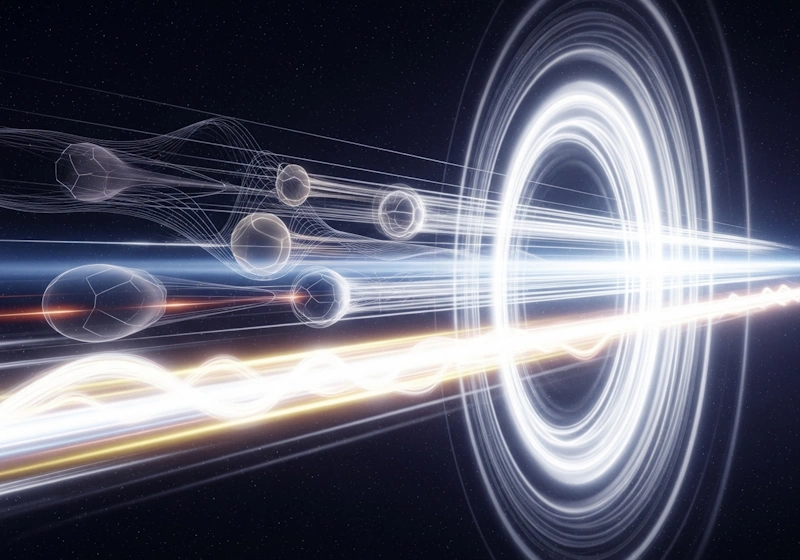
Every highway has a speed limit. Break it, and you might get a ticket. But there’s a speed limit in the universe that nobody can break, no matter how powerful their engine or how much they’re willing to pay the fine. This cosmic speed limit is the speed of light, and it governs everything from the tiniest subatomic particles to the largest galaxies.
The question is: does this limit truly hold everywhere, or are there ways around it? Can anything in our universe actually go faster than light?
[INTERACTIVE TOOL: THE COSMIC DRAG RACE]
Cosmic Drag Race
Why mass can't reach the Speed of Light (and the "loopholes" that trick us)
Experiment: Race a Photon (Light) against a Rocket, a Laser Shadow, and a piece of Expanding Space. Watch what happens to the Rocket’s mass as it tries to reach 99.9% the speed of light!
The Speed Limit of the Universe (Grades 7-9)
Light travels at approximately 299,792,458 meters per second, or about 186,282 miles per second. To put this in perspective, light could circle the Earth’s equator about 7.5 times in just one second. It seems impossibly fast, and according to Albert Einstein’s theory of special relativity, nothing with mass can reach or exceed this speed.
But why? What makes light speed so special?
Einstein discovered that as objects with mass accelerate closer to the speed of light, something strange happens. They become heavier and heavier, requiring more and more energy to go faster. To actually reach light speed, an object with mass would need infinite energy, which is impossible. It’s not just a matter of building a more powerful engine. The laws of physics themselves create this barrier.
The Famous Equation:
E=mc²
This is exactly what Einstein’s famous equation means! Energy (E) and mass (m) are interchangeable. When you pump massive amounts of rocket fuel (Energy) into a ship to make it go faster, that energy literally transforms into extra mass. The faster you go, the heavier you get, which makes you harder to push. It is an unwinnable race!
Things that actually travel at light speed
First, let’s clarify what does travel at light speed. Light itself, obviously, moves at this cosmic speed limit. But light isn’t alone. All massless particles zip through space at this ultimate velocity. This includes photons (particles of light), and theoretically, gravitons (if they exist and carry the force of gravity).
Interestingly, even though we call it the “speed of light,” it’s really the speed of all massless particles. Light just happens to be the most familiar example to us.
While nothing can move through space faster than light, the universe has some fascinating loopholes that create the illusion of faster-than-light phenomena. These don’t actually violate Einstein’s rules, but they’re worth exploring.
The Loopholes — Cheating the Speed Limit
The expanding Universe
Here’s something mind-bending: space itself can expand faster than light. When we look at distant galaxies, we see them moving away from us at speeds that appear to exceed light speed. But they’re not actually moving through space that fast. Instead, space itself is stretching between us and those galaxies.
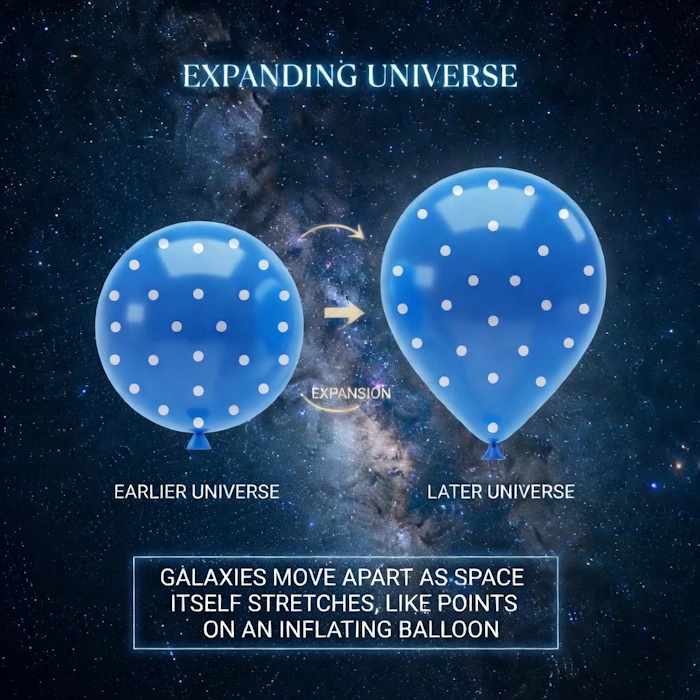
Think of it like dots on a balloon. As you inflate the balloon, the dots move apart, but they’re not sliding across the rubber. The rubber itself is expanding. Galaxies can recede from each other faster than light because space itself is growing, and there’s no law against that.
Shadows and light spots
If you shine a laser pointer at the moon and quickly swivel your wrist, the spot of light on the moon’s surface moves across the lunar landscape. With the right conditions, you could make that spot “travel” faster than light. Does this break the rules?
Not at all. The spot isn’t a physical object. It’s just an effect, like a shadow. No matter or information is actually traveling from one side of the moon to the other. It’s similar to how a shadow can move impossibly fast across a wall without violating physics. These are patterns, not things.
Deep Dive — Quantum Spookiness (Grades 10-12)
Quantum entanglement: spooky action at a distance
Einstein called it “spooky action at a distance,” and it remains one of the most peculiar phenomena in physics. When two particles become quantum entangled, measuring one particle instantly affects the state of the other, no matter how far apart they are. This correlation happens instantaneously, seemingly faster than light.
However, and this is crucial, you cannot use entanglement to send information faster than light. The outcomes are random until measured, so while the correlation is instantaneous, you can’t control what information is transmitted.
It’s like two coins that always land on opposite sides when flipped, no matter how far apart they are. The connection happens instantly, but it can’t be used for communication.
Phase velocity vs. group velocity
Scientists have managed to make light pulses appear to travel faster than light speed through certain materials. This involves the difference between phase velocity (how fast the wave crests move) and group velocity (how fast the actual information or energy moves).
While the phase velocity can exceed the speed of light, the group velocity, which carries the actual information, never does. It’s a bit like watching waves at the beach. The wave pattern might move faster than any individual water molecule, but the water itself isn’t breaking any speed limits.
Science Fiction or Future Physics?
Theoretical possibilities: science on the edge
Science doesn’t just stop at what we know. Physicists love to explore what might be possible, even if it seems unlikely.
Tachyons: the hypothetical speed demons
Tachyons are theoretical particles proposed to move at speeds exceeding that of light. They’re not something that accelerated past light speed. Rather, they would exist exclusively in the faster-than-light realm, just as normal particles exist below light speed.
If tachyons existed, they would have some bizarre properties. They would lose energy as they speed up and gain energy as they slow down. As far as we know, tachyons don’t exist, and there’s no experimental evidence for them. They remain a mathematical curiosity rather than a physical reality.
Warp drives: bending space itself
Science fiction has long featured warp drives, and surprisingly, some physicists take the idea seriously. The concept, most famously explored by physicist Miguel Alcubierre, doesn’t involve moving through space faster than light. Instead, it involves warping space itself.
Think about an airport. You’re not walking any faster, but the walkway carries you along. A warp drive would contract space in front of a spacecraft and expand it behind, effectively moving the ship without it actually traveling through space faster than light.
The catch? Such a drive would require exotic matter with negative energy density, something we’ve never observed and may not exist. It would also require enormous amounts of energy, possibly more than exists in the entire observable universe. Still, it’s not explicitly forbidden by the laws of physics, which makes it a fascinating area of theoretical research.
NASA’s Warp Lab
Did you know NASA actually has a laboratory that looked into this? The Eagleworks Laboratories (Advanced Physics Propulsion Laboratory) spent years studying whether the Alcubierre Warp Drive could eventually be miniaturized. While we are centuries away from building one, the math technically checks out!
Wormholes: shortcuts through space
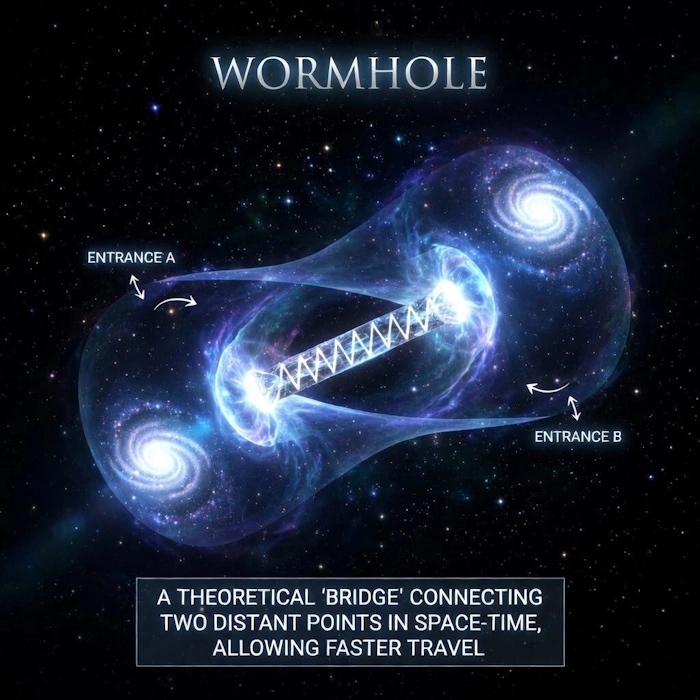
Another staple of science fiction, wormholes are theoretical tunnels through spacetime. If they exist, they could connect two distant points in space, allowing you to travel between them without actually moving faster than light.
Think of spacetime as a sheet of paper. The normal way to get from one point to another is to travel across the paper’s surface. But if you could fold the paper and punch a hole through it, you’d have a shortcut. That’s essentially what a wormhole would be.
Like warp drives, wormholes would probably require exotic matter to stay open and stable. They may also be incredibly tiny and short-lived. Even if large, traversable wormholes could exist, creating one would be far beyond our current technology. Nevertheless, they remain a legitimate subject of study in theoretical physics.
The Fabric of Reality
Why can’t we go faster than light?
The barrier isn’t just about building better rockets. Light speed is baked into the very architecture of spacetime. Space and time form a unified, four-dimensional structure, and light speed defines how quickly cause and effect can ripple through this structure.
Here’s the strange part: moving through space means you’re also traveling through time. Speed up through space, and your clock ticks more slowly. If you could somehow reach light speed, your personal time would freeze completely. Push beyond that, and you’d theoretically travel backwards through time, creating impossible paradoxes where effects happen before their causes.
This isn’t science fiction. We see these effects in the real world. GPS satellites orbit Earth at high speeds, and their clocks run at a different rate than ours on the ground. Engineers must correct for this time difference, or GPS navigation would fail within minutes. Relativity is measurable, testable, and absolutely real.
What about Cherenkov radiation?
Here’s something interesting: particles can actually outpace light under specific conditions. Before you get too excited, there’s a catch. Light travels more slowly when moving through various materials. In water, for instance, light travels at roughly 75% of its maximum speed in empty space.
Some charged particles can zip through water faster than light moves through water, though they’re still slower than light in a vacuum. When this happens, the particle generates a shock wave of electromagnetic radiation called Cherenkov radiation. Think of it as the optical equivalent of a sonic boom when jets break the sound barrier.
You can see this effect as an eerie blue glow in nuclear reactor pools. The particles haven’t broken the universal speed record. They’ve just outrun light in a medium where light was already slowed down.
The practical implications of speed faster than light
Light speed as a barrier has real consequences for how the universe works. Information cannot travel faster than light, which means the cosmos has built-in communication delays.
A star exploding 1,000 light years away won’t be visible to us for a thousand years.
Physicists describe this using “light cones,” regions of spacetime that define what can possibly affect what. You can only influence events within your light cone, the area reachable by traveling at or below light speed. This structure gives the universe its causal order.
For anyone dreaming of exploring the stars, this creates serious obstacles. Alpha Centauri, our nearest stellar neighbor, sits about 4.4 light years away. A radio signal would need over four years to reach it, and we’d wait another four years for any response. Even at half the speed of light, a journey there would take nearly nine years.
The beauty of the Limit
You might see this cosmic speed limit as nature being cruel. Actually, it’s what keeps reality orderly and predictable. Without this boundary, cause and effect would collapse. Results could happen before their triggers. The universe would descend into chaos.
This limit ties together space, time, energy, and mass in mathematically beautiful relationships. It’s far more than a maximum velocity. It’s a deep structural principle that determines how reality functions at every scale.
Conclusion
Where does this leave us? To directly answer the question: nothing with mass can move through space faster than light. The apparent exceptions we’ve discussed either don’t involve real motion through space, can’t transmit information, or involve space itself changing rather than objects moving through it.
But physics keeps surprising us. Ideas like warp drives and wormholes haven’t been ruled out completely, even though they’re wildly beyond our current abilities. Quantum physics keeps showing us bizarre connections across space that defy our everyday understanding.
If faster-than-light travel ever becomes possible, it won’t happen by simply accelerating really hard. It would require bending spacetime itself, using physics we don’t yet fully grasp and technology that might as well be magic to us today.
Scientists keep pushing at the edges of knowledge. They test quantum mechanics in new ways, map how spacetime behaves on cosmic scales, and calculate what might be theoretically possible. Maybe we’ll find new laws of physics that open doors we can’t currently see.
Right now, though, light speed stands as the universal maximum. It governs everything from quarks to galaxy clusters. And there’s something wonderful about that.
Final thoughts
This single question about whether anything exceeds light speed connects to almost everything in modern physics. Einstein’s relativity, quantum entanglement, cosmic expansion, theoretical warp technology—they all tie back to this fundamental speed limit and how the universe handles it.
If you’re a student just getting curious about science, an enthusiast who reads every astronomy article, or someone who simply enjoys looking up at the night sky, the speed of light offers something profound. It shows us our limits while simultaneously pushing us to think more creatively about reality.
The cosmos has rules. We can’t break them, but we can try to understand them better. And who knows? Maybe our descendants will find clever ways to work within those rules that we haven’t thought of yet. Human imagination, at least, has no speed limit.
🎓 Quiz: The Cosmic Speed Limit
code Code
1. Why can’t a spaceship with mass reach the exact speed of light?
- A) The engines would melt
- B) It would require infinite energy as its mass increases
- C) Space friction would slow it down
- D) The pilot would age too fast
👉 Click to check answer
As objects accelerate toward light speed, they become heavier, requiring impossible amounts of energy to push them further.
2. How do distant galaxies appear to move away from us faster than light?
- A) They have hyper-advanced warp drives
- B) They are made of Tachyons
- C) Space itself is stretching between us and them
- D) They are falling into a black hole
👉 Click to check answer
Like dots on an inflating balloon, the galaxies aren’t moving through space; the space between them is expanding.
3. Can Quantum Entanglement be used to send messages faster than light?
- A) Yes, using binary code
- B) No, because the outcomes of the measurements are random
- C) Yes, but only short distances
- D) No, because the particles die too fast
👉 Click to check answer
While the connection is instant, you cannot control what the particle will do, so you cannot transmit usable information.
4. What causes the eerie blue glow in a nuclear reactor pool (Cherenkov Radiation)?
- A) Particles moving faster than light normally travels in a vacuum
- B) Particles moving faster than light travels *through water*
- C) Radioactive algae
- D) Lasers used to cool the core
👉 Click to check answer
Light slows down by 25% in water, allowing high-energy particles to outpace it and create a visual “sonic boom.”
5. How would a theoretical “Warp Drive” work without breaking Einstein’s rules?
- A) By using a giant sail to catch solar winds
- B) By shrinking the spaceship down to quantum size
- C) By contracting space in front of the ship and expanding it behind
- D) By traveling through the center of the Earth
👉 Click to check answer
The ship itself wouldn’t move faster than light; the “bubble” of space around it would carry it like an airport walkway.
Sources & References
- Einstein, A. (1905) On the electrodynamics of moving bodies. Annalen der Physik, 322(10), pp. 891–921. Available at: guides.loc.
- Einstein, A. (1905) Does the inertia of a body depend upon its energy content? Annalen der Physik, 323(13), pp. 639–641. Available at: en.wikipedia.
- Alcubierre, M. (1994) The warp drive: Hyper-fast travel within general relativity. Classical and Quantum Gravity, 11(5), pp. L73–L77. Available at: npl.washington.
- Frank, I. and Tamm, I. (1937) Coherent visible radiation of fast electron beams passing through matter. Doklady Akademii Nauk SSSR, 14, pp. 109–114. Available at: indico.physics.lbl.
- Hubble, E. (1929) A relation between distance and radial velocity among extra-galactic nebulae. Proceedings of the National Academy of Sciences, 15(3), pp. 168–173. Available at: en.wikipedia.
- Misner, C.W., Thorne, K.S. and Wheeler, J.A. (1973) Gravitation. W. H. Freeman and Company. Available at: en.wikipedia.
- Perlmutter, S. et al. (1999) Measurements of Ω and Λ from 42 high-redshift supernovae. The Astrophysical Journal, 517(2), pp. 565–586. Available at: en.wikipedia.
- Rietdijk, C.W. (1966) To the present quantum theory of elementary particles, in particular to the solution of the basic problem of hidden variables and the impact of more recent experimental data. Annalen der Physik, 477(5), pp. 367–372. Available at: bigthink.
- Stanford Linear Accelerator Center (n.d.) An introduction to Cherenkov radiation. Retrieved from Stanford University course materials. Available at: large.stanford.