Orbital Mechanics: How Planets Move and Why They Don’t Fall
Take a look at a mechanical watch. You see gears of different sizes spinning at different speeds, yet they all work together to tell perfect time. Our Solar System is the ultimate clockwork mechanism.
It is a system of celestial bodies bound together not by gears, but by the invisible tether of Gravity. From the massive Sun to the smallest speck of dust, everything is locked in a dance of mutual attraction.
In the previous lesson, we looked at what is in the Solar System. In this lesson, we are going to look at how it moves. Why planets keep spinning around the Sun and not crashing with it, or fly away into open space? Why do some moons spin backward? And is there a secret mathematical code hidden in the spacing of the planets?
INTERACTIVE TOOL: ORBIT SIMULATOR
Explore Newtonian gravity and orbital dynamics
💡 Tips
• Try velocity ~30 km/s for a circular orbit
• Lower velocity → elliptical orbit or crash
• Higher velocity → escape trajectory
• Higher star mass → stronger gravity
Experiment: Change the velocity of Earth. If you speed it up, does the orbit get bigger or smaller? What happens if you stop it completely?
Part 1: The Architecture (Grades 7-9)
To understand how the system moves, we first need to look at how the mass is distributed. The Solar System is not a democracy; it is a dictatorship ruled by the Sun.
The Mass Distribution
The Sun is a monster in terms of size and weight. It comprises 99.87% of the Solar System’s total mass.
- The Ruler: Because the Sun is so massive, its gravity dominates the entire system. It governs the motion of planets, comets, asteroids, and meteoroids.
- The Exceptions: The only things that don’t orbit the Sun directly are satellites (moons). They orbit their parent planets because, at close range, the planet’s gravity is stronger than the Sun’s pull.
The Two Planetary Families
As we discussed in the previous lesson, astronomers divide the planets into two distinct groups. But why are they different? The answer lies in the Formation History.
1. The Terrestrial Planets (The Inner Zone)
- Members: Mercury, Venus, Earth, Mars
- Formation: These formed close to the young Sun, where temperatures were scorching hot. Volatile gases (like hydrogen and water) boiled away, leaving behind only heavy materials with high melting points.
- Composition: They are small, dense, and composed of Silicates (rocks) and Iron.
2. The Jovian Planets (The Outer Zone)
- Members: Jupiter, Saturn, Uranus, Neptune
- Formation: These formed beyond the “Frost Line,” the cold periphery of the Solar System where water and gases could freeze into solid ice.
- Composition: Because they were in the cold zone, they grew massive enough to trap Hydrogen and Helium gas. They have no solid surface. Their atmospheres get thicker and denser until they smoothly transition into a liquid mantle.
Teacher’s Note: What about Pluto?
You will notice Pluto isn’t in these groups. In terms of size and properties, Pluto is actually closer to the icy satellites of the Gas Giants (like Neptune’s moon Triton) than to any real planet. That is why it was reclassified.
Part 2: The Traffic Rules (Grades 7-9)
The Solar System works because everyone follows the rules. If planets moved randomly, they would have crashed into each other billions of years ago.
Rule #1: The Direction (Prograde Motion)
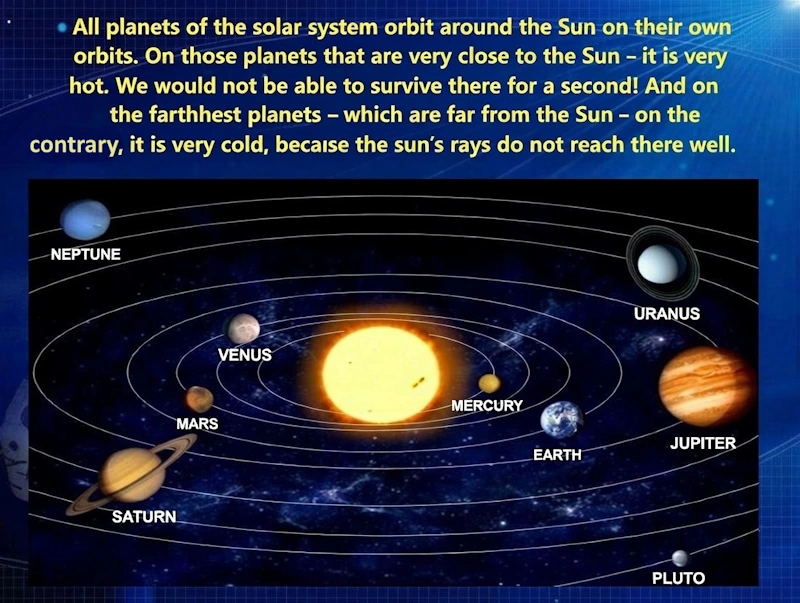
Imagine looking down at the Solar System from above the North Pole of the Sun. You would see that almost everything is spinning Counter-Clockwise.
- All planets are spinning around the Sun in exact same direction.
- This is called Direct or Prograde motion.
Why? Because the cloud of gas that formed the Solar System was spinning this way 4.5 billion years ago. We still carry that ancient momentum.
Rule #2: The Shape (Orbits)
Planets do not move in perfect circles. They move in Ellipses (slightly squashed circles). However, for most planets, the orbits are almost circular.
- The Invariable Plane: Most orbits lie flat on the same level, like marbles rolling on a dinner plate. Astronomers call this the “Invariable Plane of Laplace” or the Ecliptic.
- The Rule Breakers: The smaller the object, the more likely it is to break this rule. Mercury and Pluto have tilted orbits that stick up out of the “dinner plate” at sharp angles.
Part 3: Deep Dive Physics (Grades 10-12)
Now we enter the advanced mechanics. How do astronomers measure these orbits, and what are the mathematical laws governing them?
1. Eccentricity: Measuring the “Squash”
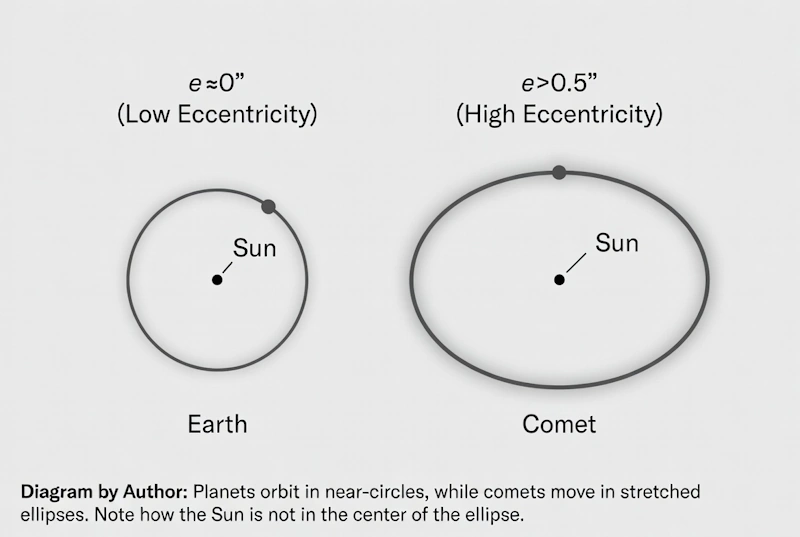
In geometry, an ellipse has two center points called “foci.” The Sun sits at one of these points.
The Eccentricity (e) is a number that tells us how stretched out the orbit is. It is the ratio of the distance between the foci to the length of the major axis.
- e = 0: A perfect circle
- 0 < e < 1: An ellipse (Planet)
- e = 1: A parabola (A comet escaping the system)
Real World Data:
- Venus (e = 0.007): almost a perfect circle
- Earth (e = 0.017): very circular
- Mercury (e = 0.21): highly stretched
- Asteroids: These lighter bodies often have high eccentricities (0.3–0.5), meaning their orbits are very oval-shaped
2. The Titius-Bode Law: A Cosmic Coincidence?
In the 18th century, astronomers noticed a spooky pattern in the math of the solar system. The distance of the planets from the Sun seemed to follow a geometric progression.
The formula is:
r = 0.4 + 0.3 × 2ⁿ
(Where r is the distance in Astronomical Units, and n is a sequence number)
Let’s test the math:
- n = 0: Venus (Matches)
- n = 1: Earth (Matches)
- n = 2: Mars (Matches)
- n = 4: Jupiter (Matches)
The Mystery of N=3
The formula predicted a planet should exist at position n=3, between Mars and Jupiter. When astronomers pointed their telescopes there, they didn’t find a big planet—they found Ceres and the Asteroid Belt.
The Breakdown: The law works perfectly until you get to Neptune and Pluto, where it fails completely. Today, scientists believe the Titius-Bode law wasn’t a strict physical law, but a mathematical coincidence resulting from orbital resonance during formation.
3. The Angular Momentum Problem
This is one of the classic problems in astrophysics.
Angular Momentum (L) is the “quantity of rotation.” For a small body orbiting a center, the formula is:
L = mvr
(mass × velocity × radius)
The Paradox:
According to the laws of mechanics, a spinning cloud that shrinks (like the early solar nebula) should spin faster. Since the Sun contains 99% of the system’s mass, it should hold 99% of the spin (angular momentum).
The Observation: The Sun rotates very slowly (once every 27 days). Its angular momentum constitutes under 2%. The Planets hold the other 98%.
The Question: How did the spin get transferred from the Sun to the planets?
Proposed Solutions:
- Tidal Friction: Could the planets dragging on the Sun slow it down?
Verdict: No. Calculations show this effect is too weak. - Magnetic Braking (The Leading Theory): The young Sun had a massive magnetic field. This field dragged through the surrounding gas cloud, acting like a brake and transferring the spin energy outward to the disk where planets were forming.
- The Jeans Hypothesis: Astronomer James Jeans proposed a star passed near the Sun and ripped material out to form planets.
Verdict: Disproven. This ignores the chemical composition of planets.
Part 4: Celestial Bodies that don’t follow the rules (Anomalies and Moons)
Not everything follows the rules. By studying the objects that misbehave, we learn about the violent history of our system.
The Backward Planets
While almost all planets spin in the Direct direction, two are different:
- Venus: Spins upside down (Retrograde). The sun rises in the West on Venus.
- Uranus: Spins on its side. Its axis is tilted 98 degrees, rolling like a ball along its orbit.
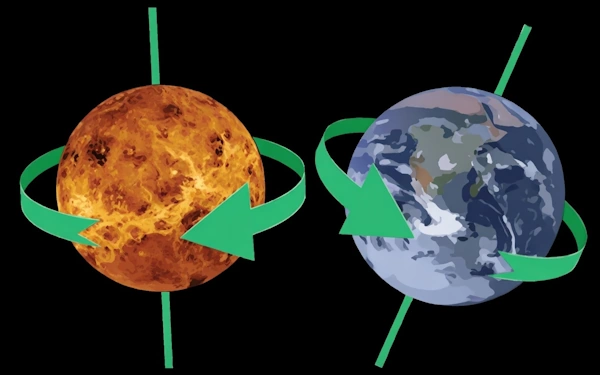
Theory: It is believed that massive proto-planets crashed into Venus and Uranus billions of years ago, knocking them over.
The Satellite (Moon) Systems
Moons tell us a lot about gravity.
Regular Satellites: These orbit close to the planet’s equator and move in the “correct” direction. These likely formed with the planet.
Irregular (Retrograde) Satellites: These orbit far away, at steep angles, or backwards.
- Jupiter: Ananke, Carme, Pasiphaë, Sinope
- Saturn: Phoebe
- Neptune: Triton
Teacher’s Note: The Capture Theory
Why do these moons orbit backwards? They weren’t born there! They were likely passing asteroids or Kuiper Belt objects that got caught by the giant planet’s gravity. Triton is the most famous example—a dwarf planet that got too close to Neptune and was captured.
Part 5: Is the Solar System Safe? (Stability)
With all these massive objects pulling on each other, is the system stable?
When planets orbit, they don’t just feel the Sun’s gravity; they feel the gravity of other planets. Jupiter pulls on Mars; Saturn pulls on Jupiter. These are called Perturbations.
The Stability Question:
Could these small tugs add up over time and throw Earth into the Sun?
- Unstable Equilibrium: Like a ball balancing on a mountain peak. One push and it falls.
- Stable Equilibrium: Similar to a ball resting at the bowl’s base. If you push it, it rocks back to the center.
The Verdict:
Mathematical models and geological history tell us the Solar System is Stable. Earth has maintained its distance from the Sun for 4.5 billion years. While the orbits “wobble” slightly (oscillate) over millions of years, there is no evidence that planets will fly out of the system or crash into the Sun. The system automatically corrects itself.
Part 6: Summary of Key Terms
- Orbit: The path of a body around a star
- Prograde Motion: Movement in the same direction as the Sun’s rotation (Counter-clockwise)
- Retrograde Motion: Movement in the opposite direction (Backwards)
- Eccentricity: A measure of how oval-shaped an orbit is
- Angular Momentum: The amount of rotational energy in a system
- Perturbation: When one planet’s gravity disturbs another planet’s orbit
🎓 Quiz: Orbital Mechanics
1. What is the “Invariable Plane” of the Solar System?
- A) The outer edge of the Oort Cloud
- B) The flat disk where most planets orbit (The Ecliptic)
- C) The magnetic field of the Sun
- D) The path taken by Halley’s Comet
👉 Click to check answer
Most planetary orbits are aligned on this plane, similar to a flat dinner plate.
2. According to the Titius-Bode Law, what was found at position n=3?
- A) The Planet Jupiter
- B) A Black Hole
- C) The Asteroid Belt
- D) The Dwarf Planet Pluto
👉 Click to check answer
The math predicted a planet between Mars and Jupiter, but astronomers found a ring of debris instead.
3. Why is the Sun’s slow rotation a problem for physicists?
- A) It causes the Sun to cool down too quickly
- B) The Angular Momentum Paradox
- C) It contradicts the Titius-Bode Law
- D) It makes the Earth orbit too fast
👉 Click to check answer
The Sun has 99% of the mass but less than 2% of the spin. Physics suggests it should spin much faster.
4. Which of these moons has a “Retrograde” (backward) orbit?
- A) The Moon (Earth)
- B) Io (Jupiter)
- C) Titan (Saturn)
- D) Triton (Neptune)
👉 Click to check answer
Triton orbits in the opposite direction of Neptune’s rotation, suggesting it was captured by gravity.
5. What does an eccentricity of e=0 mean?
- A) A perfect circle
- B) A highly stretched oval
- C) A parabola
- D) A straight line
👉 Click to check answer
Most planets have an eccentricity close to 0, while comets often have an eccentricity close to 1 (stretched).