Mercury — Closest to the Sun
The Ghost Planet in the Sun’s Glare
In our tour of the Solar System, we usually start closest to the fire. But looking for the first planet, Mercury, is like trying to find a firefly next to a spotlight. It is the fastest, smallest, and most elusive of the major planets.
For thousands of years, humans didn’t even know it was one planet. They thought it was two separate stars—one that appeared in the morning and one that appeared at night. It wasn’t until we understood the geometry of the solar system that we realized this wandering point of light was actually a world made of iron and rock, blasted by the Sun’s radiation.
In this lesson, we will explore why Copernicus supposedly never saw it, why it looks like our Moon on the outside but Earth on the inside, and the violent history that stripped away its outer layers.
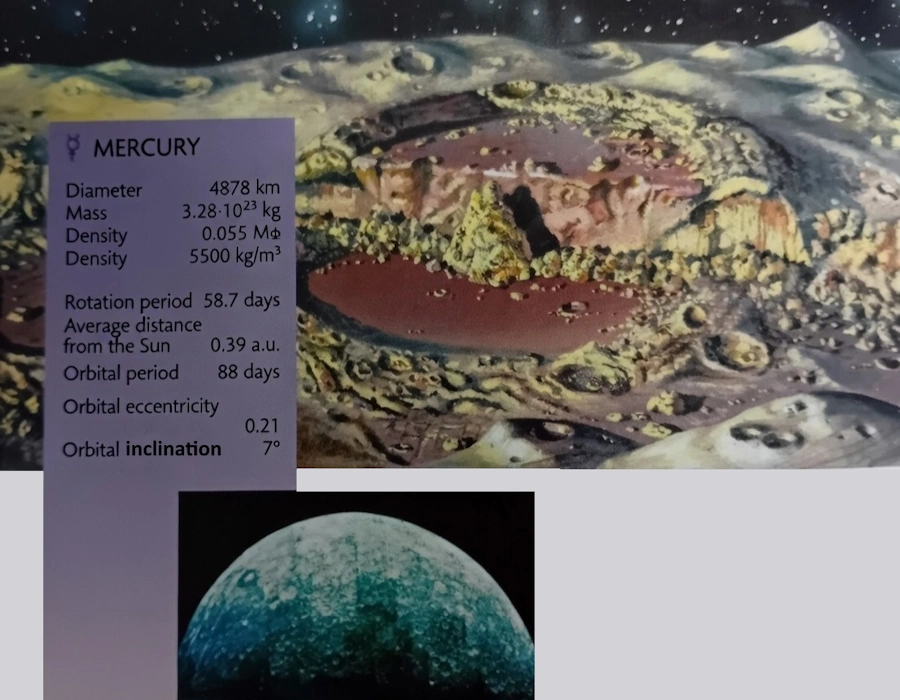
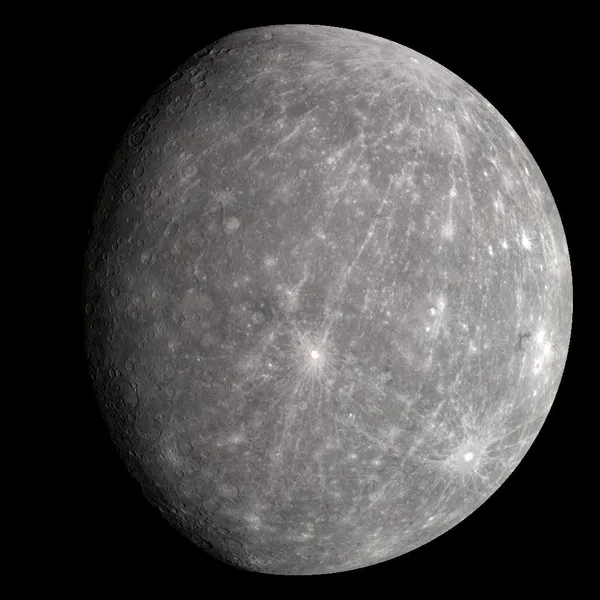
Experiment: Rotate the planet. Notice the heavy cratering. Can you find the smooth plains formed by ancient lava?
The Elusive Planet (Observation History)
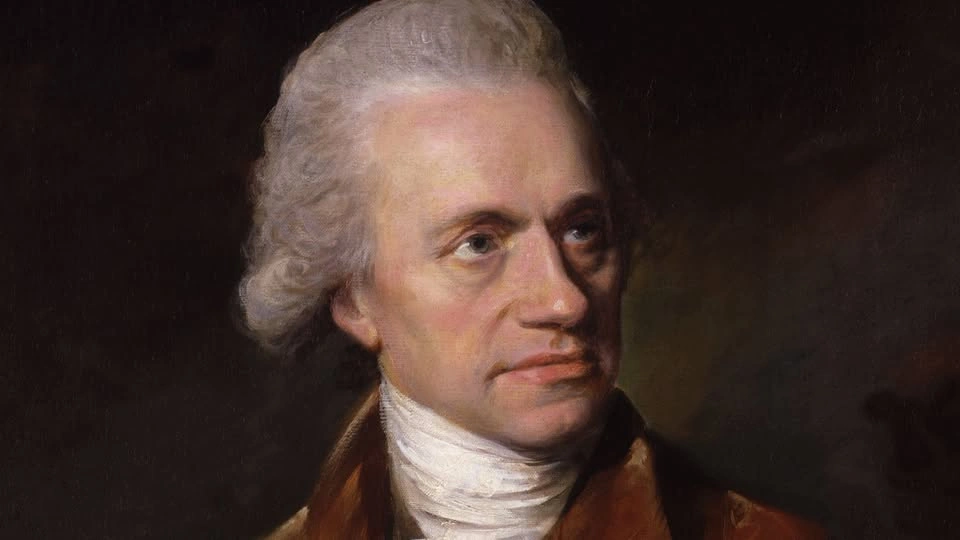
There exists a famous legend in astronomy that the great Nicolaus Copernicus—the man who figured out that the Earth orbits the Sun—never once saw Mercury throughout his entire life.
It seems impossible that the father of modern astronomy missed an entire planet, but there is truth to the story. Mercury constantly hides in the Sun’s rays. Because it orbits so close to the Sun, from our perspective on Earth, Mercury never strays far from the glare.
The “28 Degree” Problem
In astronomy, the distance between a planet and the Sun in the sky is called Elongation.
For Mercury, the maximum elongation is only 28°.
What this means: Mercury is like a shy child clinging to its mother’s leg. It never moves far enough away from the Sun for us to see it clearly in the middle of the night.
The Window of Opportunity: You can only see Mercury for about two hours before sunrise (Morning Star) or two hours after sunset (Evening Star).
In Copernicus’s immortal work “On the Revolutions of the Celestial Spheres,” not a single observation of this planet performed by him personally is provided. He relied on data from ancient astronomers like Ptolemy and his contemporaries B. Walther and J. Schöner.
However, historians note that Copernicus wrote about the difficulties of studying Mercury at the latitude of Kraków (Poland), remarking: “…nevertheless, it is possible to catch it too, if only one approaches this with somewhat greater cunning.”
This suggests he likely did spot it, but the data was too “messy” to include in his book compared to the clearer data from Southern Europe.
Teacher’s Note: Geography Matters
Why did Copernicus struggle in Poland? In northern latitudes (like Kraków or Sweden), the angle of the sun setting is shallow. This means the twilight lasts longer, keeping the sky bright and hiding faint objects like Mercury. In southern latitudes (like Southern Russia or Egypt), the sun sets vertically, creating darkness faster, making Mercury easier to spot.
Discovery and Names (Mythology vs. Science)
Mercury was most likely discovered by the most ancient pastoral tribes inhabiting the valleys of the Nile or the Tigris and Euphrates. However, because it appeared at two different times (morning and evening), ancient cultures assumed it was two different objects.
The Dual Identity:
- Egyptians: Called the morning star Set and the evening star Horus.
- Indians: Named it Buddha and Rohinaya.
- Greeks: Called it Apollo (morning) and Hermes (evening).
It was the Greek mathematician Pythagoras (famous for his triangle theorem) who first realized that Apollo and Hermes were actually the same object. Later, the Romans named it Mercury, after the messenger god with winged sandals, because it moved across the sky faster than any other planet.
The Phases of Mercury
Just like the Moon, Mercury goes through phases.
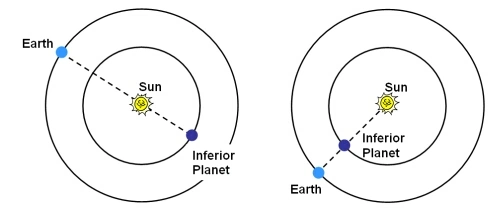
- Superior Conjunction: The point at which Mercury lies on the opposite side of the Sun from Earth. It appears as a full disk (a circle), but it is tiny and hidden in the Sun’s glare.
- Inferior Conjunction: The moment when Mercury moves directly between the Earth and the Sun. It is closest to us (largest size), but the dark side is facing Earth, making it invisible.
- The Crescent: Between these points, telescopes reveal a crescent shape. Unlike the Moon, the size of Mercury’s crescent changes dramatically because its distance from Earth varies by millions of kilometers as it zips around its orbit.
Mercury’s Physical Properties (A World of Extremes)
If you landed on Mercury, you would experience the most extreme weather in the Solar System. By the mid-20th century, astronomers suspected Mercury was a hostile world, but they were surprised by just how extreme it was.
The Albedo Effect (Reflectivity)
Mercury has a very low Albedo (0.07).
- Definition: Albedo is a measure of how much light a surface reflects.
- Context: Snow has an albedo of 0.9 (reflects 90%). Charcoal has an albedo of 0.04.
- The Finding: Mercury reflects only 7% of the light that hits it. This confirms it is a dark, dusty rock with no clouds and no atmosphere to scatter light.
The Temperature Paradox
Because it has no atmosphere (blanket) to trap heat or distribute it, Mercury is a world of fire and ice.
- Daytime: On the side facing the Sun, temperatures soar to +430°C (hot enough to melt lead).
- Nighttime: On the dark side, heat escapes instantly into space, dropping the temperature to -180°C.
This temperature swing is the largest of any planet.
Deep Dive (Grade 10-12): The Spin-Orbit Resonance
For a long time, scientists thought Mercury was “tidally locked” (keeping one face to the Sun forever), just like our Moon faces Earth.
Radar observations in the 1960s proved this wrong. Mercury is locked in a 3:2 Spin-Orbit Resonance.
It rotates on its axis 3 times for every 2 trips around the Sun.
This means a “Day” on Mercury (sunrise to sunrise) lasts 176 Earth days—longer than its year (88 days)!
The Moon’s Twin (Surface Features)
In 1974, the American spacecraft Mariner 10 performed a flyby of Mercury and transmitted the first close-up images to Earth. The photos shocked the scientific community.
“It looks just like the Moon!”
The surface was riddled with impact craters, gray dust, and ancient lava flows. However, there were key differences:
- Fewer “Maria”: The Moon has large dark patches (Maria) formed by lava. Mercury has fewer of these dark spots, suggesting its volcanic history was different.
- The “Scarps”: Mercury is covered in giant cliffs called Lobate Scarps. These formed because the planet is shrinking. As its massive iron core cooled, the planet contracted, causing the crust to wrinkle like a drying raisin.
The Theory of Impact Craters
Soviet astronomers Vsevolod Vladimirovich Fedynsky and Kirill Petrovich Stanyukovich theoretically predicted back in 1947 that impact craters should exist on all solar system bodies lacking an atmosphere.
Why? On Earth, wind and rain erase craters (Erosion). On Mercury (or the Moon/Phobos/Deimos), there is no wind or water. A crater formed 3 billion years ago looks exactly the same today as the day it was made.
The Caloris Basin
The most impressive feature on Mercury is the Caloris Basin.
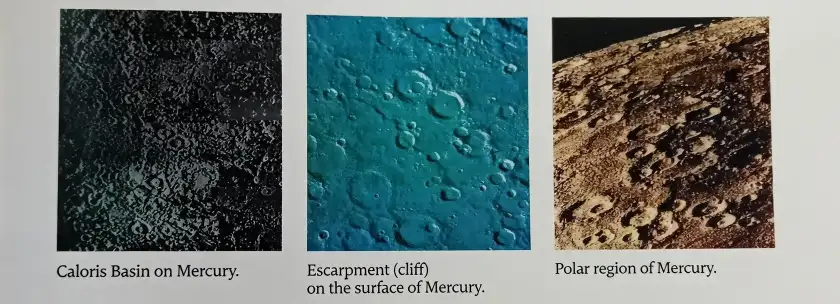
It is a massive impact scar 1,300 km wide (larger than the state of Texas).
- The Event: An asteroid roughly 100 km wide slammed into Mercury billions of years ago.
- The Shockwave: The impact was so powerful it sent shockwaves through the planet, creating “Weird Terrain” (jumbled hills) on the exact opposite side of the globe.
Internal Structure (The Iron Heart)
Here is where Mercury gets weird.
If you look at the outside, it resembles the Moon. But if you look at the inside (density), it resembles Earth.
- Moon Density: 3.3 g/cm³
- Earth Density: 5.5 g/cm³
- Mercury Density: 5.4 g/cm³
Despite being small, Mercury is incredibly heavy for its size. This implies that the planet is almost entirely made of metal.
The Core Anomaly
Models suggest Mercury has a gigantic Iron Core with a radius of 1,800 km.
The core makes up 75% of the planet’s radius. It accounts for 80% of the planet’s mass.
By comparison, Earth’s core is only about 17% of its volume.
Why is the core so big? (Three Theories)
- The Evaporation Theory: The early Sun was so hot it vaporized the outer rock layers of Mercury, leaving only the iron core.
- The Giant Impact Theory (Most Accepted): A massive proto-planet smashed into young Mercury, stripping away its lighter outer crust and mantle, leaving the heavy iron core behind. This is a “Hit and Run” cosmic accident.
- The Formation Theory: The solar nebula was drag-heavy near the Sun, causing heavy iron particles to settle there while lighter rocks drifted outward.
The Magnetic Field Surprise
The large core generates circular electric currents (the Dynamo Effect), which create a magnetic field. This was a surprise to scientists, as small planets usually cool down and stop generating magnetic fields (like Mars).
Mercury’s active magnetic field proves its core is still partially liquid.
Evolution of a Dead World
By studying the photographs, geologists have pieced together the life story of Mercury:
- Differentiation (4.5 Billion Years Ago): Mercury formed. Heavy iron sank to the center; lighter rock floated to the surface.
- The Great Bombardment (3.9 Billion Years Ago): The “Late Heavy Bombardment” era pummeled the solar system. Remnants of the pre-planetary swarm (planetesimals) smashed into Mercury, cracking the crust.
- The Caloris Impact: A massive object hit the planet, creating the Caloris Basin.
- Volcanism: Lava flowed up through the cracks, filling the craters and creating smooth plains (similar to the Moon).
- Contraction and Silence (3 Billion Years Ago – Present): The core cooled and shrank. The crust buckled, forming cliffs. Volcanism stopped. Today, Mercury is geologically dead, a silent witness to the early violence of the solar system.
Teacher’s Note: The “Water” Paradox
Even though Mercury is the hottest planet (during the day), radar scans from Earth and the MESSENGER probe found Water Ice at the poles!
How? Mercury has deep craters at its North and South poles that are in permanent shadow. The sunlight never hits the bottom of these craters. The temperature there stays at -170°C forever, preserving ancient ice delivered by comets.
Summary of Key Terms
Elongation: The angle between the Sun and a planet as seen from Earth.
Albedo: The proportion of incoming light that a surface reflects.
Transit: When Mercury passes directly in front of the Sun (visible from Earth).
Caloris Basin: The largest impact crater on Mercury.
Differentiation: The process of a planet separating into layers (Core, Mantle, Crust).
🎓 Quiz: The Mystery of Mercury
1. Why did ancient astronomers think Mercury was two different stars?
- A) It changed color
- B) It appeared only in the morning and evening
- C) It moved backwards
- D) It had a twin planet
👉 Click to check answer
Because it orbits close to the Sun, it is never visible in the middle of the night.
2. What makes Mercury’s internal structure unique compared to Earth?
- A) It has no core
- B) Its core is made of ice
- C) Its iron core is huge (80% of its mass)
- D) It is hollow
👉 Click to check answer
Mercury is essentially a giant ball of iron covered in a thin layer of rock.
3. What feature covers the surface of Mercury, caused by the planet shrinking?
- A) Canals
- B) Lobate Scarps (Cliffs)
- C) Oceans
- D) Sand Dunes
👉 Click to check answer
As the iron core cooled, the planet contracted, causing the crust to wrinkle.
4. Who was the first spacecraft to photograph Mercury’s surface in 1974?
- A) Apollo 11
- B) Voyager 1
- C) Mariner 10
- D) Hubble Telescope
👉 Click to check answer
It revealed a cratered world that looked remarkably like our Moon.
5. Why do craters on Mercury last for billions of years?
- A) The rock is harder than Earth rock
- B) There is no atmosphere to cause erosion
- C) The Sun repairs them
- D) Aliens maintain them
👉 Click to check answer
Without wind or rain (weather), geological features stay preserved forever.