Solar System
The Solar System
Explore how the Sun, eight planets, moons, and other celestial bodies form the Solar System, their orbits, temperatures, and unique features, plus…
Start lesson →Orbital Mechanics: How Planets Move and Why They Don’t Fall
The Solar System operates like precise clockwork, driven by gravity rather than gears. This lesson reveals why planets orbit stably without crashing…
Start lesson →Mercury — Closest to the Sun
Mercury, the Sun’s elusive “ghost planet,” hides in the star’s glare yet reveals a Moon-like surface, Earth-like interior, and some of the…
Start lesson →Venus — Earth’s Toxic Twin and the Ultimate Greenhouse
This lesson unveils Venus—the dazzling "Morning Star"—but reveals its brutal reality: crushing 90 atm pressure, sulfuric acid clouds, runaway greenhouse effect hotter…
Start lesson →Planet Earth: Structure, Heat and Evolution
This lesson explores Earth's layered structure—crust, mantle, lithosphere, asthenosphere, and dual core. It explains heat sources from radioactive decay and convection driving…
Start lesson →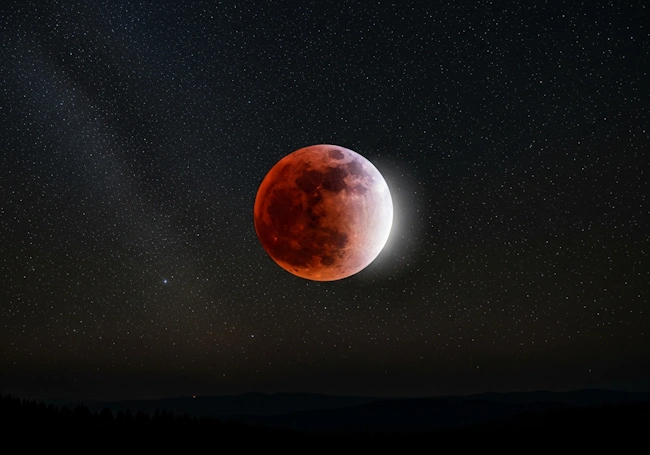 Article
Why the Moon Turns Red: A Guide to the Physics and History of Lunar Eclipses
Lunar eclipse key takeaways A lunar eclipse happens when the Earth passes between the Sun and the Moon, casting a shadow on…
Read article →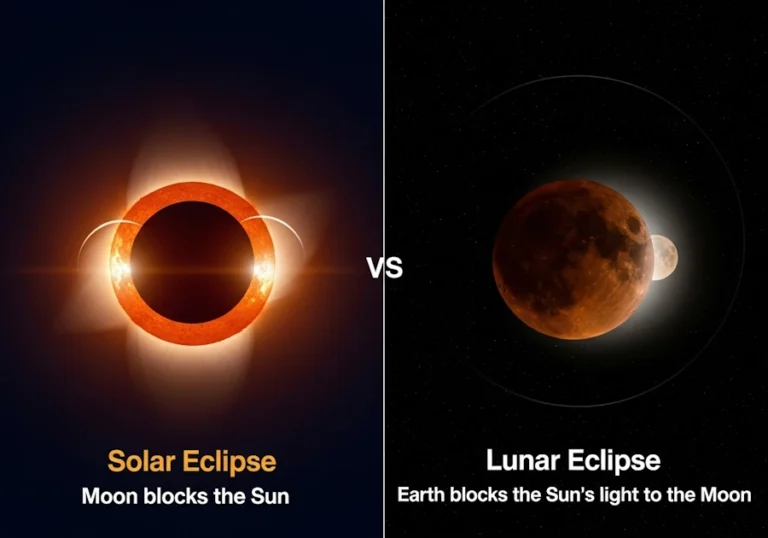 Article
Solar vs Lunar Eclipse: what is the difference?
Eclipses have profoundly influenced human understanding of the cosmos. Ancient civilizations used them to develop sophisticated calendars and predict celestial events. Solar…
Read article →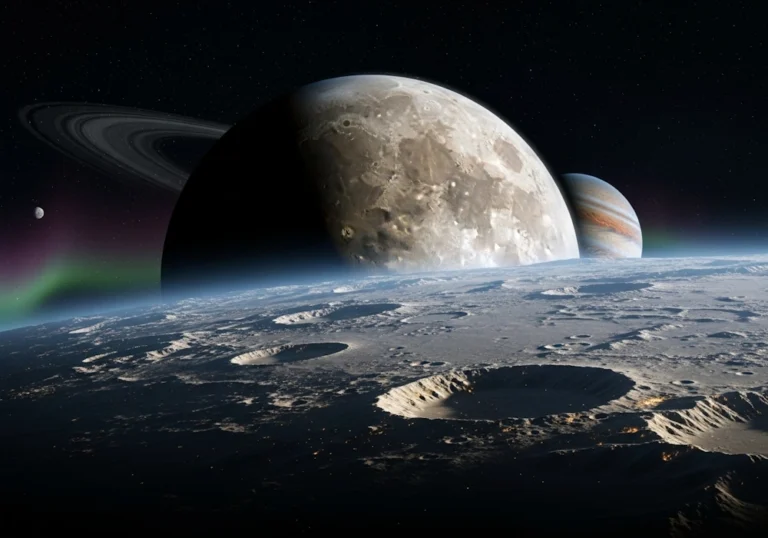 Article
Biggest moon in the Solar System: which one?
When we look up at the night sky, we often see Earth’s companion—the Moon. It glows brightly against the darkness, inspiring countless…
Read article →What Is the Solar System?
At its heart, the Solar System is our local family in space—a vast, spinning system centered around the Sun, the brilliant star that gives us light and life. Circling the Sun are:- Eight unique planets: Mercury, Venus, Earth, Mars, Jupiter, Saturn, Uranus, and Neptune
- Dwarf planets like Pluto
- Hundreds of moons
- Millions of asteroids and icy comets
History of Our Solar System Discovery
For thousands of years, people watched the skies and created myths and calendars around the wandering planets, calling them the "moving stars." Then came the revolution:- Copernicus and Galileo showed that Earth is just one planet orbiting the Sun.
- Robotic explorers have completely changed the picture. Spacecraft have landed on Mars, flown through Saturn's rings, visited asteroids, and even touched down on a comet.
- Modern missions keep revealing surprising secrets—from water on Mars to possible oceans beneath icy moons.
Why Learn About the Solar System?
Because this is our home address in the universe! Understanding the planets helps you see how special and fragile Earth truly is compared to its neighbors. Learning about the Solar System:- Sharpens your thinking and boosts your grasp of physics and chemistry in action.
- Sparks a deep sense of wonder and helps you notice connections everywhere—from seasons and weather to modern technology like solar panels and GPS.
- Inspires respect for our planet and fuels dreams of what lies beyond.
Solar System for Beginners: How to Start Exploring
The best part about exploring the Solar System is how easy and exciting it is to begin right now:- Spot planets with your eyes: On any clear evening, you can see Venus shining like a diamond or Jupiter glowing steadily.
- Use binoculars: Suddenly, Jupiter’s moons or Saturn’s rings come alive.
- Free apps: They turn your phone into a personal guide—just point it upward and watch the planets appear with their names and stories.
- Hands-on activities: Track the Moon’s phases in a journal, build simple backyard models, or join groups for special events like meteor showers.
What Can You Do If You Learn About the Solar System?
The possibilities are truly out of this world!- As a hobby: Capture breathtaking photos of planetary conjunctions, follow live Mars rover updates, or enjoy peaceful nights watching planets drift across the sky.
- Careers in planetary science: Help design the next spacecraft, study Mars geology, or search for signs of life on distant moons.
- Skills for life: Observation, critical thinking, and problem-solving become superpowers in engineering, environmental science, data analysis, and science communication.
Mind-Blowing Solar System Facts
Here are a few facts that never fail to spark imagination:- A single day on Venus lasts longer than its entire year.
- Jupiter’s Great Red Spot is a storm bigger than Earth that has raged for over 400 years.
- Saturn is so light it could float in a giant bathtub.
- There are more than 200 known moons—some with underground oceans that might hide life.