Planet Earth: Structure, Heat and Evolution
Introduction
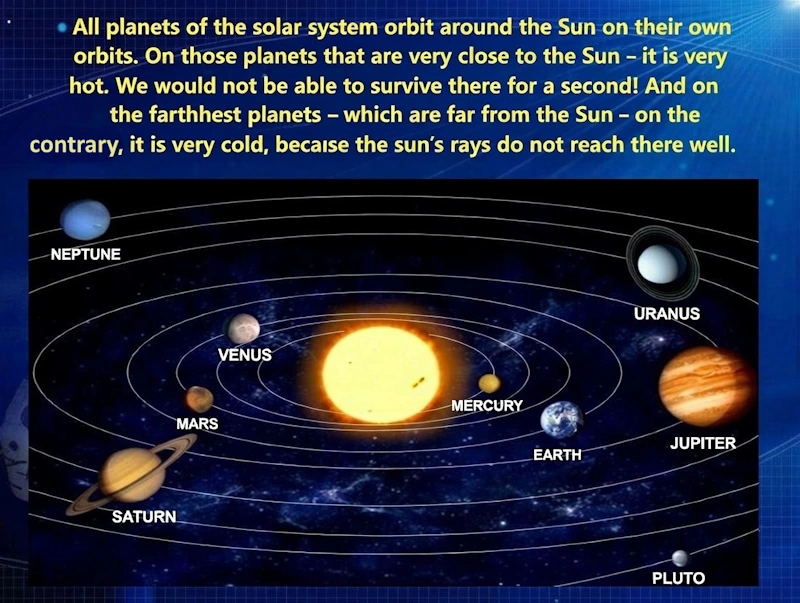
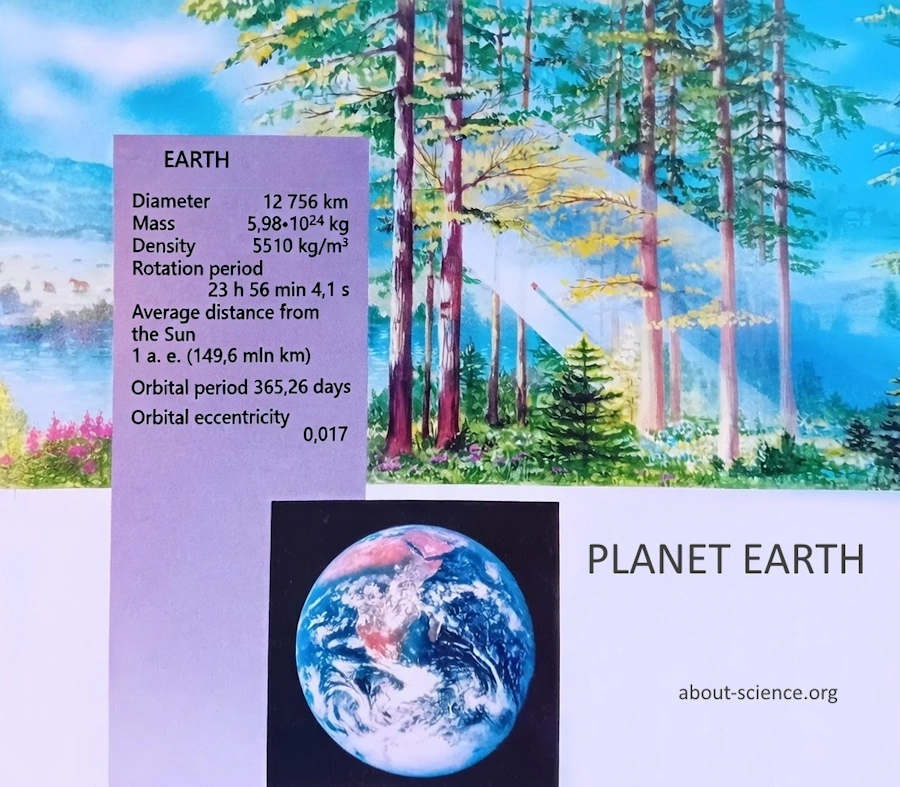
Earth as one of the planets of the Solar System appears unremarkable at first glance. It is neither the largest nor the smallest of the planets. It is not closer to the Sun than others, nor does it inhabit the periphery of the planetary system.
And yet Earth possesses one unique feature—there is life on it.
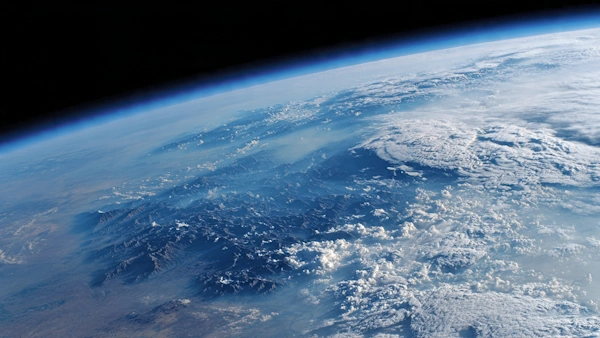
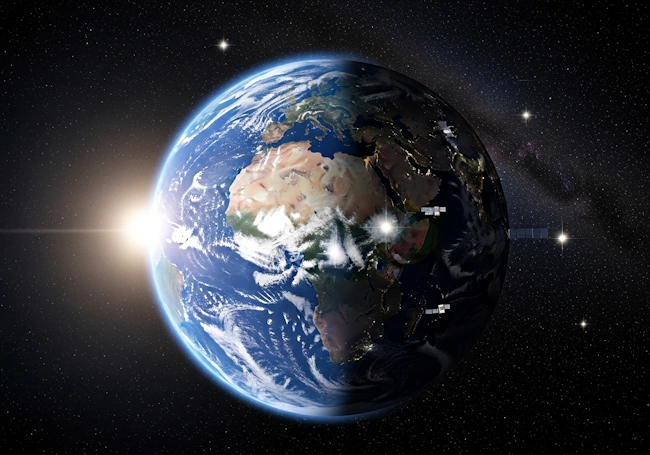
However, when looking at Earth from space, this is not noticeable. Clouds floating in the atmosphere are clearly visible. Through gaps in them, continents can be distinguished. The greater part of Earth, however, is covered by oceans.
The emergence of life, of living matter—the biosphere—on our planet was a consequence of its evolution. In turn, the biosphere has exerted significant influence on the entire further course of natural processes. Thus, were there no life on Earth, the chemical composition of its atmosphere would be completely different.
Undoubtedly, comprehensive study of Earth has enormous significance for humanity, but knowledge about it also serves as a kind of starting point in studying the other terrestrial planets.
[INTERACTIVE TOOL: THE EARTH SLICER]
Experiment: Drag the slider to slice the Earth in half. Identify the Crust, Mantle, Outer Core, and Inner Core. Compare the temperature at each layer.
Part 1: The Internal Structure of Earth
It is not simple to “look into” the depths of Earth. Even the deepest wells on land barely overcome the 10-kilometer mark, and underwater it is possible, having passed through the sedimentary cover, to penetrate the basalt foundation no more than 1.5 km.
However, another method has been found. Just as in medicine X-rays allow us to see a person’s internal organs, so in the study of a planet’s interior, seismic waves come to the rescue. The speed of seismic waves depends on the density and elastic properties of the rock formations through which they pass. Moreover, they reflect from the boundaries between layers of different types of rock and refract at these boundaries.
From recordings of Earth’s surface oscillations during earthquakes—seismograms—it was established that Earth’s interior consists of three main parts: the crust, the mantle, and the core.
Teacher’s Note: How Seismic Waves Work
Imagine shouting in a long hallway vs. shouting underwater. Sound travels differently depending on what it moves through.
-
P-Waves (Primary): These are fast pressure waves that push through solids and liquids.
-
S-Waves (Secondary): These are slower shearing waves. Crucially, S-waves cannot travel through liquid. When S-waves disappear deep inside the Earth, scientists know they have hit a liquid layer (the Outer Core).
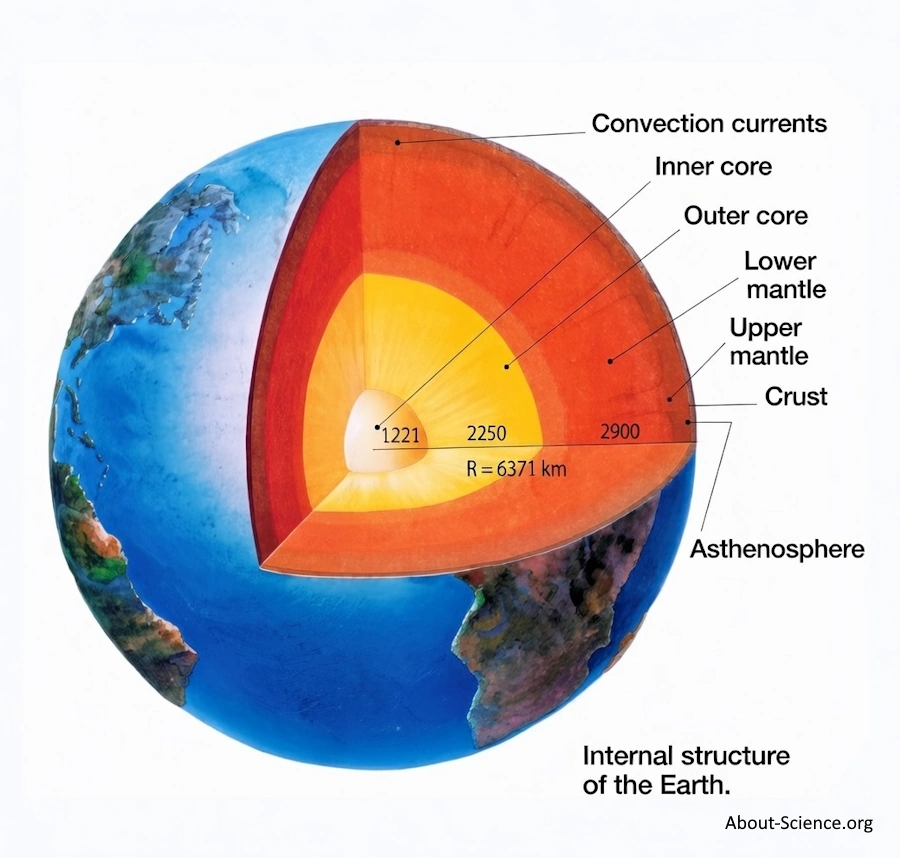
What do you see here? This image shows the internal structure of the Earth in a cross-section view. Even though we live on the surface, our planet is actually composed of several very different layers.
Starting from the center:
- The Inner Core is a solid ball made mostly of iron and nickel. Despite temperatures over 5000°C, it remains solid due to extreme pressure. Its radius is about 1221 km.
- Surrounding it is the Outer Core, which is liquid. This layer generates Earth’s magnetic field.
- Above the outer core is the Lower Mantle and Upper Mantle. Together, the mantle makes up most of Earth’s volume.
- The Asthenosphere, located in the upper mantle, is a soft, partially molten layer that allows tectonic plates to slowly move.
- Finally, the very thin Crust is the outermost layer – only 5 to 70 km thick – and this is where all life exists.
You can also see convection currents in the mantle. These are slow-moving currents of hot rock that transfer heat from the core to the surface and drive plate tectonics.
The Earth’s Crust and the Moho
The crust is separated from the mantle by a distinct boundary at which the velocities of seismic waves increase abruptly, which is caused by a sharp increase in the density of matter. This boundary is called the Mohorovičić discontinuity (otherwise known as the Moho surface or the M discontinuity) after the Serbian seismologist who discovered it in 1909.
The thickness of the crust is not constant; it varies from several kilometers in oceanic areas to several tens of kilometers in mountainous regions of continents. In the crudest models of Earth, the crust is represented as a uniform layer with a thickness of about 35 km. Below, to a depth of approximately 2,900 km, lies the mantle. It, like Earth’s crust, has a complex structure.
The Mystery of the Earth’s Dense Core
As early as the 19th century it became clear that Earth must have a dense core. Indeed, the density of the outer rocks of Earth’s crust is about 2,800 kg/m³ for granites and approximately 3,000 kg/m³ for basalts, while the average density of our planet is 5,500 kg/m³.
At the same time, there exist iron meteorites with an average density of 7,850 kg/m³, and an even more significant concentration of iron is possible. This served as the basis for the hypothesis of Earth’s iron core. And in the early 20th century, the first seismological evidence of its existence was obtained.
The boundary between the core and the mantle is the most distinct. It strongly reflects longitudinal (P) and transverse (S) seismic waves and refracts P-waves. Below this boundary, the velocity of P-waves drops sharply, while the density of matter increases: from 5,600 kg/m³ to 10,000 kg/m³.
Key Discovery: The core does not transmit S-waves at all. This means that the matter there is in a liquid state.
The Source of Magnetism
There is other evidence in favor of the hypothesis of the planet’s liquid iron core. Thus, the change in Earth’s magnetic field in space and intensity, discovered in 1905, led to the conclusion that it originates in the depths of the planet. There, relatively rapid movements can occur without causing catastrophic consequences.
The most probable source of such a field is a liquid iron (i.e., electrically conducting) core, where movements arise that operate by the mechanism of a self-exciting dynamo. In it there must exist current loops roughly resembling wire windings in an electromagnet, which generate various components of the geomagnetic field.
In the 1930s, seismologists established that Earth also has an inner, solid core. The modern value for the depth of the boundary between the inner and outer cores is approximately 5,150 km; the transition zone is quite thin—about 5 km.
Lithosphere and Asthenosphere
The boundary of Earth’s outer zone—the lithosphere—is located at a depth of about 70 km. The lithosphere includes both Earth’s crust and part of the upper mantle. This rigid layer is united into a single whole by its mechanical properties. The lithosphere is fractured into approximately ten large plates, at the boundaries of which the overwhelming majority of earthquakes occur.
Beneath the lithosphere, at depths from 70 to 250 km, there exists a layer of increased fluidity—the so-called asthenosphere of Earth. Rigid lithospheric plates float in the “asthenospheric ocean.”
In the asthenosphere, the temperature of mantle material approaches its melting temperature. The deeper, the higher the pressure and temperature. In Earth’s core, the pressure exceeds 3,600 kbar, and the temperature exceeds 6,000°C.
Part 2: The Thermal Energy of the Planet
Scientists have long suspected the high temperature of Earth’s interior. This was evidenced by both volcanic eruptions and the rise in temperature when descending into deep mines. On average, near Earth’s surface its increase amounts to 20°C per kilometer.
The thermal energy of Earth’s interior is released from the planet’s surface in the form of heat flow, which is measured by the amount of heat released per unit area per unit time. It was possible to measure Earth’s heat flow with sufficient accuracy only in the second half of the 20th century.
Radioactive Heating (Continental vs. Oceanic)
The continental Earth’s crust can conventionally be represented as a 15-kilometer layer of granite lying on a basalt layer of the same thickness. The concentration of radioactive isotopes, which serve as heat sources, in granites and basalts has been well studied. These are primarily radioactive potassium, uranium, and thorium.
It has been calculated that their decay releases approximately 130 J/(cm²·year). At the same time, the average heat flow that is annually dissipated from the surface equals 130–170 J/(cm²·year). Consequently, it is almost completely determined by heat release in the granite and basalt layers.
With the oceanic crust, everything is different. It is significantly thinner than the continental crust, and its foundation consists of a 5–6-kilometer basalt layer. The decay of radioactive elements contained in it yields only about 10 J/(cm²·year). However, when specialists measured the heat flow in the oceans in 1956, it turned out to be approximately the same as on the continents.
Mantle Convection
Today it has been established that the main part of the heat enters the oceanic crust through the lithospheric plate from the mantle. Mantle material is constantly in motion. The inequality of temperatures of different layers in it leads to active mixing of matter: colder and, consequently, denser material sinks, while hotter material rises. This is so-called thermal convection.
Teacher’s Note: The Soup Pot Analogy
Thermal Convection sounds complex, but you see it every time you cook soup. The soup at the bottom of the pot gets hot and rises to the top. The soup at the top cools down and sinks to the bottom. Inside the Earth, rock behaves like that thick soup—it just moves incredibly slowly (centimeters per year).
Most modern researchers point to three possible energy sources for maintaining thermal convection in the mantle:
-
The mantle still retains a large amount of heat accumulated during the planet’s formation period. This is sufficient for the surface heat flow to be maintained at its present level for a period several times exceeding Earth’s current age. In this case, the planet must be cooling, but its cooling occurs very slowly.
-
A certain amount of heat is apparently supplied to the mantle from the core.
-
The third source is the decay of radioactive elements (their content in the mantle is currently difficult to assess).
Part 3: The Evolution of Earth
The question of Earth’s early evolution is closely connected with the theory of its origin. Today it is known that our planet formed approximately 4.6 billion years ago.
Formation: The Heat of Impact
In the process of Earth’s formation from particles of the protoplanetary cloud, its mass gradually increased. The forces of gravity grew, and consequently, so did the velocities of particles falling onto the planet. The kinetic energy of the particles was converted into heat, and Earth heated up more and more intensely. During impacts, craters formed on it, and the matter ejected from them could no longer overcome Earth’s gravity and fell back.
The larger the falling bodies were, the more strongly they heated Earth. The impact energy was released not at the surface, but at a depth equal to approximately two diameters of the impacting body. And since the main mass at this stage was supplied to the planet by bodies several hundred kilometers in size, the energy was released in a layer with a thickness of about 1,000 km.
It did not have time to radiate into space, remaining in Earth’s interior. As a result, the temperature at depths of 100–1,000 km could approach the melting point. An additional temperature increase was probably caused by the decay of short-lived radioactive isotopes.
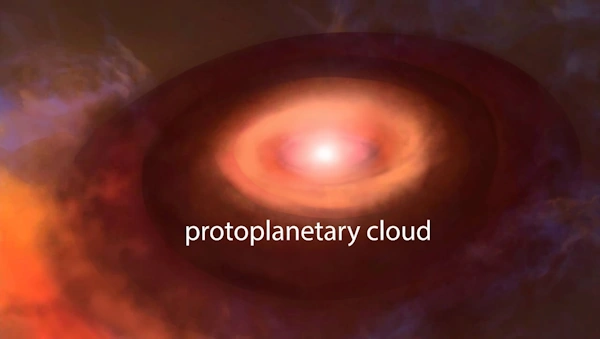
Let’s take a closer look at this fascinating image. This is an artistic depiction of a protoplanetary cloud, sometimes called a protoplanetary disk. Imagine a huge, spinning cloud of gas (mostly hydrogen and helium) and tiny dust particles surrounding a very young star, or protostar, right in the center—that’s the bright white spot you see glowing. These disks can be enormous, stretching hundreds of astronomical units across (one AU is the distance from Earth to the Sun).
Over millions of years, gravity causes the dust grains to clump together, forming larger rocks, then planetesimals, and eventually planets like the ones in our Solar System. This process explains why planets orbit in the same plane and direction around their star. Our own Sun and planets formed from a similar disk about 4.6 billion years ago!
Differentiation: The Iron Catastrophe
Apparently, the first melts that formed were a mixture of liquid iron, nickel, and sulfur. The melt accumulated and then, due to its higher density, seeped downward, gradually forming Earth’s core.
Thus, the differentiation (stratification) of Earth’s matter could have begun even at the stage of its formation. Impact processing of the surface and the convection that had begun undoubtedly hindered this process. But a certain portion of the heavier matter still managed to sink below the mixed layer. In turn, differentiation by density halted convection and was accompanied by additional heat release, accelerating the process of formation of various zones in Earth.
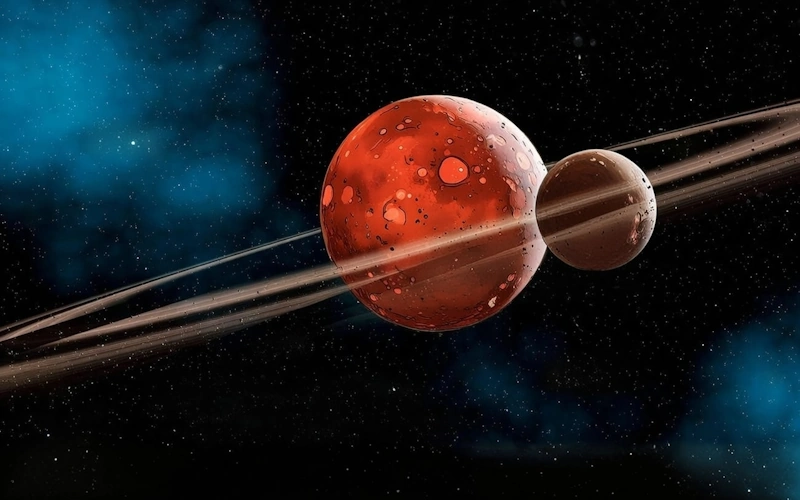
Presumably, the core formed over several hundred million years. During the planet’s gradual cooling, the nickel-rich iron-nickel alloy, having a high melting temperature, began to crystallize—thus the solid inner core was born. By the present time it constitutes 1.7% of Earth’s mass. The molten outer core concentrates about 30% of Earth’s mass.
The Great Bombardment and Atmosphere
The development of other shells continued much longer and in some respects has not ended to this day.
The lithosphere immediately after its formation had a small thickness and was very unstable. It was reabsorbed by the mantle, destroyed during the epoch of the so-called Great Bombardment (from 4.2 to 3.9 billion years ago), when Earth, like the Moon, was subjected to impacts from very large and quite numerous meteorites.
On the Moon, evidence of meteorite bombardment can still be seen today—numerous craters and maria (areas filled with erupted magma).
On our planet, active tectonic processes and the effects of the atmosphere and hydrosphere have practically erased the traces of this period.
About 3.8 billion years ago, the first light and, consequently, “unsinkable” granite crust formed. At that time the planet already had an atmosphere and oceans; the gases necessary for their formation were intensively supplied from Earth’s interior in the preceding period.
The atmosphere then consisted mainly of carbon dioxide, nitrogen, and water vapor. There was little oxygen in it, but it was produced as a result of, first, photochemical dissociation of water and, second, the photosynthesizing activity of simple organisms such as blue-green algae.
Pangaea and the Future
600 million years ago, there were several mobile continental plates on Earth, quite similar to modern ones. The new supercontinent Pangaea appeared significantly later. It existed 300–200 million years ago, and then broke apart into pieces that formed the present continents.
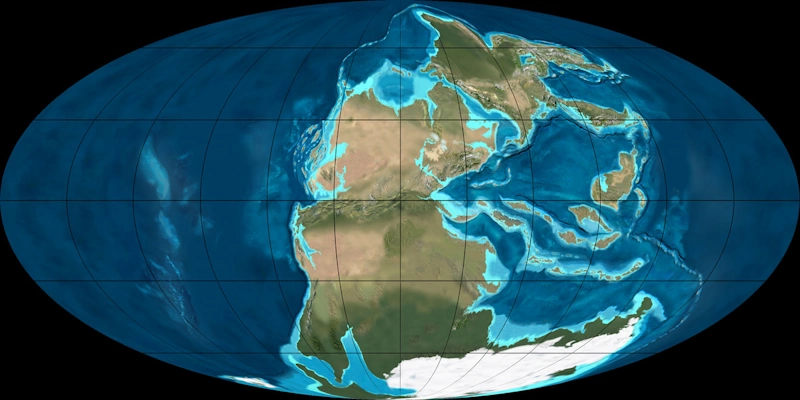
What awaits Earth in the future? This question can be answered only with a great degree of uncertainty, abstracting both from possible external, cosmic influence and from human activity transforming the environment, and not always for the better.
Eventually, Earth’s interior will cool to such a degree that convection in the mantle and, consequently, the movement of continents (and therefore mountain building, volcanic eruptions, earthquakes) will gradually weaken and cease. Weathering will in time erase the irregularities of Earth’s crust, and the planet’s surface will be hidden under water.
Its further fate will be determined by the average annual temperature. If it drops significantly, then the ocean will freeze and Earth will be covered with an icy crust. If, however, the temperature rises (and most likely this is precisely what the increasing luminosity of the Sun will lead to), then the water will evaporate, exposing the smooth surface of the planet. Obviously, in neither case will human life on Earth be possible any longer, at least in our modern conception of it.
🎓 Quiz: Journey to the Center of the Earth
code Code
1. How do scientists know the Outer Core is liquid?
- A) They drilled down and saw it
- B) S-waves (from earthquakes) cannot travel through it
- C) Volcanoes erupt liquid iron
- D) Magnetic scans proved it
👉 Click to check answer
Secondary seismic waves are stopped by liquids, creating a “shadow zone.”
2. What generates Earth’s Magnetic Field?
- A) The rotation of the solid Inner Core
- B) The movement of the liquid Outer Core
- C) Ocean currents
- D) Radioactive rocks in the crust
👉 Click to check answer
The swirling liquid metal creates a dynamo effect.
3. What is the “Asthenosphere”?
- A) The layer of air we breathe
- B) The solid iron center of the Earth
- C) The “gooey” layer of the mantle that plates slide on
- D) The boundary between crust and mantle
👉 Click to check answer
It allows the rigid lithospheric plates to move (Plate Tectonics).
4. Why is the Inner Core solid even though it is hotter than the sun?
- A) It is made of ice
- B) The pressure is too high for it to melt
- C) It cools down very fast
- D) It is made of rock, not metal
👉 Click to check answer
The atoms are squeezed so tightly they cannot flow as a liquid.
5. What is the main source of heat in the continental crust?
- A) Sunlight
- B) Friction from earthquakes
- C) Radioactive decay of Uranium and Potassium
- D) Forest fires
👉 Click to check answer
Granite rocks act like thermal blankets, releasing heat as isotopes decay.
Sources & References
Seismic Waves and Internal Structure
- Mohorovičić, A. (1910). “Das Dasiam-Gebirge und das Problem der Hvar-Insel.” Jahrbuch des Berg und Hüttenmuseums in Leoben. (Discovery of the Moho discontinuity.)
- Gutenberg, B. (1913). “Über die Konstitution des Erdinnern.” Zeitschrift für Geophysik. (Core-mantle boundary identification.)
- Lehman, I. (1936). “P’.” Bureau Central Seismologique International, Trav. Sci., 14. (Inner core discovery.)
Core, Mantle, and Lithosphere/Asthenosphere
- Dziewonski, A. M., & Anderson, D. L. (1981). “Preliminary reference Earth model.” Physics of the Earth and Planetary Interiors, 25(4), 297-356. (PREM model for layers, densities, and waves.)
- Romanowicz, B. (2010). “Imaging of the Earth’s deep interior.” Physics Today, 63(2), 28-33.
Heat Flow, Convection, and Radioactive Decay
- Pollack, H. N., Hurter, S. J., & Johnson, J. R. (1993). “Heat flow from the Earth’s interior: Analysis of the global data set.” Reviews of Geophysics, 31(3), 267-286. (Global heat flow measurements.)
- Jaupart, C., Labrosse, S., & Tait, S. (2007). “Temperatures, heat and energy in the mantle of the Earth.” Treatise on Geophysics, 7, 253-303. (Mantle convection and radiogenic heat.)
Formation, Differentiation, and Evolution
- Kleine, T., et al. (2009). “Hf-W chronology of the accretion and early evolution of asteroids and terrestrial planets.” Geochimica et Cosmochimica Acta, 73(1), 515-535. (Earth formation ~4.6 Ga.)
- Rubie, D. C., et al. (2011). “Heterogeneous accretion, composition and core-mantle differentiation of the Earth.” Earth and Planetary Science Letters, 301(1-2), 1-12. (Iron catastrophe and core formation.)
- Trail, D., et al. (2012). “The origin of water on Earth.” Science, 340(6132), 467-470. (Early atmosphere and oceans.)
Plate Tectonics and Future Evolution
- Morgan, W. J. (1968). “Rises, trenches, great faults, and crustal blocks.” Journal of Geophysical Research, 73(6), 1959-1982. (Lithosphere plates and asthenosphere.)
- Stern, R. J. (2004). “Subduction initiation: spontaneous and induced.” Earth and Planetary Science Letters, 226(3-4), 275-292.
Educational and Overview Resources
- USGS: “Understanding Earthquakes – The Science of Seismology.” (https://earthquake.usgs.gov/learn/)
- NASA Earth Observatory: “Earth’s Internal Heat.” (https://earthobservatory.nasa.gov/)