William Herschel and his amazing discoveries
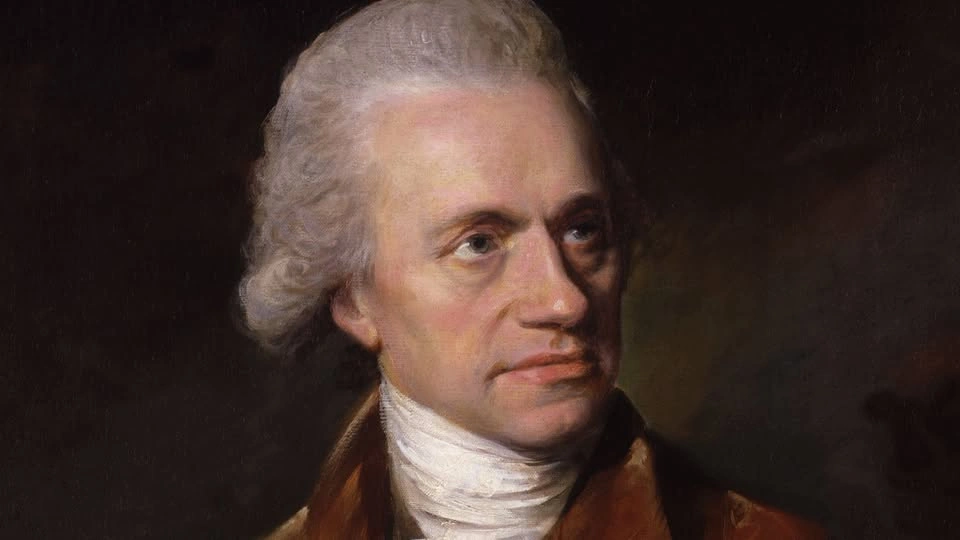
Willam Herschel was a pioneer in everything he did. As a designer of the first large reflecting telescopes and as an observer, he left his contemporaries far behind. He exerted an even greater influence on the history of astronomy as a deep thinker who reconstructed the general picture of the Universe from individual details. Based on his own observations, William Herschel established the general shape and made the first estimates of the size of our grandiose “stellar home” — the Galaxy.
He was also the first to venture with his telescopes into the boundless world of distant “milky” nebulae — other stellar universes.
Herschel doubled the size of the Solar System and “dislodged” the Sun, discovering its motion in cosmic space.
In observational astronomy, he was both a Columbus and a Magellan. And it all began with curiosity and a love for… music.
Early life
Friedrich Wilhelm (William) Herschel was born on November 15, 1738, in Hanover (Germany), into the family of a regimental musician of the Hanoverian Guards.
From the age of 15, he himself began playing the oboe in the same orchestra, and later played the violin and organ.
At 19, his life path changed abruptly. Fleeing from conscription, he fled to England with his mother’s secret blessing (Hanover was then subject to the English King), parting forever with his homeland.
After many hardships and privations, Herschel gained fame as a performing musician, composer, and music teacher in the seaside resort city of Bath, near Bristol. He seriously studied music theory. From there, his passion shifted to mathematics and optics, through which he became acquainted with astronomy.
Herschel was 35 years old — his life, it seemed, was settled. His talented younger sister Caroline, whom he had summoned to England, performed successfully with him at concerts.
But Herschel’s interest in the stars, the desire to see everything with his own eyes, and his energetic, active nature decided his future fate.
The beginner astronomer
In 1773, Herschel acquired a small reflecting telescope with a focal length of 2.5 feet (about 76 cm). Although observations with it did not satisfy him, there were no funds for a larger instrument.
Then, having bought up an optician’s entire stock of blanks and materials, Herschel set about making a telescope on his own.
Already in March 1774, Herschel observed the beautiful bright nebula in the constellation Orion using his first homemade Newtonian reflector telescope, 5.5 feet long (almost 2 m) with a primary mirror diameter of 20 cm.
Herschel’s days were henceforth filled with making mirrors, his evenings with music, and the night hours he devoted with ever-increasing passion to astronomical observations, which he managed to conduct even during concert intermissions.
His younger brother Alexander, a talented mechanic also summoned from Germany, helped him make telescopes.
His sister Caroline played an invaluable role in the scientist’s life and research. She performed the laborious processing of observation results and managed the household of their small family for 16 years.
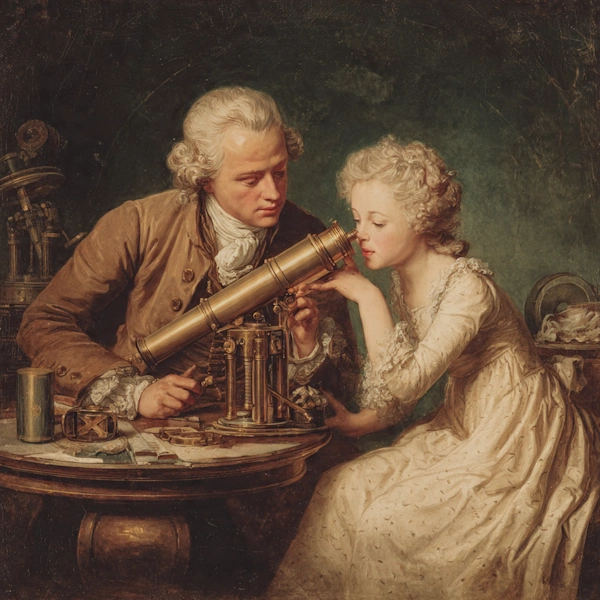
Caroline was driven to despair by the fact that the clean rooms of their house were turned into workshops, and the traditional lace cuffs on her brothers’ shirt sleeves were often hopelessly ruined during the grinding and polishing of mirrors. This multi-hour work, initially done by Herschel by hand, allowed for no breaks.
Later, he mechanized the grinding of long-focus mirrors, which were not spherical but parabolic and therefore required special precision in processing.
Building a telescope
Already in Bath, Herschel made hundreds of mirrors for 7-, 10-, and 20-foot reflectors. His main working instrument was a 20-foot (tube focal length about 7 m) Newtonian reflector with an objective diameter of almost half a meter. The pinnacle of telescope construction until the mid-19th century was the giant 40-foot reflector created by Herschel in 1787–1789, with a tube length of 12 m and a mirror diameter of 147 cm (weighing about 1 ton!). The maximum effective magnification on Herschel’s large telescopes was 2,500 and was used for special purposes — for observing double stars.
Herschel usually conducted his famous sky surveys with a magnification of 150–300. Observations required considerable endurance and courage, as they were conducted from a platform at a height of several meters above the ground.
Starting in 1775, he conducted four systematic surveys of the starry sky so as not to miss a single unknown object, with each survey taking several years. Caroline recorded everything seen by her brother under his dictation.
Acknowledgement and fame
During the second such survey, his musical career ended unexpectedly: on March 13, 1781, Herschel, for the first time since the priests of Babylon, discovered a planet — Uranus. The solar planetary system immediately more than doubled in size.
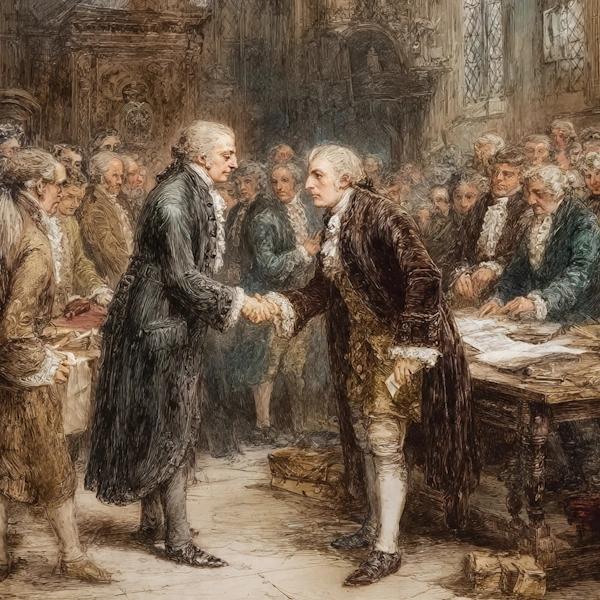
Herschel entered astronomy in triumph. The Gold Medal of the Royal Society of London, election as a fellow of this Society, the honorary and rare degree of Doctor of Oxford University for a foreigner, and the position of Court Astronomer with a life pension of 300 guineas were Herschel’s rewards in England.
But most importantly: he became a professional astronomer.
In 1782, Herschel moved to Old Windsor, and in 1786 he settled forever in Slough, 30 km from London (now within the city limits). It was Slough that the famous François Arago called the place on Earth where the greatest number of astronomical discoveries had been made.
More discoveries
In the Solar System, besides Uranus, Herschel discovered two of its satellites (1787), detecting their retrograde motion (1797), as well as two new satellites of Saturn (1789); quite accurately measured the rotation period of Saturn and its rings (1790); revealed seasonal changes in the size of the polar caps on Mars, which became the first impulse for speculations about Martians, and much more.
However, Herschel’s planetary studies were merely “incidental trivia” that he sometimes found by chance on the roadside of his main path — into the unexplored World of Stars.
Already in 1783, comparing the known proper motions of 13 stars in the vicinity of the Sun, Herschel discovered its motion in space and indicated its direction (apex) quite accurately towards the star Lambda Herculis.
Double stars
Even more important was the discovery of double and multiple stars. Beginning in 1778 with a mass census of all close pairs of stars visible in the sky, Herschel, just a quarter of a century later, on June 9, 1803, made a famous report to the Royal Society of London about his discovery of a real gravitational connection between the components of 50 pairs of stars.
His last work was a catalog of 145 physical double stars with a detailed study of their orbits (1822).
In total, Herschel discovered over 800 double and multiple stars.
He was also the first to attempt to bring clarity to the field of stellar photometry. Conducting systematic observations in this field from 1794, Herschel compiled six catalogs of relative stellar brightness in six years.
Solar activity
He was the first to introduce a reliable scale of stellar magnitudes (which differed slightly from the modern one) and measured the brightness of about 3,000 stars with an accuracy of 0.1 magnitude, the maximum for visual observations. As a result, he discovered several new variable stars.
Herschel knew how to see what completely escaped the field of view of his contemporaries. In 1804, he drew attention to the link between wheat prices (determined by its harvest) and solar radiation, which depended on the number of spots on its surface. This report, curious for those times, was published in Johann Bode’s Berliner Astronomisches Jahrbuch in 1808.
There were also misconceptions: like many at the time, Herschel was captivated by the idea of the plurality of inhabited worlds and admitted that even the Sun might be such a body — cold, surrounded only by a brightly glowing atmosphere, through the gaps of which a dark surface peeks out in the form of spots…
Discovery of star spectrum
In 1800, Herschel discovered that a thermometer placed outside the visible solar spectrum at its red end also heats up. Thus, heat rays, or infrared radiation, were discovered.
In stellar spectra, Herschel was the first to note the difference in the position of their brightness maximum, which is why some stars could be called blue, and others yellow or red.
This phenomenon, speaking of the difference in the surface temperatures of stars, later formed the basis of the first spectral classifications of stars.
Herschel’s Prism Experiment: Finding the Invisible Heat
Herschel's Infrared Experiment
Drag the thermometers into the light colors... and then try dragging one just to the right of the red band!
Galaxies
Herschel made his main contribution to the understanding of the general structure of the Universe.
The very first surveys of the sky with the 20-foot telescope revealed to him a colossal abundance of stars indistinguishable to the naked eye and the extreme unevenness of their apparent distribution across the sky.
Herschel’s telescope revealed the nature of even the most mysterious objects of the sky at that time — stationary “milky” nebulae.
These small misty patches hindered the main business of 18th-century observers — the search for new comets. The famous discoverer of new comets, Charles Messier, in 1781–1783 even published a special catalog of over a hundred such “nuisances” — “milky” spots, so that observers would not mistake them for new comets. What was Herschel’s surprise when, in his telescopes, many of Messier’s nebulae resolved into heaps of stars, seemingly confirming the theory of island universes of the English astronomer Thomas Wright (1711–1786).
Thus, the stellar Universe gradually revealed the complex structure of its organization.
Measuring distance between stars
The immense world that opened up before Herschel could no longer be studied in the old way, object by object.
To understand its structure, he created a statistical method of star gauges — “scoops”. He counted the number of stars in the field of view of the 20-foot telescope in different parts of the sky and, by their abundance, judged how far our stellar Universe extends in a given direction.
At the same time, Herschel consciously accepted the rough assumption of a uniform distribution of stars in space.
Having made more than a thousand such “scoops”, Herschel revealed the general shape of the Milky Way as a flattened system of stars and correctly estimated its oblateness at 1/5.
He discovered the isolation of our system in space, appearing for the first time as a stellar “island”. Even with Herschel’s very approximate assumptions, the size of our Galaxy turned out to be monstrously huge — 850 x 200 units — distances to Sirius, equal to 8 light-years (6800 x 1600 light-years) — and made a deep impression on his contemporaries.
Here, however, a catch awaited Herschel and all his followers right up to the 1930s. Observations of individual stars do not allow reaching the boundaries of the Galaxy, resulting in the impression of the central position of the observer himself, and therefore our Sun, within it. Harlow Shapley was the first to destroy this illusion.
Discovering conglomerate of galaxies
A year before that, Herschel made a discovery, the significance of which was understood only a century and a half later. In 1784, during a survey of nebulae from the Messier catalog, he became convinced that nebulae of a special kind also exist. Herschel discovered over 400 new, mostly much fainter, “milky” nebulae, “unresolvable” into stars even by his powerful telescope. In the sky, they were located extremely unevenly — in clusters, and these clusters and individual nebulae combined into long strips — strata.
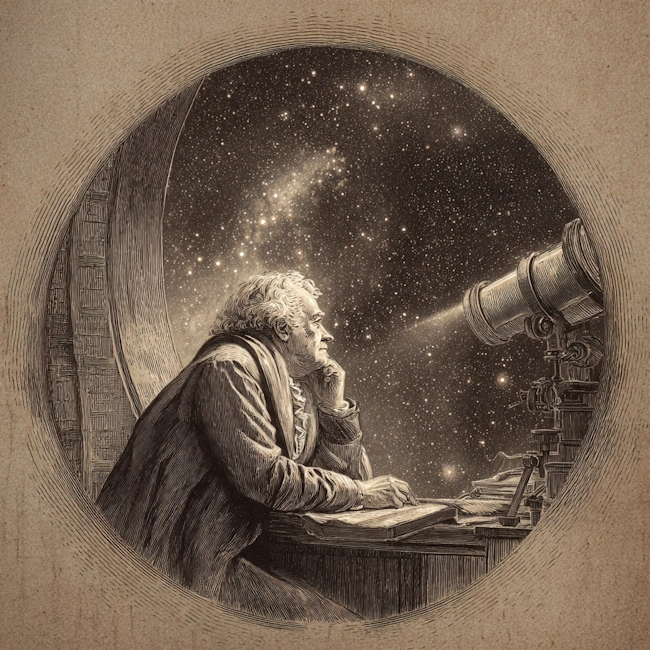
Herschel identified two strata of nebulae, and called the most noticeable of them the “Coma Berenices stratum”, since the part of the stratum richest in nebulae fell on this constellation and the neighboring constellation Virgo.
In addition, Herschel noted its continuation in some other northern constellations — Ursa Major, Leo — and pointed out that its location is perpendicular to the Milky Way.
He admitted that this stratum, like our Milky Way, might encompass the entire sky in a great circle ring, continuing into the southern hemisphere.
With brilliant insight, he saw in the tendency of nebulae to cluster and form strata the characteristic structural features of the observed Universe. Herschel compared these nebular strata to geological strata, in which the history of the Earth is, as it were, written.
Only in 1953 did the French astronomer Gérard de Vaucouleurs finally establish (apparently without even knowing about Herschel’s pioneering work) that the characteristic strata, consisting, as was already known by then, not of nebulae but of other galaxies, contain the equatorial part of a huge supersystem of tens of thousands of galaxies, one of which is ours.
Herschel can be called the discoverer of the large-scale structure of the Universe, which is now attracting so much attention from cosmologists.
Nebulae catalog
Herschel’s discoveries in the world of nebulae are truly inexhaustible. His three catalogs of new nebulae and star clusters (1786, 1789, and 1802) contained two and a half thousand of these objects, the majority of which, as it turned out, are galaxies.
Herschel discovered and described many forms of nebulae, including noting “cometary” nebulae, viewed in our days as an important stage in star birth.
He was the first to draw attention to the existence of double and multiple nebulae and presented them as real physical systems.
Gravity between giant objects
Thus, Herschel was the first to voice the idea of the evolution of cosmic matter under the influence of gravitational forces.
Since he managed to resolve some nebulae into stars, he considered all of them at that time to be distant stellar systems — “milky ways” — and therefore suggested, to avoid confusion, writing the name of our system with capital letters — the Milky Way.
Among the nearly 200 double and multiple nebulae noted by Herschel, about half turned out to be real multiple systems, and 19 (which Herschel saw with “bridges”) are now classified as so-called interacting galaxies.
The latter were rediscovered and examined only in the 20th century by Fritz Zwicky.
Herschel also expressed the important idea that a “clustering power” should arise in places of random increased spatial density of stars, making the further process of gravitational contraction irreversible. (These ideas were developed much later by James Jeans.)
Philosophy in astronomy
Herschel made an amazing discovery in 1791. By that time, among the huge variety of nebulae, he had singled out a special class — nebulae in the form of small disks with a completely uniform distribution of a faint greenish glow within them.
In appearance, they resembled Uranus and were named “planetary” by him. At first, Herschel considered them also to be stellar systems, and the most distant ones at that. But when in 1791 he discovered a similar object in Perseus (the now-known planetary nebula NGC 1514), where a bright point was located in the center of a pale disk, he made the correct conclusion: the matter around the bright center — an ordinary star — is not of a stellar, but of a diffuse nature. Herschel’s imagination was captivated by the vivid picture of how matter gathers towards the center by the forces of gravity, thus forming a central star. (In fact, as is known today, these nebulae are expanding.) Now Herschel could divide unresolvable “milky” nebulae into “true” and “false” (distant stellar systems).
The solution to the structure of planetary nebulae, however, led Herschel astray for a long time from the correct interpretation of “milky” nebulae in general, especially those with bright nuclei. He began to explain them as forming stars, and in the variety of forms he saw different stages of this process. Despite the erroneous explanation of specific objects, the idea itself played a major role in the development of evolutionary concepts about nature in general. In astronomy, the idea of the development of nature, first voiced in the works of Immanuel Kant, was strengthened thanks to Herschel even earlier than in biology, where its founder was Jean-Baptiste Lamarck (1809). Laplace corrected his cosmogonical hypothesis from edition to edition in accordance with Herschel’s discoveries.
Having put forward ideas that seemed bold in his time, such as the stratum-like distribution of nebulae, the evolution of cosmic matter, and the ongoing formation of stars from diffuse matter, Herschel proved himself to be a deeply thinking philosopher.
In the last years of his life, Herschel, observing with the 40-foot telescope, became convinced of the unattainability of the Galaxy’s boundaries. He also became convinced that not all milky nebulae are clumps of diffuse matter and that even the faintest of them, detected at the limit of visibility, could be other distant “milky ways”.
Herschel conducted observations every clear night for more than 30 years and only in 1807, after a serious illness, began to withdraw from them.
He passed away on August 23 (according to other sources — August 25), 1822.
William’s sister Caroline Lucretia Herschel (1750–1848) was a most famous female astronomer. She processed and, after her brother’s death, published Herschel’s catalog of 2,500 nebulae and star clusters. Caroline discovered 14 nebulae and 8 comets all by herself.
His son John Frederick William Herschel (1792–1871) was also a famous astronomer who continued the observations begun by his father. Frederick Herschel is also known as a member of the St. Petersburg Academy of Sciences.
William Herschel’s Major Astronomical Discoveries (1781–1802)
| Category | Discovery | Year | Significance / Notes |
|---|---|---|---|
| Planets | Uranus — First new planet discovered since antiquity | 1781 | Originally named “Georgium Sidus” after King George III; doubled the known size of the solar system |
| Moons of Uranus | Titania | 1787 | Largest moon of Uranus; discovered using his 20-foot telescope |
| Oberon | 1787 | Outermost major moon of Uranus | |
| Moons of Saturn | Mimas | 1789 | Innermost major moon of Saturn; discovered with his 40-foot telescope |
| Enceladus | 1789 | Brightest moon of Saturn; now known for geysers of water ice | |
| Deep Sky Objects | 2,400+ nebulae and star clusters | 1783–1802 | Systematic cataloging revolutionized observational cosmology; formed basis for the NGC catalog |
| First catalog of 1,000 nebulae | 1786 | Published in Philosophical Transactions; unprecedented statistical approach to mapping the universe | |
| Second catalog of 1,000 nebulae | 1789 | Continued systematic sky surveys with Caroline Herschel’s assistance | |
| Third catalog of 500 nebulae | 1802 | Final catalog; 8 additional objects published posthumously by his son John in 1847 | |
| Stellar Astronomy | ~800 double stars (binary systems) | 1779–1822 | Demonstrated that many double stars are physically bound systems orbiting a common center of gravity |
| Solar motion through space | 1783 | First to determine that the Sun moves toward the constellation Hercules | |
| Galactic Structure | First model of the Milky Way | 1784–1785 | “Disc Theory” — first statistical attempt to map our galaxy’s shape from stellar counts; called the “amoeba model” |
| Physics/Astronomy | Infrared radiation | 1800 | Discovered “calorific rays” beyond the red end of the spectrum using thermometers and prisms; revolutionized astrophysics |
| Solar System Studies | Confirmation of Sun’s gaseous nature | — | Observed sunspots and confirmed the Sun is a hot gas body rather than solid |
| Nomenclature | Coined the term “asteroid” | 1802 | Proposed the term for star-like objects (though not widely adopted until the 1850s) |
Most important to remember about William Herschel
Methodology: William Herschel revolutionized astronomy through systematic “sweeping” of the sky—methodically scanning strips of the sky using his large reflecting telescopes (18-inch to 48-inch mirrors) while his sister Caroline recorded observations from the base of the ladder.
Classification System: He developed an 8-class system for nebulae based on appearance (bright, faint, planetary, clusters, etc.), though this was later superseded by physical understanding.
Legacy: His catalogs formed the foundation for the New General Catalogue (NGC, 1888) by Dreyer, which remains the standard reference for deep-sky objects today. Over 4,600 of the 7,840 NGC objects were discovered by William and John Herschel.
Collaboration with Caroline: His sister Caroline Herschel was essential to his work, discovering 8 comets and 3 nebulae independently and organizing his catalogs into the comprehensive zone catalog still used by astronomers.
🎓 Quiz: The Musician Who Mapped the Stars
1. What was William Herschel’s profession before he became a famous astronomer?
- A) A Sailor
- B) A Musician and Composer
- C) A Blacksmith
- D) A Mathematician
👉 Click to check answer
He played the oboe, violin, and organ, and wrote music before turning his passion to the stars.
2. What major discovery did Herschel make in 1781 that doubled the size of the known Solar System?
- A) The planet Neptune
- B) The planet Uranus
- C) The Asteroid Belt
- D) Pluto
👉 Click to check answer
It was the first planet discovered since ancient times.
3. How did Herschel discover “Infrared” radiation?
- A) By looking at the sun through a smoked glass
- B) By placing a thermometer outside the red end of a rainbow spectrum
- C) By using a radio telescope
- D) By feeling the heat of a volcano
👉 Click to check answer
He noticed the temperature was highest in the dark area where no visible light existed.
4. Who was Herschel’s constant assistant and a famous astronomer in her own right?
- A) His wife Mary
- B) His daughter Maria
- C) His sister Caroline
- D) His mother Anna
👉 Click to check answer
She recorded his observations, discovered 8 comets herself, and published his catalogs.
5. What did Herschel realize about the “Milky Nebulae” in the sky?
- A) They were clouds of gas in our atmosphere
- B) They were distant “Island Universes” (Galaxies) made of stars
- C) They were reflections of the ocean
- D) They were cracks in the crystal sphere
👉 Click to check answer
His powerful telescopes resolved these blurry patches into millions of individual stars.
Sources & References
- Britannica (2026) William Herschel | Biography, Education, Telescopes, & Facts. Available at: https://www.britannica.com/biography/William-Herschel (Accessed: 26 February 2026).
- de Vaucouleurs, G. (1953) ‘The Coma Berenices stratum’, Annales d’Astrophysique, 16, pp. 267–278.
- Dreyer, J.L.E. (1888) New General Catalogue of Nebulae and Clusters of Stars. London: Royal Astronomical Society.
- Encyclopaedia for Children (1997) ‘William Herschel’, in Astronomy. Encyclopedia for children. Moscow: Avanta+. ISBN 5-89501-008-3.
- European Space Agency (2019) William Herschel. Available at: https://sci.esa.int/web/herschel/-/25805-william-herschel (Accessed: 26 February 2026).
- Herschel, W. (1786) ‘Catalogue of One Thousand New Nebulae and Clusters of Stars’, Philosophical Transactions of the Royal Society of London, 76, pp. 457–499.
- Herschel, W. (1803) ‘Account of the Changes that have happened, during the last Twenty-five Years, in the relative Situation of Double-stars’, Philosophical Transactions of the Royal Society of London, 93, pp. 365–382.
- Hoskin, M. (2011) Discoverers of the Universe: William and Caroline Herschel. Princeton: Princeton University Press.
- Wikipedia (2026) William Herschel. Available at: https://en.wikipedia.org/wiki/William_Herschel.