The Solar System
The Solar System is a planetary system that includes a central star — the Sun — and all natural cosmic objects orbiting around the Sun.
Between all celestial bodies in the Universe, there exist forces of mutual attraction. With these forces, the Sun holds planets and other celestial bodies around itself.
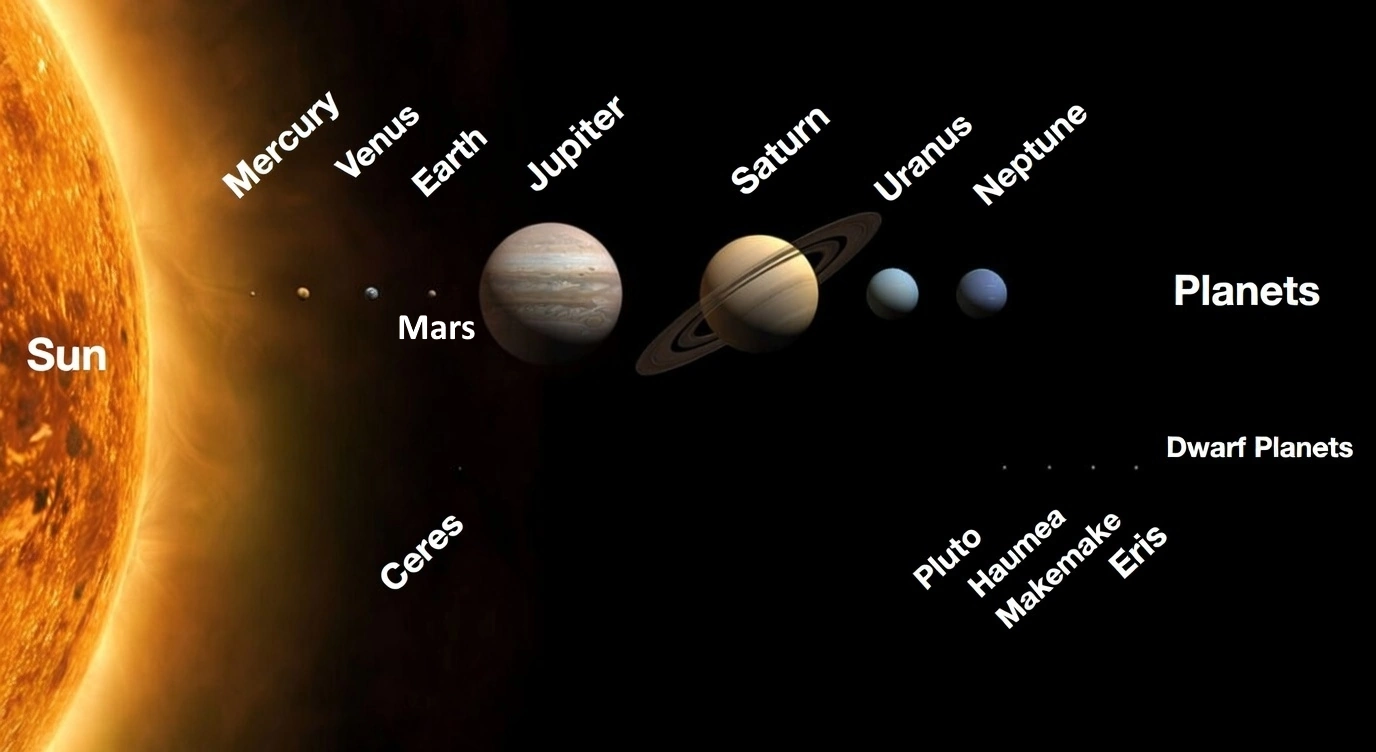
A planet (Greek πλανήτης — “wanderer”) is a celestial body that moves around a star, has significant mass, and a shape close to spherical.
Planets do not shine on their own, but only reflect light from the star. Planets rotate around their own axis and around the Sun.
An orbit (from Latin “orbita” — “track, road”) is the path of movement of planets around the Sun.
Orbits in shape are close to circles.
A satellite is a body of the Solar System smaller in size and orbiting around a planet.
The composition of the Solar System includes:
- The Sun;
- large planets — 8;
- satellites of planets — more than 60;
- small planets (asteroids), comets;
- interplanetary space, filled with tiny solid particles and rarefied gases.
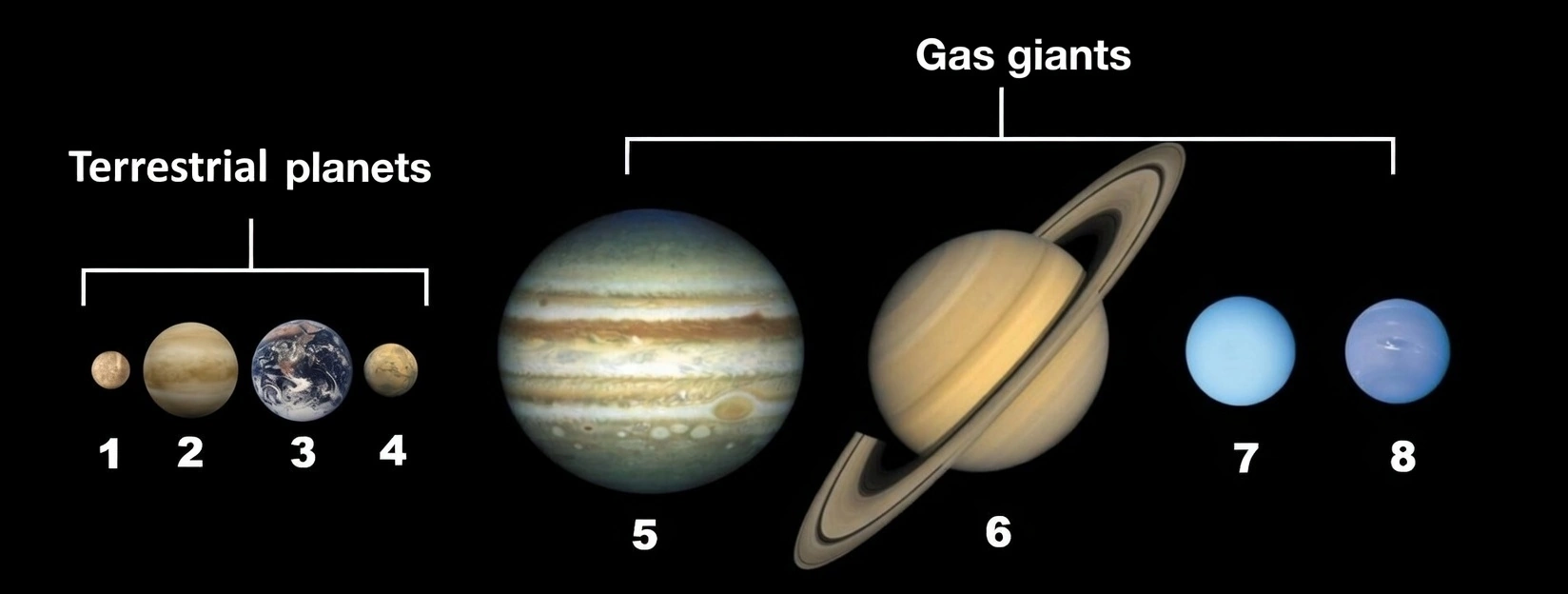
The planets of the Solar System are grouped:
🚀 Explore the Solar System in 3D
Rotate the planets, zoom in on moons, and see the true scale of our cosmic neighborhood.
Comparison of Planets
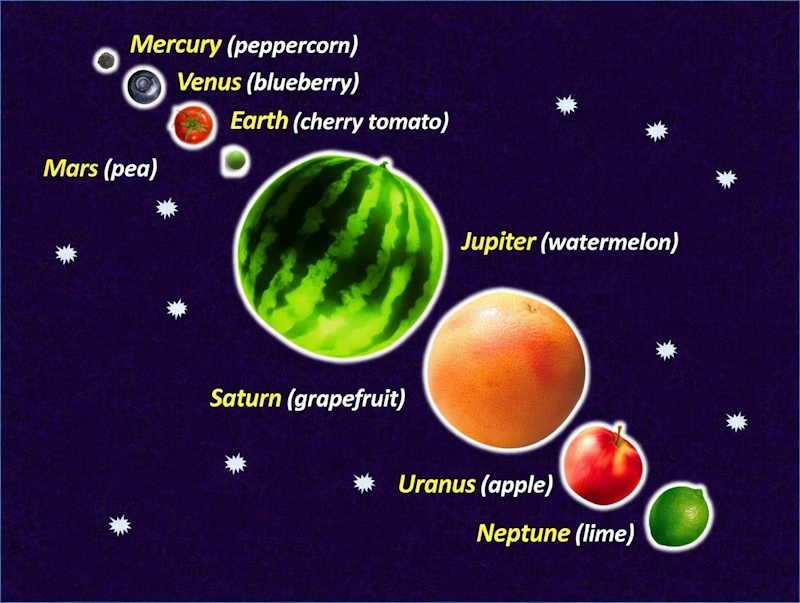
Common features of all planets:
- emerged simultaneously;
- move around the Sun in one direction along conventional lines — orbits;
- their orbits in shape are close to circles;
- all planets rotate around their axis;
- a planet has the shape of a sphere.
Terrestrial Planets
Terrestrial planets:
- are located closer to the Sun;
- consist of solid matter;
- have small sizes;
- slowly rotate around their axis.
Mercury
Closest to the Sun is Mercury. It is difficult to notice Mercury, as solar rays interfere with seeing it. Mercury has no atmosphere. The temperature of the planet’s surface changes greatly: from −170 °C at night to +430 °C during the day. Mercury has no satellites.
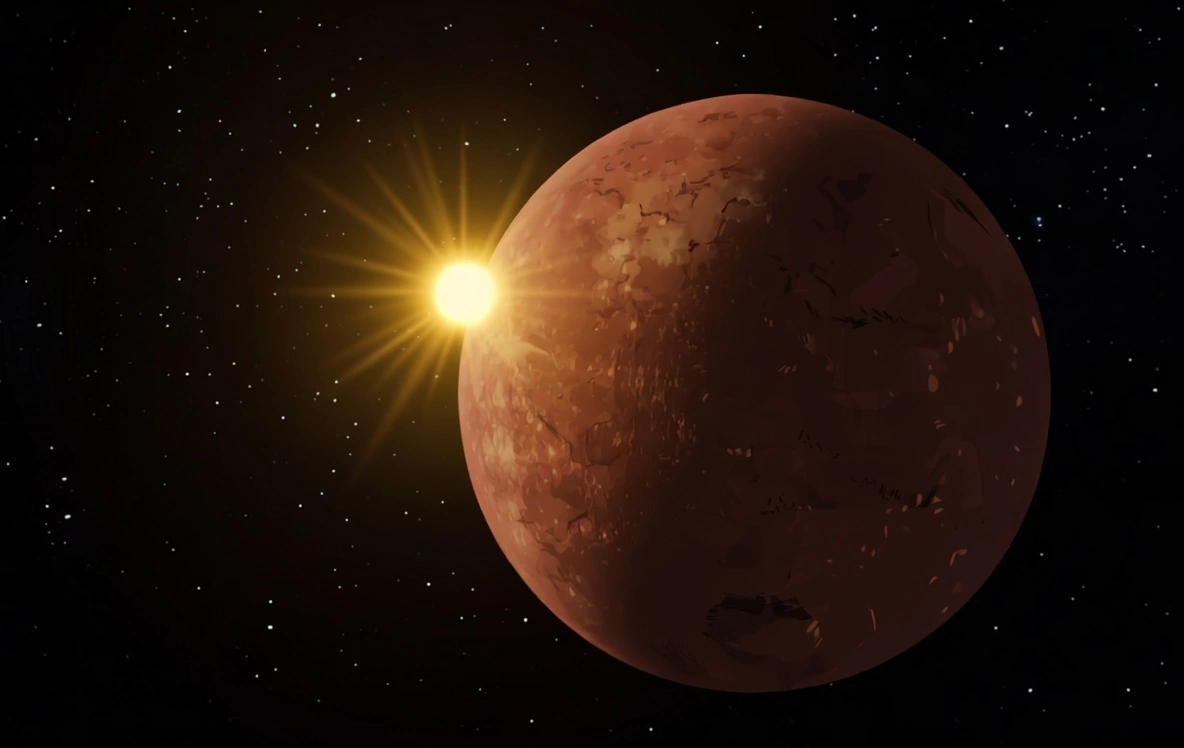
Mercury is much smaller than Earth; in size and mass it is similar to the Moon. The surface is the same as the lunar: many craters (up to 200 km in diameter) and mountains (up to 4000 m in height).
The diameter of Mercury is 4880 km. The distance from Mercury to the Sun is 58 million km. Mercury makes a complete revolution around the Sun in 88 Earth days. A day on the smallest planet of the terrestrial group equals 59 Earth days.
The planet received its name in honor of the god Mercury.
Mercury — in ancient Roman mythology, the god-patron of trade, son of the sky god Jupiter. His attributes include the caduceus staff, winged helmet and sandals, and also often a money pouch.
Venus
The second planet from the Sun in the Solar System is Venus. In size, Venus is similar to Earth, therefore it is called the “sister of planet Earth.”
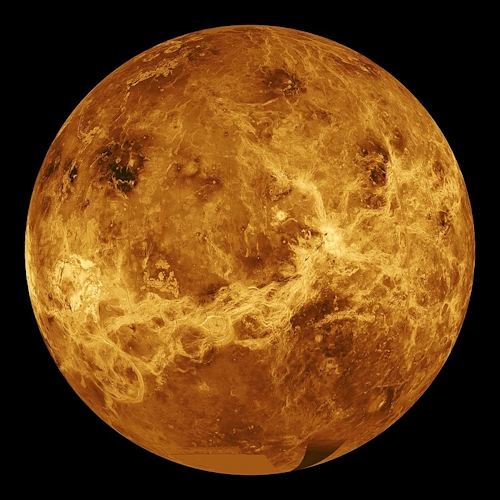
From our planet, the surface of Venus cannot be seen due to the dense atmosphere, which consists mainly of carbon dioxide. Very thick clouds let through little sunlight. The atmosphere retains heat, therefore the surface temperature of Venus is greater than that of Mercury; it reaches +470 °C throughout the day.
On the surface of Venus there are mountains and plains. The planet has no known satellites.
A year on Venus lasts 225 Earth days; the planet makes one rotation around its axis in approximately 243 Earth days. The diameter of Venus is 12,100 km, the average distance to the Sun is 108 million km.
The planet received its name in honor of the goddess Venus. Venus — in Roman mythology, the goddess of beauty, fertility, and prosperity.
Teacher’s Note: The Greenhouse Effect
What makes Venus hotter than Mercury, even though Mercury orbits closer to the Sun? Venus is wrapped in a thick blanket of clouds (CO2). Just like a car parked in the sun with the windows up, the heat gets trapped inside. This is called the Greenhouse Effect run wild!
Earth
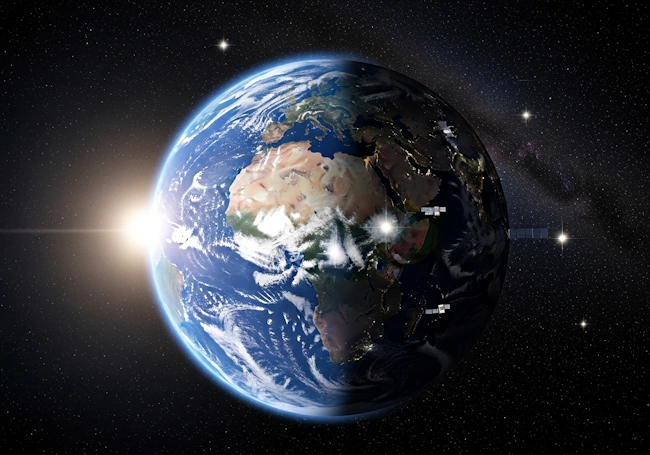
Earth is the third planet from the Sun. Fifth in size among all planets of the Solar System, first in diameter, mass, and density among planets of the terrestrial group.
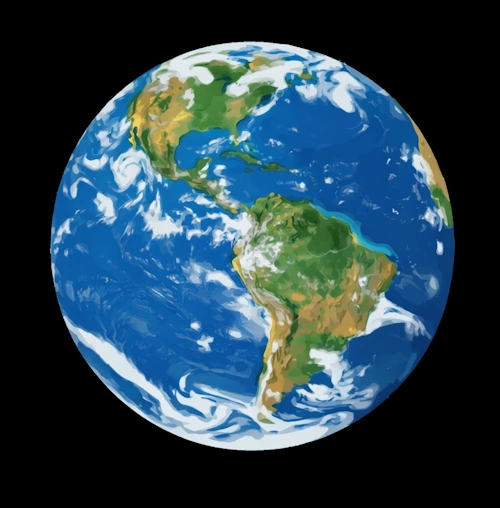
Earth’s atmosphere consists of gases necessary for life: nitrogen, oxygen, carbon dioxide, and others.
Earth has an enormous quantity of water (more than 70% of the planet’s surface). This distinguishes it from other planets.
A year on Earth constitutes 365 days. The distance from the planet to the Sun is about 150 million km. Earth’s diameter is 12,742 km.
Earth has one single satellite — the Moon.
Mars
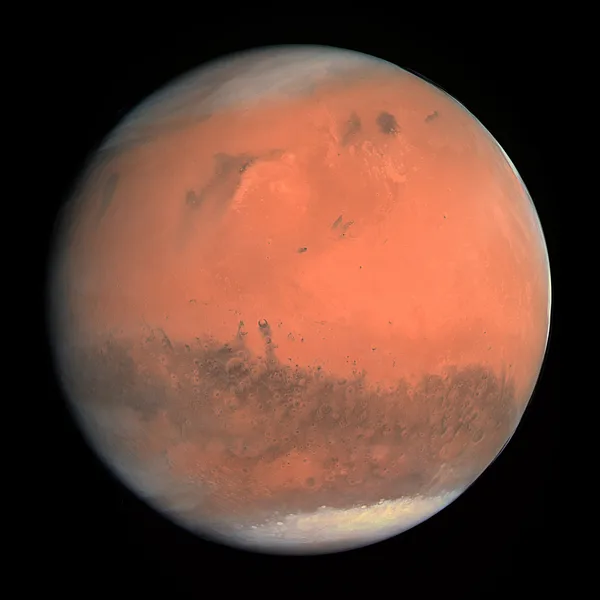
Mars is the fourth planet from the Sun. The surface of Mars can be observed with amateur telescopes. Mars is distinguished from other planets by its reddish-brown color. Images obtained from spacecraft indicate that the planet’s surface is a lifeless desert covered with sand and stones. The reddish color of Mars is explained by iron, with which the planet’s soil is very rich.
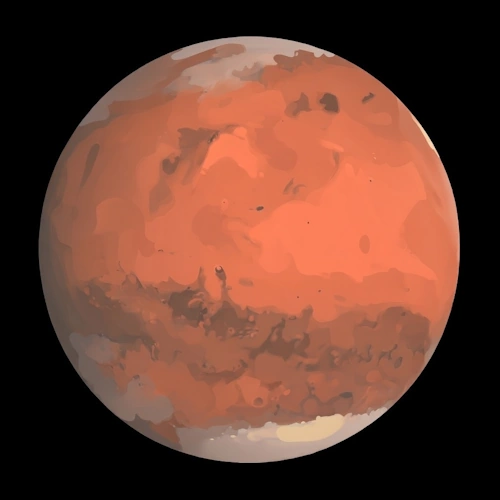
Earth is 2 times larger than Mars in diameter and 10 times larger in mass.
The temperature ranges from −130 °C to +15 °C, but there is still a water at Mars’ poles, but it is always frozen and kept as ice. Scientists believe that water previously existed on the planet, as dried-up riverbeds are visible on its surface.
Mars’s atmosphere is very rarefied; it consists mainly of carbon dioxide.
Phobos and Deimos
Mars has two satellites — Phobos (“Fear“) and Deimos (“Terror“).
A year on Mars lasts 687 Earth days; the planet makes a rotation around its axis in approximately 24 hours. The distance to the Sun is 228 million km, the planet’s diameter is 6,790 km.
Planet Mars got its name after Roman god of war.
Giant Planets
Giant planets:
- are located farther from the Sun;
- consist of substances in gaseous and liquid states;
- have large sizes;
- possess a large number of satellites;
- all of them have rings;
- rapidly rotate around their axis.
Jupiter
Jupiter is the most massive and largest planet in the entire Solar System. Jupiter’s mass is 318 times greater than Earth’s mass. The white stripes on Jupiter are long layers of clouds that encircle the planet.
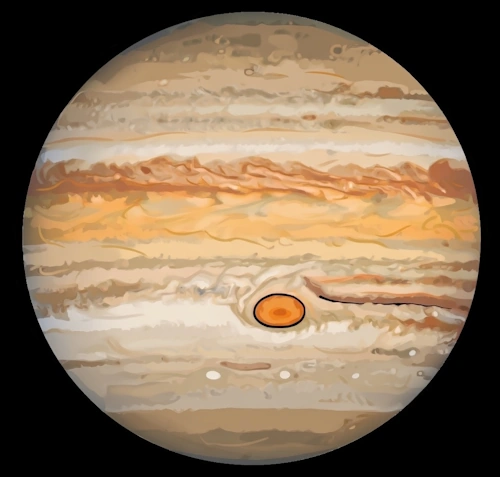
The Great Red Spot is a vortex on Jupiter. It was discovered back in 1665. Scientists believe this is an enormous anticyclone that constantly rotates in the upper layers of Jupiter’s atmosphere. The Spot has changed in size and color over time, moved in different directions, and sometimes even disappeared completely.
Fun Fact: The Vacuum Cleaner
Jupiter is so massive that its gravity acts like a giant shield. It pulls in asteroids and comets that might otherwise hit Earth. It is the solar system’s vacuum cleaner!
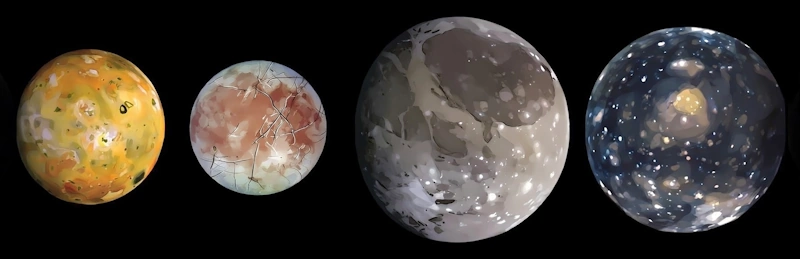
The planet’s ring is narrow and consists of fine dust particles. Jupiter has the most satellites — 69. The largest among the satellites of all other planets of the Solar System is Ganymede.
The Galilean satellites of Jupiter are the 4 largest satellites discovered by Galileo Galilei in 1610. From left to right, in order of distance from Jupiter: Io, Europa, Ganymede, Callisto.
Jupiter’s diameter is 140 thousand km. A year on the planet lasts about 12 Earth years; Jupiter rotates around its axis in less than 10 hours. The average distance to the Sun is 778 million km. To reach Jupiter on a spacecraft would take almost 2 years.
The planet is named in honor of the chief Roman god Jupiter.
Jupiter — in ancient Roman mythology, the god of the sky, daylight, and thunderstorms, father of the gods, supreme deity of the Romans.
Saturn
Saturn is an unusual planet surrounded by beautiful rings, which are formed by a system of thin rings. According to scientists, the rings consist of ice.
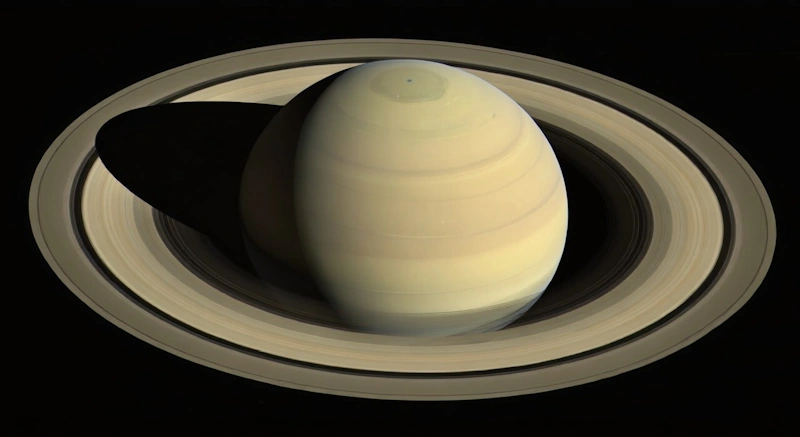
The atmosphere temperature is −214 °C. The planet’s diameter is 120 thousand km. A year on the planet equals almost 30 Earth years, and the duration of a day is the same as on Jupiter. The planet lies about 1,427 million km away from the Sun.
Saturn has 62 known natural satellites with confirmed orbits. Most satellites have small sizes and consist of rocky material and ice. The largest of the satellites is Titan.
Saturn — one of the most ancient Roman gods of earth and sowing.
Did you know?
Saturn is huge, but it is very “fluffy.” Its density is so low that if you could find a bathtub big enough, Saturn would float in water!
Uranus
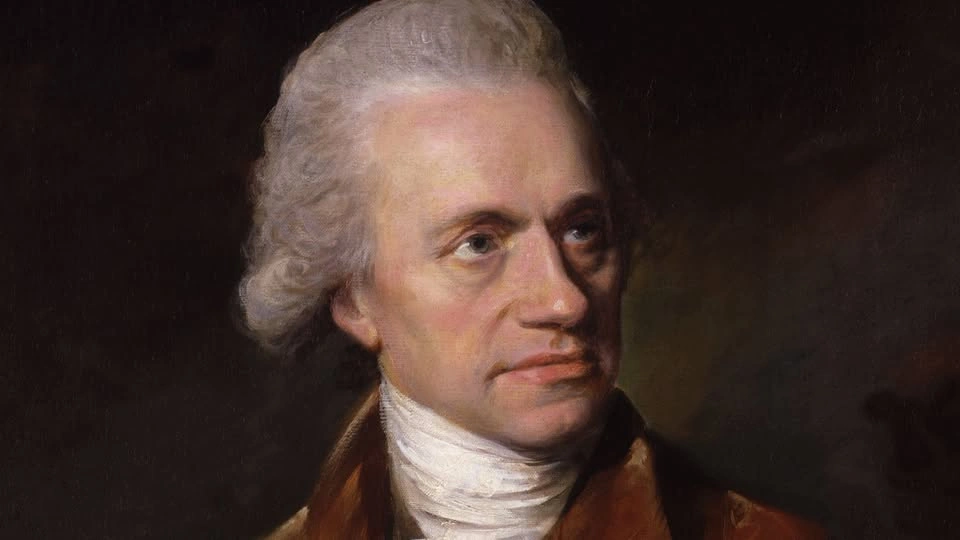
Uranus is the seventh planet of the Solar System in distance from the Sun, third in diameter and fourth in mass. Uranus is the first planet discovered with the help of a telescope. This was done in 1781 by the English astronomer William Herschel. The planet is named in honor of the Greek god of the sky, Uranus.
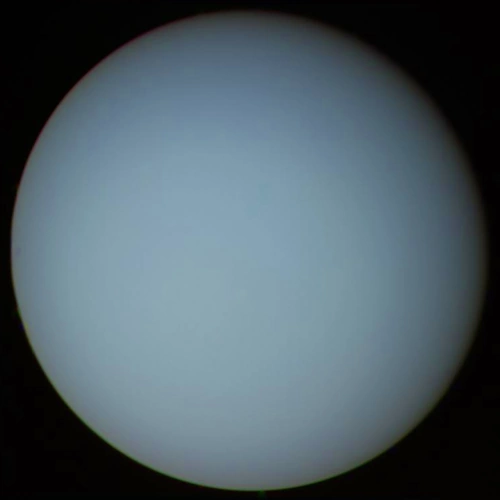
Uranus — in ancient Greek mythology, the personification of the sky, husband of Gaea (earth), belongs to the oldest generation of gods.
Uranus is a greenish-colored planet. Its rings consist of fine dust and solid dark particles. The temperature is −217 °C.
Uranus’s diameter is 51 thousand km. Revolution time around the Sun is 84 Earth years, around its axis — about 17 hours. The distance from Uranus to the Sun equals 2,871 million km.
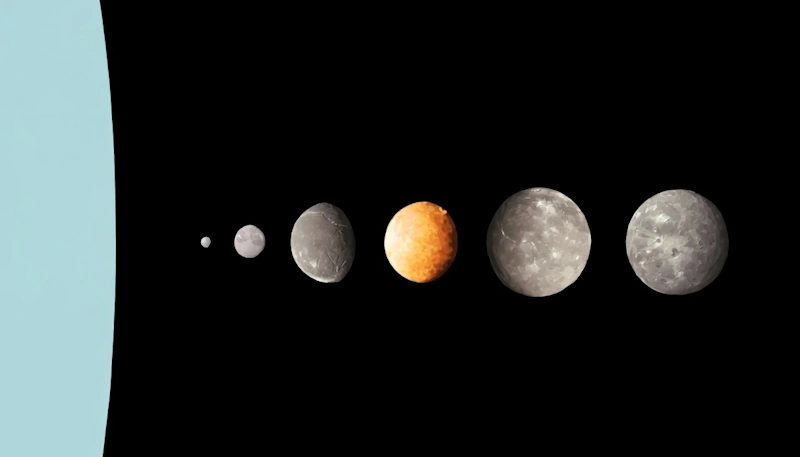
In the Uranus system, 27 natural satellites have been discovered. Names for them were chosen from the names of characters from the works of William Shakespeare and Alexander Pope. Five main, largest satellites can be distinguished — Miranda, Ariel, Umbriel, Titania, and Oberon.
Neptune
Neptune is the eighth planet of the Solar System, fourth in diameter and third in mass. Neptune became the first planet discovered through mathematical calculations rather than through regular observations, and only later, in 1846, was it possible to detect it with a telescope.
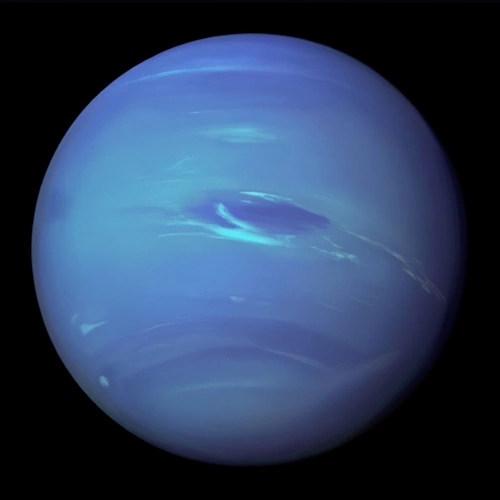
The atmosphere temperature is −214 °C. The planet’s diameter is 49.5 thousand km. The distance to the Sun is 4,497 million km. Revolution time around the Sun constitutes almost 165 Earth years, around its axis — about 16 hours.
Currently there are 14 satellites of Neptune. Neptune’s largest satellite, Triton, was discovered by the English astronomer William Lassell in 1846, only 17 days after the discovery of the planet.
The planet was named in honor of the Roman god of the seas. Its astronomical sign depicts a stylized form of Neptune’s trident.
Where is Pluto?
You might notice Pluto is missing. Scientists downgraded Pluto to dwarf planet status in 2006. It is still there, and we love it, but it is too small to clear its own orbit of debris, so it lost its “Planet” status.
The Moon
The Moon is Earth’s natural satellite. The closest satellite to the Sun of any planet, since the planets closest to the Sun, Mercury and Venus, have no satellites. The second brightest object in Earth’s sky after the Sun and the fifth largest natural satellite of a planet in the Solar System. The first astronomical object beyond Earth on which humans have landed.
Characteristics of the Moon
| Characteristic | Value |
|---|---|
| Mass | 0.0123 of Earth’s mass (7.35×10²² kg) |
| Diameter at the equator | 0.273 of Earth’s diameter (3,476 km) |
| Axial tilt | 6.68° |
| Surface temperatures | –173 °C to +123 °C |
| Distance to Earth | 384,400 km |
| Orbital velocity around Earth | 1.02 km/s |
During its movement around Earth, the Moon occupies different positions relative to the Sun. These positions are called phases of the Moon.
- New Moon: The phase where the Moon is invisible from Earth.
- Young Moon: The Moon’s initial visibility post-new moon as a slim crescent.
- First Quarter: Half of the Moon appears lit.
- Waxing Moon.
- Full Moon: The Moon is fully illuminated.
- Waning Moon.
- Last Quarter: Half the Moon is lit once more.
- Old Moon.
Lunar gravity combined with Earth-Moon interactions generates tides and ebbs.
Quiz: Test Your Solar System Knowledge
1. Which planet is known as the “Red Planet”?
- A) Venus
- B) Jupiter
- C) Mars
- D) Saturn
👉 Click to check answer
2. Why is Venus hotter than Mercury?
- A) It is closer to the Sun
- B) It has active volcanoes
- C) Its thick atmosphere traps heat
- D) It spins faster
👉 Click to check answer
3. Which planet has such low density it could float in a bathtub?
- A) Earth
- B) Saturn
- C) Uranus
- D) Mars
👉 Click to check answer
4. What is the Great Red Spot on Jupiter?
- A) A volcano
- B) A crater
- C) A giant storm
- D) An ocean of lava
👉 Click to check answer
5. Which two planets lack moons entirely?
- A) Mercury and Venus
- B) Mars and Earth
- C) Uranus and Neptune
- D) Jupiter and Saturn