Venus — Earth’s Toxic Twin and the Ultimate Greenhouse
Planet Venus: The Beauty and the Beast
When you look at the night sky, Venus is the brightest object after the Moon. It shines with a beautiful, steady white light. The ancient Romans named it after the Goddess of Love and Beauty.
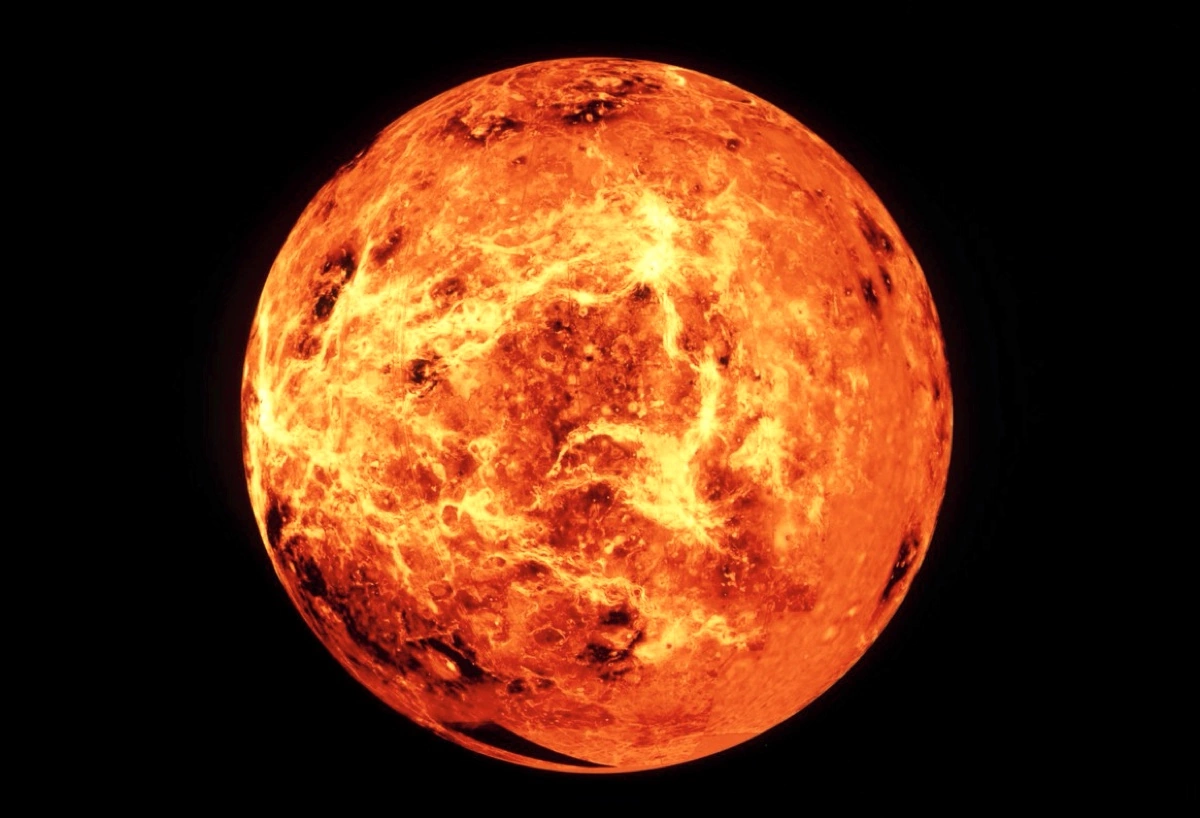
But if you could teleport to the surface of Venus, you wouldn’t find love. You would find a hellscape.
- The temperature is hot enough to melt lead (470°C).
- The air pressure is crushing (90 times heavier than Earth).
- It rains concentrated sulfuric acid.
How did a planet almost the exact same size and composition as Earth go so wrong? In this lesson, we will peel back the clouds to understand the atmospheric physics, the Soviet robots that died exploring it, and why Venus spins backward.
[INTERACTIVE TOOL: VENUS CLOUD PEELER]
Venus: Surface vs. Atmosphere
(Surface) VISIBLE LIGHT
(Clouds)
Experiment: Use the slider to remove the atmosphere layers. Switch from “Visible Light” (Clouds) to “Radar” (Surface) to see the volcanoes hidden beneath.
Part 1: The Morning Star (Observation & History)
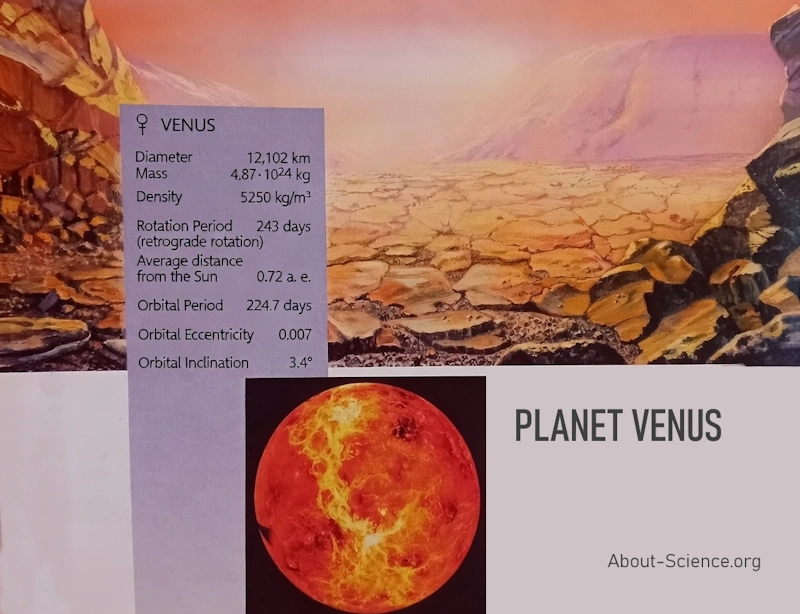
Because Venus is closer to the Sun than Earth is, it never strays far from the Sun in our sky. It behaves like Mercury, but it moves slightly further away—up to 48° elongation. This makes it the “Morning Star” or the “Evening Star.”
The Discovery of the Atmosphere (1761)
We have known Venus has an atmosphere for over 250 years, thanks to a brilliant Russian scientist named Mikhail Lomonosov.
In 1761, the world watched a rare event: the Transit of Venus. This occurs when Venus moves straight across the Sun’s face, showing up as a tiny dark silhouette.
Lomonosov observed this through a telescope from his home in St. Petersburg. As the black dot of Venus began to leave the Sun, he noticed something strange:
- A thin, glowing arc or “bulge” appeared at the edge of the planet.
- Lomonosov called this a “pimple.”
He correctly realized that this glow was sunlight bending (refracting) through a layer of gas surrounding the planet. He concluded:
“Venus is surrounded by a considerable aerial atmosphere, such (if not greater) as surrounds our terrestrial sphere.”
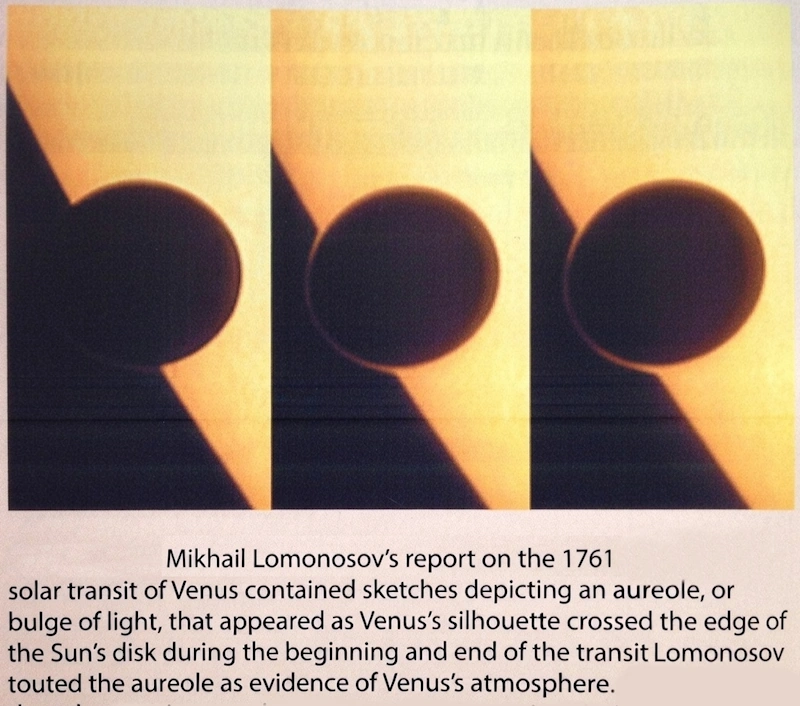
Teacher’s Note: The Lomonosov Effect
Try this at home! If you look at a streetlamp through the bottom of a glass of water, the light bends. The atmosphere of Venus acted like that glass, bending the sunlight around the planet so Lomonosov could see it.
Part 2: The Atmosphere (The Crushing Blanket)
For centuries, astronomers dreamed that beneath those thick white clouds, Venus might be a tropical jungle with dinosaurs. They hoped to find oxygen and water.
When we finally analyzed the light spectrum in the 1930s and sent probes in the 1960s, that dream died instantly.
The Composition
Venus does not have “air” like Earth.
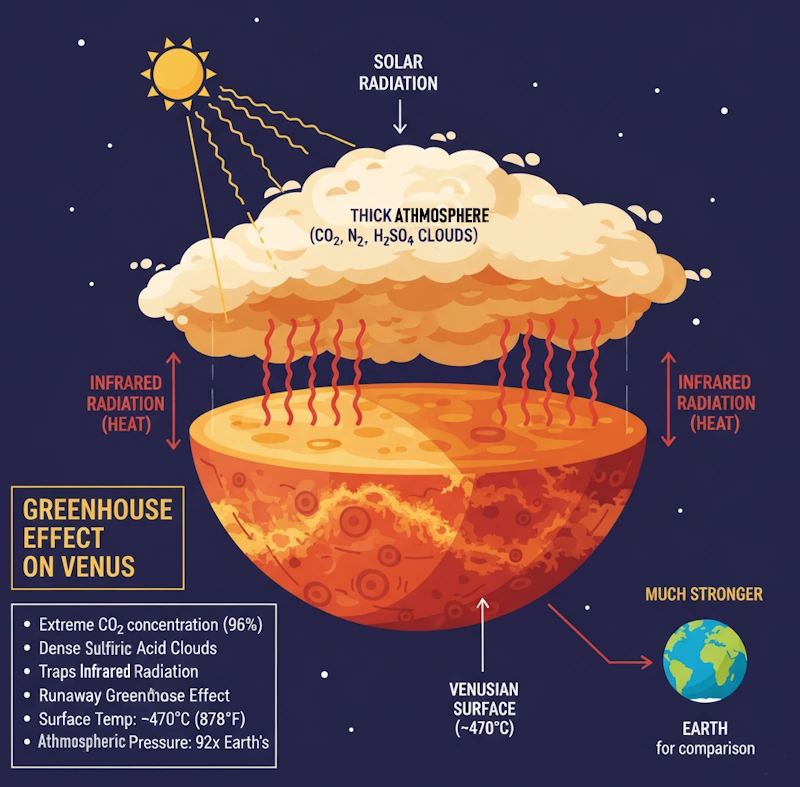
- 96% carbon dioxide (CO₂): The gas humans exhale and vehicles release.
- 3.5% nitrogen: The primary component of Earth’s atmosphere.
- Trace Gases: Sulfur dioxide, argon, water vapor (tiny amounts).
The Clouds of Acid
In 1972, researchers discovered that the clouds of Venus are not made of water vapor like on Earth. They are made of Concentrated Sulfuric Acid (H₂SO₄).
- The Cycle: Volcanoes erupt Sulfur Dioxide (SO₂). Sunlight reacts with it to form acid.
- The Rain: It rains acid on Venus, but the surface is so hot that the rain evaporates before it ever hits the ground! This phenomenon is called Virga.
The Pressure Cooker
The atmosphere on Venus is incredibly heavy. Surface pressure measures 90 atmospheres.
- Comparison: To feel this pressure on Earth, you would have to dive 1 kilometer (3,300 feet) deep into the ocean.
- If you stood on Venus, the air is so thick it would feel less like a gas and more like a liquid. You wouldn’t just walk; you would have to push your way through the air.
Part 3: The Greenhouse Effect (Physics Deep Dive)
Why is Venus hotter than Mercury?
Mercury is closer to the Sun, but Venus is hotter. The answer is the Greenhouse Effect.
How it works (Level 1: Grades 7-9):
Think of a car parked in the sun with the windows up.
- Sunlight (Visible Light) goes through the glass easily.
- It heats up the car seats.
- The seats try to release the heat (Infrared Heat), but the glass won’t let the heat out.
- The inside of the car gets hotter and hotter.
On Venus, the CO₂ atmosphere acts like the glass windows. It lets sunlight in but traps the heat forever.
The Physics (Level 2: Grades 10-12):
- Visible Light (Short Wavelength): Can penetrate the CO₂ barrier. The ground absorbs it and warms up.
- Thermal Radiation (Long Wavelength): The warm ground radiates energy back up as Infrared. However, CO₂ molecules are excellent at absorbing Infrared wavelengths. They catch the energy and re-radiate it back down to the surface.
The “Runaway” Scenario:
Venus may have possessed oceans billions of years in the past. But as the sun got brighter, the oceans evaporated. Water vapor is also a greenhouse gas. This trapped more heat, which evaporated more water, which trapped more heat. Eventually, the oceans boiled dry, and the carbon trapped in rocks baked out into the atmosphere, creating the nightmare we see today.
Part 4: The Surface (Radar Mapping)
Because the clouds are so thick, we cannot see the surface with normal telescopes. We had to use Radar.
Spacecraft like the Soviet Venera 15/16 and the American Magellan shot radio waves through the clouds. The waves bounced off the ground and came back, allowing computers to draw a 3D map of the planet.
What does Venus look like?
It looks like a volcanic wasteland.
- Vast Plains: Smooth volcanic plains blanket 80% of the planet’s surface.
- Continents: There are two main highland regions, named Ishtar Terra (North) and Aphrodite Terra (Equator). These are about the size of the USA or Africa.
- Maxwell Montes: The highest mountain on Venus (11 km high), taller than Mount Everest.
The Volcano Mystery
Venus has more volcanoes than any other planet—over 1,600 major ones and thousands of smaller ones.
- Shield Volcanoes: Like the volcanoes in Hawaii (Beta Regio), these are wide and flat, formed by runny lava.
- Pancake Domes: Strange, flat-topped volcanoes that look like pancakes, formed by thick, sticky lava oozing out under high pressure.
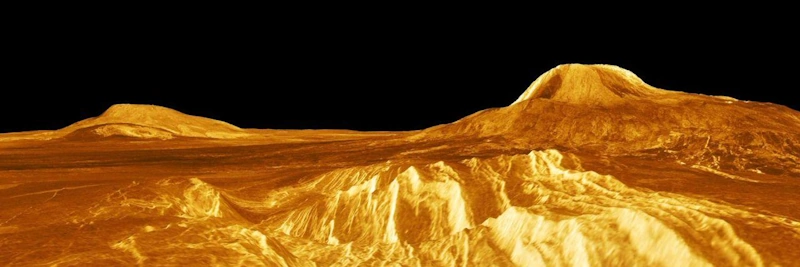
This is an amazing picture of the surface of the planet Venus! 🌋 Imagine you’re standing on an alien world. What do you see?
The ground is super bumpy and wrinkly, full of hills, ridges, cracks, and lumps—like a giant rocky blanket that got crumpled up.
There are two big hills (actually huge volcanoes!):
- One smaller, flatter hill on the left.
- A taller, dome-shaped mountain on the right (that’s Gula Mons, a giant volcano).
The colors are beautiful warm golden-orange, yellow, and brown—like a sunset or caramel candy. The sky is completely pitch black—no blue, no clouds, no sun visible.
Why does it look like this?
This isn’t a normal photograph. Venus has super thick clouds that completely hide the surface (you could never see this from space with a camera).
Scientists used a special tool called radar from the Magellan spacecraft (it orbited Venus in the 1990s). Radar sends out radio waves that bounce off the ground, and the spacecraft measures how long they take to come back. This tells us exactly how high or low everything is. Then, computers made this beautiful 3D picture using that radar data. The golden colors show height (higher places are brighter/yellow) and are tinted to match the real orange-ish color the ground has on Venus.
Are they active?
Evidence says Yes. Satellites have detected spikes in sulfur dioxide (from eruptions) and flashes of lightning (volcanic thunderstorms). Also, radar images taken years apart show changes in the landscape. Venus is geologically alive!
Teacher’s Note: No Tectonic Plates?
On Earth, we have tectonic plates that move around, recycling the crust (Earthquakes).
On Venus, the crust seems to be one solid, thick lid. The heat builds up inside until the whole planet undergoes a “Global Resurfacing Event”—where the entire crust melts and reforms every 500 million years.
Part 5: The Soviet History of Exploration
While Americans were aiming for the Moon and Mars, the Soviet Union (USSR) fell in love with Venus. They launched the Venera Program. It is one of the most heroic engineering feats in history.
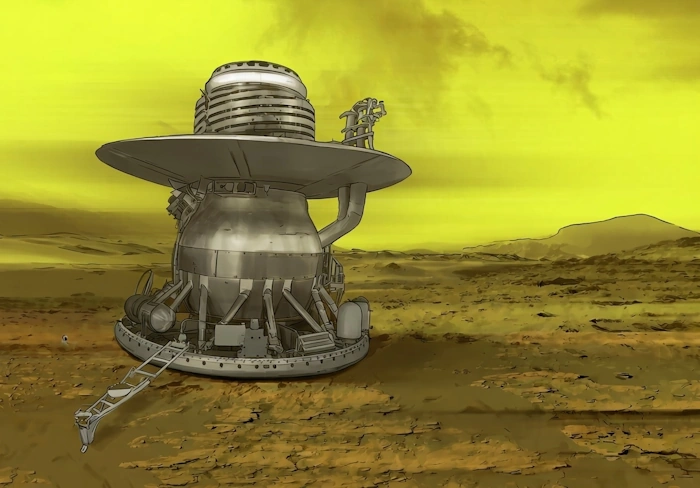
The Early Failures
The first few probes were crushed instantly by the air pressure like soda cans. The scientists didn’t realize the pressure was 90 times higher than Earth’s.
The Success: Venera 7 (1970)
They built a lander like a tank (titanium reinforced). It survived the landing and sent back data for 23 minutes before the heat melted its electronics. It was the first time humans landed a spacecraft on another planet and received data.
The Photos: Venera 9 & 13
Later probes included cameras. They took the only photos we have of the surface of Venus. They show a yellow sky (due to thick clouds filtering blue light) and sharp, broken slab-like rocks.
Part 6: The Rebel Planet (Rotation Oddities)
Venus behaves very strangely compared to the other planets in terms of motion.
1. Retrograde Rotation (Backwards Spin)
Every planet spins counter-clockwise (West to East).
Venus spins Clockwise (East to West).
- On Venus, the Sun would rise in the west and set in the east if you lived there.
- Why? Scientists believe a massive protoplanet the size of Earth smashed into young Venus billions of years ago, flipping it upside down or reversing its spin.
2. The Day is Longer than the Year
Venus spins incredibly slowly.
- 1 Year on Venus: 225 Earth Days (Time to orbit the Sun).
- 1 Day on Venus: 243 Earth Days (Time to spin once).
This means you could celebrate your birthday twice in a single day!
3. The Super-Rotation of Winds
While the solid planet spins slowly (walking speed), the atmosphere spins insanely fast. Winds at the cloud tops scream around the planet at 360 km/h (220 mph). The atmosphere rotates fully every 4 days, while the planet takes 243 days. Physicists are still trying to fully understand what drives this “Super-Rotation.”
4. Could we live on Venus? (Terraforming)
Some scientists suggest we could live on Venus—but not on the ground.
At an altitude of 50 km (30 miles) up in the clouds, the temperature is a mild 30°C and the pressure is equal to Earth (1 atm).
Because our air (Nitrogen/Oxygen) is lighter than CO₂, a city filled with normal air would float in Venus’s atmosphere like a balloon. We could build “Cloud Cities” like in Star Wars!
Summary of Key Terms
- Greenhouse Effect: The trapping of heat by an atmosphere.
- Atmospheric Pressure: The downward force exerted by the weight of the overlying air.
- Retrograde Rotation: Spinning backwards compared to orbit.
- Albedo: How reflective a planet is.
- Transit: Passing in front of the Sun.
🎓 Quiz: The Secrets of Venus
1. Who first discovered that Venus has an atmosphere?
- A) Galileo Galilei
- B) Mikhail Lomonosov
- C) Isaac Newton
- D) Carl Sagan
👉 Click to check answer
He saw the refraction of light (“the pimple”) during the 1761 transit.
2. Of what substance are Venus’s clouds composed?
- A) Water Vapor
- B) Carbon Dioxide Ice
- C) Sulfuric Acid
- D) Liquid Methane
👉 Click to check answer
It rains acid, but the drops evaporate before hitting the ground.
3. Why is the surface of Venus hotter than Mercury?
- A) It has thousands of active volcanoes
- B) The Greenhouse Effect traps solar heat
- C) It rotates very slowly
- D) It is closer to the Sun
👉 Click to check answer
The thick CO2 atmosphere acts like a blanket, preventing heat from escaping.
4. How did scientists map the surface of Venus through the clouds?
- A) Using X-rays
- B) Using Radar
- C) Sending astronauts
- D) Waiting for the clouds to clear
👉 Click to check answer
Radio waves can penetrate the thick clouds and bounce off the surface.
5. What is unique about Venus’s rotation?
- A) It rotates faster than any other planet
- B) It does not rotate at all
- C) It rotates backwards (Retrograde)
- D) It wobbles unpredictably
👉 Click to check answer
The sun rises in the West and sets in the East on Venus.