Venus: Earth’s Twisted Twin
Step outside on a clear evening and you may catch sight of the brightest point of light in the sky after the Moon — a brilliant, steady beacon that ancient stargazers mistook for a star but that never strays far from the horizon at dusk or dawn. This is Venus, and for most of human history it has been considered Earth’s sister world: nearly identical in size, mass, and composition, formed from the same swirling disk of material at roughly the same time. But that sisterly resemblance is deeply misleading. Beneath its dazzling, cloud-wrapped exterior, Venus turned into one of the most hostile environments in the solar system — a planet with a surface hot enough to melt lead, an atmosphere so dense it would crush a submarine, clouds made of sulfuric acid, and a day that lasts longer than its year. Venus is not Earth’s twin. It is Earth’s cautionary tale.
Understanding what happened to Venus — how a planet so similar to our own could diverge so catastrophically — has become one of the most urgent questions in planetary science, offering sobering insight into the fragility of habitable conditions and the runaway consequences of a greenhouse atmosphere gone wild.
Named for the Goddess of Beauty
Venus takes its name from the Roman goddess of love and beauty, a fitting title for what appears, from a distance, to be the most luminous and serene object in our night sky. Ancient civilizations across the world — Babylonian, Mayan, Egyptian, and Greek — tracked its movements obsessively, since it was visible only in the hours surrounding sunrise and sunset, earning it the titles “Morning Star” and “Evening Star.” Like Mercury, it was initially believed to be two separate objects before astronomers realized both apparitions belonged to the same wandering point of light.
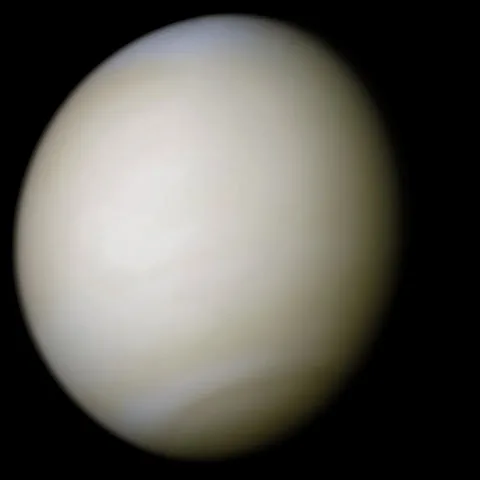
Venus’s brilliance comes from a straightforward cause: its thick, highly reflective cloud layer bounces back roughly 70% of the sunlight that reaches it, far more than any other planet reflects. Combined with its relative closeness to Earth, this makes Venus outshine every star in the sky and even become visible in broad daylight under the right conditions.
Orbital Characteristics: A World Turned Upside Down
The Nearest Planetary Neighbor
Venus orbits the Sun at an average distance of about 108 million kilometers, making it the second planet from the Sun and, at its closest approach, the nearest planet to Earth — closer, in fact, than any other planetary neighbor at conjunction. Its orbit is also the most circular of any planet in the solar system, deviating from a perfect circle by less than 1%.
Retrograde Rotation
Perhaps Venus’s strangest orbital quirk is the direction it spins. While nearly every planet in the solar system rotates counter-clockwise when viewed from above the Sun’s north pole, Venus rotates clockwise — a phenomenon called retrograde rotation. If you could stand on Venus’s surface and watch the sky (an impossibility given the crushing conditions, but a useful thought experiment), you would see the Sun rise in the west and set in the east.
The cause of this backward spin remains debated. Leading hypotheses suggest that a massive ancient collision may have physically flipped the young planet, or alternatively, that powerful tidal interactions between Venus’s dense atmosphere and the Sun’s gravity gradually slowed and reversed its original rotation over billions of years.
A Day Longer Than a Year
Venus’s rotation is not only backward but astonishingly slow. It takes about 243 Earth days to complete a single rotation on its axis, while it takes only 225 Earth days to complete one full orbit around the Sun. This means a single Venusian day, measured from sunrise to sunrise, is longer than a Venusian year — a bizarre calendar shared only with Mercury among the planets.
Physical Characteristics
| Property | Value |
|---|---|
| Diameter | 12,104 km (about 95% of Earth’s diameter) |
| Mass | 4.87 × 10²⁴ kg (about 82% of Earth’s mass) |
| Average density | 5.24 g/cm³ (close to Earth’s 5.51 g/cm³) |
| Surface gravity | 8.87 m/s² (about 90% of Earth’s gravity) |
| Average distance from Sun | 108.2 million km |
| Orbital period (year) | 225 Earth days |
| Rotation period (day) | 243 Earth days (retrograde) |
| Axial tilt | 177.4° (essentially upside down) |
| Known moons | 0 |
| Average surface temperature | 464°C |
| Surface pressure | 92 times Earth’s sea-level pressure |
These raw numbers explain why Venus was once called Earth’s twin. In terms of bulk properties — size, mass, density, and internal composition — Venus and Earth are remarkably alike, likely built from very similar raw materials in the early solar system. It is what happened next, in each planet’s atmospheric history, that determined their dramatically different fates.
The Greenhouse Effect Gone Catastrophically Wrong
An Atmosphere Ninety Times Thicker Than Earth’s
Venus possesses the densest atmosphere of any rocky planet in the solar system, composed of roughly 96.5% carbon dioxide with a thick, permanent haze of sulfuric acid clouds. Standing on the Venusian surface would feel similar to standing nearly a kilometer beneath Earth’s ocean surface, with atmospheric pressure crushing enough to destroy unprotected equipment within minutes.
How the Runaway Greenhouse Effect Works
Venus’s suffocating heat is not primarily a consequence of its proximity to the Sun — it actually receives less sunlight at its surface than Earth does, since its thick clouds reflect most incoming solar radiation back into space. Instead, its extreme temperature comes from an atmospheric trap: carbon dioxide allows sunlight to pass through and warm the surface, but then prevents the resulting heat from escaping back into space as infrared radiation. With such an overwhelming concentration of greenhouse gases, this trapping effect becomes so powerful that surface temperatures soar to levels hot enough to melt lead and zinc, and hotter even than Mercury, despite Venus orbiting nearly twice as far from the Sun.
This process, known as the runaway greenhouse effect, likely explains one of the starkest planetary transformations in the solar system, and understanding its mechanics has become directly relevant to climate science on Earth, offering a natural laboratory for studying what happens when greenhouse warming spirals out of control.
What Went Wrong: The Water Loss Hypothesis
Evidence suggests Venus may once have possessed oceans of liquid water, similar in volume to Earth’s, during the solar system’s earlier and cooler youth. As the young Sun gradually brightened over billions of years, however, Venus’s proximity pushed it past a critical threshold: rising temperatures caused ocean water to evaporate into the atmosphere, and water vapor itself is a potent greenhouse gas, accelerating the warming in a destructive feedback loop. Eventually, ultraviolet radiation from the Sun broke apart water molecules high in the atmosphere, and the resulting hydrogen, being extremely light, escaped into space permanently, while much of the oxygen combined with surface minerals or was lost as well. Without water to lock away carbon through rock weathering and the carbon cycle, as continues to happen on Earth, carbon dioxide instead accumulated unchecked in Venus’s atmosphere, entrenching the runaway heating that persists to this day.
Clouds of Sulfuric Acid
The thick cloud decks that make Venus so brilliant in our sky are composed not of water droplets, as on Earth, but of concentrated sulfuric acid, floating at altitudes between roughly 45 and 65 kilometers above the surface. These clouds circulate the planet in a phenomenon called super-rotation, in which the upper atmosphere whips around Venus in only about four Earth days — dramatically faster than the sluggish 243-day rotation of the solid planet beneath it, a mismatch scientists still work to fully explain.
A Volcanic and Geologically Active Surface
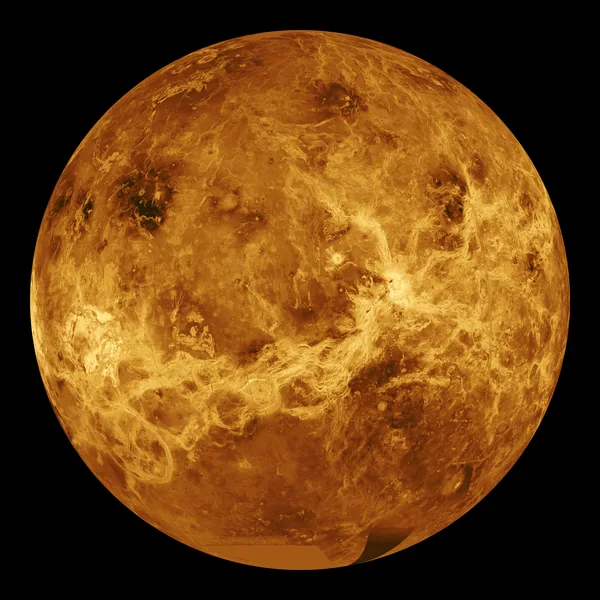
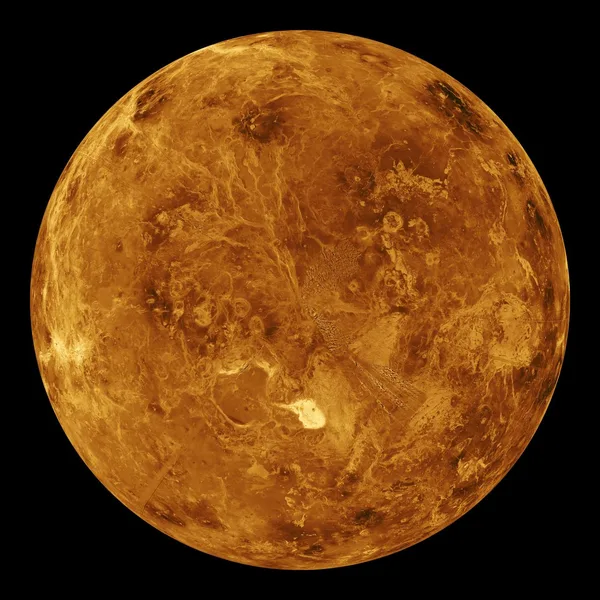
Beneath its toxic atmosphere, Venus hides a landscape reshaped extensively by volcanic activity, revealed to scientists primarily through radar mapping, since optical telescopes and cameras cannot penetrate its thick clouds.
Mapping an Invisible World
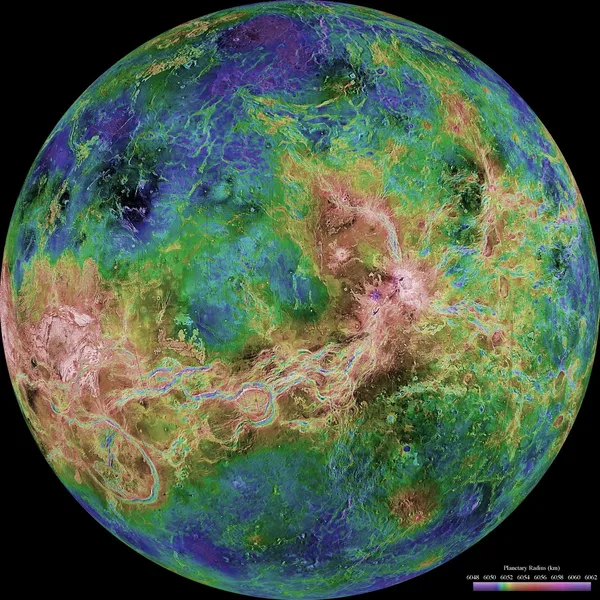
Because visible light cannot pierce Venus’s atmosphere, our knowledge of its surface comes almost entirely from radar instruments capable of penetrating the clouds. NASA’s Magellan spacecraft, which orbited Venus from 1990 to 1994, used radar to map about 98% of the planet’s surface in remarkable detail, revealing a world dominated by volcanic plains, expansive lava flows, and tens of thousands of volcanic structures — more volcanoes than on any other planet in the solar system.
Evidence of Ongoing Volcanism
For years, scientists debated whether Venus’s volcanoes were entirely extinct relics of an ancient hot past or whether the planet remains geologically active today. Several converging lines of evidence now support ongoing activity:
- Sudden, temporary spikes in atmospheric sulfur dioxide concentrations, a gas typically released by volcanic eruptions and normally broken down quickly by sunlight
- Radar images from Magellan, when compared across different observation windows, revealing changes in surface features consistent with fresh lava flows
- Thermal anomalies detected by the European Space Agency’s Venus Express orbiter, suggesting localized hot spots consistent with active or recent lava flows
- A 2023 reanalysis of archival Magellan radar images that appeared to show a volcanic vent changing shape and enlarging between two observations taken eight months apart — potential direct evidence of an eruption in progress
Coronae and Tesserae: Uniquely Venusian Terrain
Venus hosts several types of surface features not clearly duplicated anywhere else in the solar system. Coronae are enormous, ring-shaped structures, some hundreds of kilometers across, thought to form where plumes of hot material rise from deep within the mantle and push up the crust before it collapses back inward. Tesserae are highly deformed, tile-like patches of ancient, heavily fractured terrain believed to represent some of the oldest crust on the planet. Together, these features suggest Venus experiences its own distinctive style of tectonic activity — one that lacks Earth’s system of mobile, sliding plates but still involves substantial crustal deformation driven by heat escaping from within.
A Planet That Resurfaced Itself
One of Magellan’s most striking findings was the near-total absence of small and medium impact craters compared to what would be expected on a surface as old as the solar system itself. Statistical analysis of crater counts suggests that Venus’s entire surface may have been resurfaced by massive volcanic activity somewhere between 300 million and 700 million years ago — a relatively recent event in geological terms — possibly in one or several planet-wide volcanic episodes rather than through gradual, continuous activity. The cause of this dramatic resurfacing event remains one of the most compelling open questions in Venusian science.
No Magnetic Field, No Moon
Despite its similarity in size and composition to Earth, Venus lacks a global magnetic field of the kind generated by Earth’s churning liquid outer core. The leading explanation involves Venus’s extremely slow rotation, which may be too sluggish to drive the kind of vigorous internal convection required to sustain a planetary dynamo, though the planet’s uncertain internal heat flow and core state also play a role in ongoing debates. Without this protective magnetic shield, the solar wind interacts directly with Venus’s upper atmosphere, gradually stripping away lighter atmospheric particles into space over geological time, a process that may have contributed to its long history of atmospheric change.
Venus is also, like Mercury, entirely without natural satellites — a moonless world, likely because any small body wandering too close would be gravitationally disrupted by the Sun before Venus could ever capture it into a stable orbit.
Exploring Venus: A History of Bold and Difficult Missions
The Soviet Venera Program
The Soviet Union led the earliest successful exploration of Venus’s surface through its ambitious Venera program. Between the 1960s and 1980s, a series of Venera landers achieved the extraordinary feat of surviving Venus’s crushing pressure and searing heat, even if only briefly. Venera 7 became the first spacecraft to transmit data from the surface of another planet in 1970, while later missions, including Venera 9 and 13, captured the first — and to this day, among the only — photographs ever taken from the Venusian surface, revealing a rocky, sun-baked landscape shrouded in an eerie orange-tinted haze.
Magellan’s Radar Revolution
NASA’s Magellan mission, launched in 1989, transformed our understanding of Venus by using synthetic aperture radar to peer beneath the planet’s opaque clouds, producing the first truly comprehensive maps of its surface topography and revealing its volcanic and tectonic character in unprecedented detail.
Modern and Upcoming Missions
Interest in Venus has surged in recent years, driven partly by mounting evidence of possible ongoing volcanism and partly by a controversial and still-debated 2020 announcement of phosphine gas detected in Venus’s clouds — a chemical that, on Earth, is strongly associated with biological processes, though non-biological explanations remain firmly on the table. Multiple space agencies now have Venus-focused missions in development, including NASA’s DAVINCI mission, designed to send a descent probe through the atmosphere to sample its chemistry directly, and VERITAS, intended to map the surface with radar resolution far exceeding Magellan’s, alongside the European Space Agency’s EnVision orbiter, all aimed at finally answering long-standing questions about the planet’s volcanic activity, atmospheric evolution, and its shared, divergent history with Earth.
Venus in Context: Comparing the Inner Planets
| Feature | Mercury | Venus | Earth | Mars |
|---|---|---|---|---|
| Distance from Sun | 57.9 million km | 108.2 million km | 149.6 million km | 227.9 million km |
| Diameter | 4,879 km | 12,104 km | 12,742 km | 6,779 km |
| Rotation | Prograde, slow | Retrograde, very slow | Prograde, fast | Prograde, fast |
| Atmosphere | Virtually none | Extremely thick, CO2-dominated | Moderate, nitrogen-oxygen | Thin, CO2-dominated |
| Average surface temp | 167°C (wide swings) | 464°C | 15°C | -63°C |
| Surface pressure (Earth = 1) | Negligible | 92 | 1 | 0.006 |
| Known moons | 0 | 0 | 1 | 2 |
Why Venus Still Matters
It is tempting to look at Venus purely as a hellish curiosity, a planet too extreme to hold much practical relevance to our own. But Venus’s importance to science runs far deeper than its shock value. As the clearest example in the solar system of a runaway greenhouse effect, Venus offers a stark, real-world illustration of how a planet’s climate can spiral irreversibly out of balance — a lesson with obvious and pressing resonance for Earth’s own climate future. Its unexplained retrograde rotation challenges our models of planetary formation and evolution. Its apparent volcanic activity and mysterious resurfacing history raise profound questions about how rocky planets release internal heat over billions of years, particularly in the absence of Earth-style plate tectonics. And the tantalizing, unresolved question of phosphine in its clouds has reopened serious scientific conversation about whether Venus’s upper atmosphere — cooler, less pressurized, and chemically active in ways its surface is not — might harbor conditions worth investigating in the search for life beyond Earth.
Venus, in the end, is less a twin of Earth than a mirror held up at a warped angle — similar enough to feel unsettlingly familiar, different enough to reveal just how dramatically a planet’s fate can diverge. As new missions prepare to pierce its clouds once again in the coming decade, Venus stands ready to teach us as much about our own planet’s fragile equilibrium as it does about itself.
References
- NASA Science (n.d.) Venus overview. Available at: https://science.nasa.gov/venus/ (Accessed: 3 August 2026).
- NASA Solar System Exploration (n.d.) Venus: in depth. Available at: https://solarsystem.nasa.gov/planets/venus/in-depth/ (Accessed: 3 August 2026).
- NASA (n.d.) Magellan mission. Available at: https://science.nasa.gov/mission/magellan/ (Accessed: 3 August 2026).
- ESA (n.d.) Venus Express archive. Available at: https://www.esa.int/Science_Exploration/Space_Science/Venus_Express (Accessed: 3 August 2026).
- NASA Climate (n.d.) Greenhouse effect comparison context. Available at: https://science.nasa.gov/earth/climate-change/ (Accessed: 3 August 2026).
- NASA Photojournal (n.d.) Venus images. Available at: https://photojournal.jpl.nasa.gov/target/Venus (Accessed: 3 August 2026).