Microbial Genetics: Plasmids, Gene Swapping & the Biotech Revolution
In the human world, evolution takes millions of years. We pass genes to our children, who pass them to their children.
But bacteria don’t have time for that. They live in a world of constant chemical warfare. To survive, they need to update their software instantly.
This is the fascinating world of Microbial Genetics. Unlike humans, bacteria can swap DNA with their neighbors, pick up genetic “trash” from the environment, and even get hacked by viruses.
In this lesson, we will explore how bacteria organize their hereditary material, the mechanisms of microbial genetics and evolution, and how humanity uses these tiny genetic engineers for biotechnology.
[INTERACTIVE TOOL: THE CONJUGATION SIMULATOR]
Experiment: You have two bacteria. One is resistant to antibiotics (Red), one is not (Blue). Connect them with a “Sex Pilus” and watch the resistance plasmid copy itself to the neighbor. Now both are Red!
Part 1: The Bacterial Hard Drive (Organization of Hereditary Material)
The hereditary apparatus of bacteria is simpler than ours, but highly efficient.
It consists of a single chromosome—a DNA molecule spiralized and coiled into a ring. This ring is attached to the cytoplasmic membrane at one point.
However, the bacterial genome has functional units outside the main chromosome. Think of these as “Downloadable Content” (DLC) or extra apps.
1. IS-Sequences (Insertion Sequences)
These are short DNA fragments. They are the simplest jumping genes.
Function: They do not carry structural genes (they don’t code for proteins). They only contain genes responsible for transposition—the ability to move along the chromosome and paste themselves into different regions.
2. Transposons (Jumping Genes)
These are larger DNA molecules. Unlike IS-sequences, they carry structural genes in addition to transposition genes.
- Behavior: They move along the chromosome, turning genes on or off (gene expression).
- Limit: They can exist autonomously (outside the chromosome) but cannot replicate themselves. They need the host.
3. Plasmids (The Superpowers)
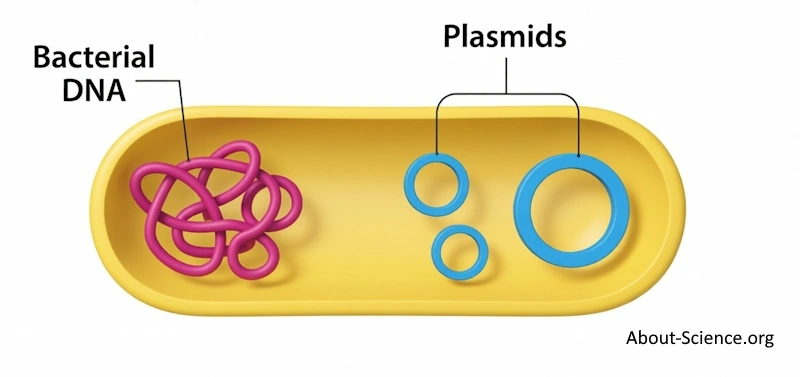
Plasmids are the most important element for microbial genetics and biotechnology.
They are circular, double-stranded DNA molecules that exist separately from the main chromosome.
- Autonomy: They can replicate independently.
- Amplification: A cell can have multiple copies of the same plasmid, boosting a specific trait (like making more toxins).
Types of Plasmids
1. R-Plasmids (Resistance): The most dangerous type for humans. They provide drug resistance by encoding enzymes that destroy antibiotics or changing the cell wall so drugs can’t get in.
2. F-Plasmids (Fertility/Sex): These encode “sex” in bacteria.
- Male (F+): Has the plasmid. Acts as the Donor.
- Female (F-): Lacks the plasmid. Acts as the Recipient.
- Note: F-plasmids can integrate into the chromosome and drag chromosomal genes with them during transfer.
3. Col-Plasmids: Encode Bacteriocins—chemical weapons that kill closely related bacteria (eliminating the competition).
4. Tox-Plasmids: Encode the production of dangerous exotoxins (causing disease).
5. Biodegradation Plasmids: Encode enzymes that allow bacteria to eat xenobiotics (artificial chemicals like oil or plastic).
Survival
Loss of a plasmid does not kill the cell. Plasmids provide advantages, not basic life functions. A bacterium without plasmids is like a smartphone without apps—it works, but it can’t do cool stuff.
Part 2: How Bacteria Change (Variability)
Microbial genetics and physiology are linked through variability. There are two ways bacteria change:
1. Phenotypic Variability (Modifications)
This is temporary. It does not change the DNA.
Example: If you grow bacteria in a cold room, they might grow thicker walls. If you move them back to heat, the walls thin out.
It affects the majority of the population but is not inherited.
2. Genotypic Variability of Bacteria (Mutations & Recombination)
This changes the DNA forever.
A. Bacteria Mutations
Changes in the genotype that persist across generations.
- By Origin: Spontaneous (random error) or Induced (caused by radiation/chemicals).
- By Location: Gene (point), Chromosomal, or Plasmid mutations.
B. Bacteria Recombination (Genetic Exchange)
This is where microbial genetics application gets interesting. Bacteria can swap genes using four distinct mechanisms:
Conjugation (The Direct Link):
Exchange through direct contact. The “Male” (F+) cell builds a bridge (conjugation bridge) to the “Female” (F-). One strand of DNA passes through.
The longer the contact lasts, the more DNA is transferred.
Protoplast Fusion:
If you strip the cell walls off two bacteria, their membranes can fuse together, mixing their genetic material.
Transformation (The Scavenger):
The transfer of “naked” DNA fragments from the environment.
Requirement: The recipient cell must be in a state of Competence (physiologically ready to accept DNA). This usually happens when the cell is actively dividing and the wall is permeable.
Transduction (The Viral Carrier):
Transfer of genes via a Bacteriophage (virus). The virus accidentally picks up a piece of bacterial DNA and injects it into the next victim.
- Specific Transduction: Always transfers the same gene.
- Nonspecific Transduction: Can transfer any random gene.
Part 2.5: Microbial Genetics and Evolution (The Speed of Life)
When we think of evolution, we think of Darwin’s finches or apes turning into humans over millions of years. This is Vertical Evolution (Parent to Child). But Microbial Genetics and Evolution operate by a different set of rules. Bacteria primarily use Horizontal Gene Transfer (HGT).
The “AirDrop” Analogy
Imagine if you could sit next to a person who knows how to speak French, press a button, and instantly download the ability to speak French into your own brain. That is how bacteria evolve. They don’t have to wait to reproduce; they can “AirDrop” genes to their neighbors instantly using Plasmids and Conjugation.
The Rise of Resistant Bacteria
This evolutionary speed is why we have a global crisis with Antibiotic Resistance.
- The Pressure: You take an antibiotic. It kills 99.9% of the bacteria.
- The Survivor: One bacterium has a random mutation (or an R-Plasmid) that lets it survive.
- The Spread: That survivor doesn’t just multiply; it shares its “shield” plasmid with other bacterial species nearby.
- The Result: Within days, an entire population is resistant. This rapid adaptation is the dark side of microbial genetics.
The Concept of the Pangenome
Because bacteria swap genes so freely, defining a “species” is hard. Scientists now talk about the Pangenome:
- Core Genome: The genes every E. coli has (essential for life).
- Accessory Genome: The genes only some have (toxins, resistance).
The Lesson: Bacteria are not static; they are open-source coding projects that anyone can contribute to.
Part 3: Bacteriophages (The Viruses That Eat Bacteria)
Bacteriophages (or Phages) are viruses that specifically infect bacteria. They are obligate intracellular parasites—they cannot reproduce without a host.
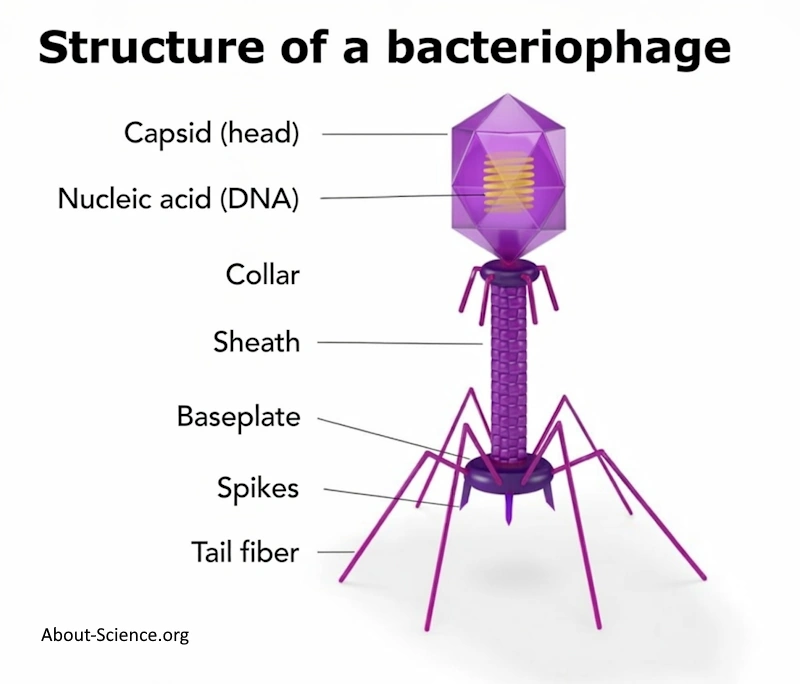
Structure:
- Head: Contains the nucleic acid (DNA or RNA). Has Cubic symmetry.
- Tail: A hollow tube to inject DNA. Has Helical symmetry.
- Mixed Symmetry: Phages are unique because they combine both shapes.
The Two Forms of Phage Existence
- Virion: Extracellular (floating outside).
- Prophage: Intracellular (DNA integrated into the bacteria).
The Two Types of Infection (War vs. Peace)
1. The Lytic Cycle (Productive Infection)
This is total war between bacteria and bacteriophage. The virus hijacks the cell to make babies, then kills the host.
- Adsorption: The phage latches onto the bacterial wall.
- Injection: It uses lysozyme (enzyme) to drill a hole and injects its DNA.
- Synthesis: The bacterial DNA is shut down. The cell is forced to print Phage DNA and Phage Proteins.
- Self-Assembly: New viruses are built.
- Lysis: The cell bursts open, releasing new phages to hunt. These are called Virulent Phages.
2. The Lysogenic Cycle (Temperate Phages)
This is the “Sleeping Agent” strategy.
- The Phage DNA enters the bacterial cell but does not kill it.
- It integrates into the bacterial chromosome and becomes a Prophage.
- Every time the bacteria divides, it copies the virus DNA too. They coexist.
Lysogenic Conversion: Sometimes, the prophage gives the bacteria new powers (like producing toxins).
Wake Up Call: If conditions change (e.g., UV radiation), the phage can exit the chromosome and switch to the Lytic cycle to kill the cell.
Phage Specificity
- Polyvalent: Can kill many genera of bacteria.
- Monovalent: Kills only one species.
Type Phages: Kills only specific variants of bacteria within a species (Used for diagnosis).
Part 4: Microbial Genetics and Biotechnology (Hacking Nature)
We used to just study bacteria. Now, we program them. Microbial Genetics and Biotechnology is the science of using bacterial cellular machinery to build things for humans. By understanding plasmids and enzymes, we have turned bacteria into microscopic factories.
1. Recombinant DNA Technology (The Copy-Paste Tool)
Scientists realized that because DNA is universal, they could cut a gene out of a human and paste it into a plasmid.
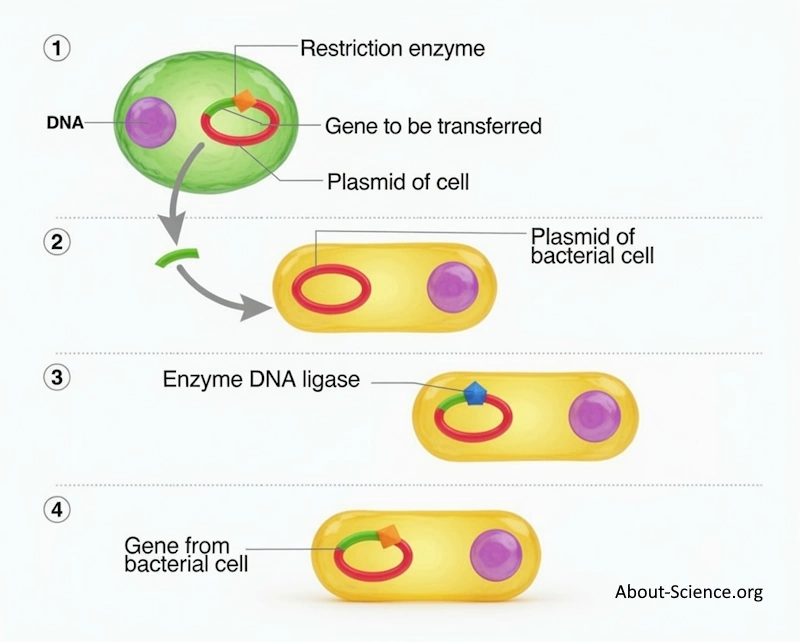
The Restriction Enzyme: This is the “Chemical Scissors.” It cuts DNA at specific spots.
The Ligase: This is the “Glue.” It sticks the human gene into the bacterial plasmid.
The Result: When the bacteria accepts this plasmid (Transformation), it reads the human gene and starts following the instructions.
Real World Application: Insulin
Before the 1980s, diabetics used insulin harvested from the pancreases of slaughtered pigs and cows. It caused allergic reactions. Today, we insert the Human Insulin Gene into E. coli bacteria. The bacteria read the code and pump out pure human insulin in massive vats. If you know a diabetic, their life is likely sustained by a genetically modified bacterium.
2. CRISPR-Cas9 (The Gene Editor)
This is the biggest breakthrough in 21st-century science. CRISPR wasn’t invented by humans; it was discovered inside bacteria. It is the bacterial immune system!
How nature uses it: When a bacterium survives a Phage attack, it saves a piece of the virus DNA in a library called CRISPR. If the virus attacks again, the protein Cas9 uses that saved snippet to hunt down and cut the virus DNA.
How we use it: Scientists reprogrammed Cas9. Instead of hunting viruses, we give it a guide to hunt bad genes in humans (like the gene for Sickle Cell Anemia) and cut them out.
3. Bioremediation (Environmental Cleanup)
We are identifying biodegradation plasmids in nature—bacteria that have evolved to eat oil spills or plastic.
The Goal: Geneticists are tweaking these plasmids to make “Super-Eaters” that we can release into oil spills to clean the ocean naturally.
4. Synthetic Biology (New Life)
This goes beyond editing. Scientists are now trying to create Synthetic Genomes.
In 2010, the J. Craig Venter Institute created “Synthia”—the first cell controlled by a completely synthetic, computer-designed genome.
Future Application: Creating bacteria that excrete Bio-fuel (diesel) or absorb massive amounts of Carbon Dioxide to fight climate change.
Summary of Key Terms
- Horizontal Gene Transfer (HGT): Passing genes to neighbors (sideways) rather than offspring.
- Recombinant DNA: DNA strands artificially engineered in the lab by combining genetic material originating from two or more different sources.
- CRISPR: A tool derived from bacterial immune systems used for precise gene editing.
- Bioremediation: The process of harnessing microbes to digest and degrade contaminants in the environment.
🎓 Quiz: Microbial Genetics
1. What is the function of R-Plasmids?
- A) To produce toxins
- B) To allow the bacteria to reproduce sexually
- C) To provide resistance to drugs/antibiotics
- D) To digest plastic
👉 Click to check answer
They encode enzymes that destroy medicinal substances.
2. Which recombination method involves a “Conjugation Bridge”?
- A) Transformation
- B) Conjugation
- C) Transduction
- D) Mutation
👉 Click to check answer
It is the direct exchange of genetic info between a Donor and Recipient.
3. What happens during the Lytic Cycle of a bacteriophage?
- A) The virus sleeps inside the DNA
- B) The bacteria becomes stronger
- C) The virus reproduces and bursts (kills) the cell
- D) The bacteria turns into a spore
👉 Click to check answer
This is also called a productive viral infection.
4. What is “Transformation” in genetics?
- A) When a virus injects DNA
- B) When a bacteria changes shape
- C) When a bacteria picks up “naked” DNA from the environment
- D) When two bacteria fuse together
👉 Click to check answer
The recipient cell must be in a state of “competence” to do this.
5. What is a “Prophage”?
- A) A dead virus
- B) The tail of a virus
- C) Viral DNA integrated into the bacterial genome
- D) A bacteria that eats viruses
👉 Click to check answer
It exists intracellularly during the lysogenic cycle.
Sources & References
- Madigan, M.T., Bender, K.S., Buckley, D.H., Sattley, W.M. and Stahl, D.A., 2021. Brock Biology of Microorganisms. 16th ed. Hoboken: Pearson. – Comprehensive coverage of plasmids (R, F, Col, degradative), horizontal gene transfer, and bacteriophages, matching the article’s sections on microbial genetics and evolution.
- Microbial Genetics (Dr. B), 2025. Horizontal Gene Transfer – Microbial Genetics (Dr.B). Open Maricopa. Available at:
https://open.maricopa.edu/microbialgenetics/chapter/horizontal-gene-transfer/
. – Explains conjugation, transformation, and transduction with clear medical examples, supporting the discussion of HGT and antibiotic resistance. - Kaiser, G., 2023. ‘Conjugation’ and ‘Plasmids’. In: Microbiology LibreTexts. LibreTexts. Available at: https://bio.libretexts.org . – Provides concise descriptions of F‑plasmids, Hfr strains, R‑plasmids and their roles in bacterial genetics, aligning with the article’s “bacterial hard drive” and plasmid types.
- Technology Networks, 2025. Lytic vs Lysogenic – Understanding Bacteriophage Life Cycles. Technology Networks. Available at: https://www.technologynetworks.com . – Accessible overview of virulent vs temperate phages, prophage integration, lysogenic conversion and induction, underpinning the section on bacteriophage life cycles.
- Wikipedia, 2005–. Lysogenic Cycle. Wikipedia. Available at: https://en.wikipedia.org/wiki/Lysogenic_cycle
. – Useful reference for definitions and stepwise description of lysogenic infection, prophage state, and switching to lytic growth. - Fang, Y., n.d. Recombinant Insulin Production in E. coli. Teaching case PDF. – Describes plasmid vectors, restriction enzymes, transformation and industrial production of recombinant human insulin, directly supporting the recombinant DNA and biotech insulin example.
- van Vliet, S., 2022. ‘Vertical and horizontal gene transfer tradeoffs direct plasmid fitness’. EMBO Reports, 23(12), e55481. – Research article on how conjugative plasmids balance costs and benefits, illuminating the evolutionary role of plasmids and the rise of antibiotic resistance discussed in the article.