Quantum Tunneling: How Particles Walk Through Walls
Introduction to Quantum Tunneling: The Phantom Particle

In the world you and I live in, solid objects are solid.
If you roll a ball up a hill, and it doesn’t have enough speed to reach the top, it rolls back down. If you throw a tennis ball at a brick wall, it bounces back. It never just… ghosts through to the other side.
But Quantum Mechanics operates by a different rulebook.
Electrons, protons, and other subatomic particles have a “superpower” that defies classical logic. They can encounter an impossible barrier—an energy wall they shouldn’t be able to cross—and simply appear on the other side.
This phenomenon is called Quantum Tunneling. And far from being a rare curiosity, it is the reason the Sun shines, the reason your USB drive saves data, and the reason you exist.
[INTERACTIVE TOOL: THE ENERGY BARRIER]
Quantum Tunneling
Experiment: Fire a particle at a wall.
- Classical Mode: It bounces 100% of the time.
- Quantum Mode: Occasionally, the particle “teleports” through the wall. Try making the wall thinner—does it happen more often?
Part 1: The Classical Paradox (The Impossible Jump)
To understand why tunneling is so shocking, we first have to look at Classical Physics.
Imagine a rollercoaster. To get over a big hill, the car needs enough Kinetic Energy (speed). If the hill requires 100 Joules of energy to climb, and the car only has 90 Joules, it will stop near the top and roll back.
Classical Rule: If Energy < Barrier Height, you cannot pass. Absolute certainty.
The Quantum Rebellion
In the early 20th century, physicists noticed something weird. Alpha particles were escaping from atomic nuclei even though they didn’t have enough energy to break the “Nuclear Force” walls holding them in.
The universe, it seemed, had not received the memo about forbidden regions.
Part 2: How Quantum Tunneling Works (Waves Don’t Stop Abruptly)
The secret lies in Wave-Particle Duality.
As we learned in previous lessons, an electron isn’t just a dot; it is a Wave Function (Ψ).
Imagine a sound wave hitting a heavy soundproof door. Most of the sound bounces back. But the sound doesn’t stop exactly at the surface of the door. A tiny bit of the vibration penetrates into the wood. If the door is thin enough, a faint whisper comes out the other side.
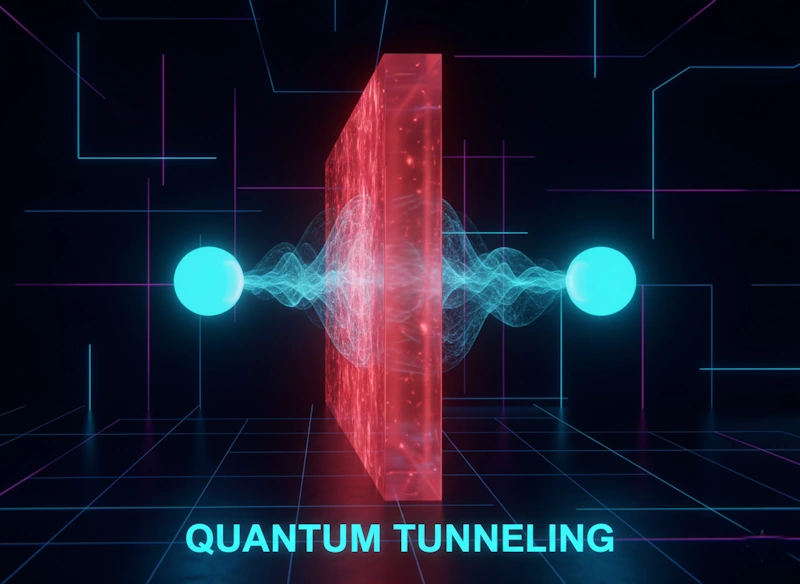
The Probability Tail
The electron’s wave function behaves the same way.
- The wave hits the barrier.
- It decays exponentially inside the barrier (gets weaker very fast).
- However, if the barrier is thin enough, the wave doesn’t reach zero. A tiny “tail” of the wave pokes out the other side.
Since the wave represents the probability of finding the particle, that tiny tail means there is a non-zero chance the electron will simply “materialize” on the other side of the wall.
Teacher’s Note: The “Ghost” Analogy
Tunneling isn’t like digging a hole under the wall. It is more like a ghost floating through it. The particle doesn’t break the wall; it simply uses its wave nature to exist on both sides.
Part 3: Deep Dive — The Math of Quantum Tunneling (Grades 11-12)
Physicists don’t just guess; they calculate the odds. This is done using the WKB Approximation (named after Wentzel, Kramers, and Brillouin).
They found that the Transmission Coefficient (T)—the chance of tunneling—depends on three things:
- Mass (m): Lighter particles tunnel easier. (Electrons tunnel often; bowling balls never do).
- Barrier Width (a): The thinner the wall, the higher the chance.
- Barrier Height (V): The lower the energy gap, the easier the jump.
The Formula of Sensitivity:
The probability drops exponentially as the wall gets thicker.
- Doubling the wall’s width doesn’t halve the tunneling probability. It might drop from “1 in 10” to “1 in 10 billion.”
- This extreme sensitivity allows us to build incredible sensors like the Scanning Tunneling Microscope (STM), which measures surface bumps less than the size of an atom!
Part 4: How Quantum Tunneling Works in Everyday Life (Real World Magic)
You might think tunneling is just a lab trick. It isn’t. It powers the universe and your pocket.
1. Why the Sun Shines (Nuclear Fusion)
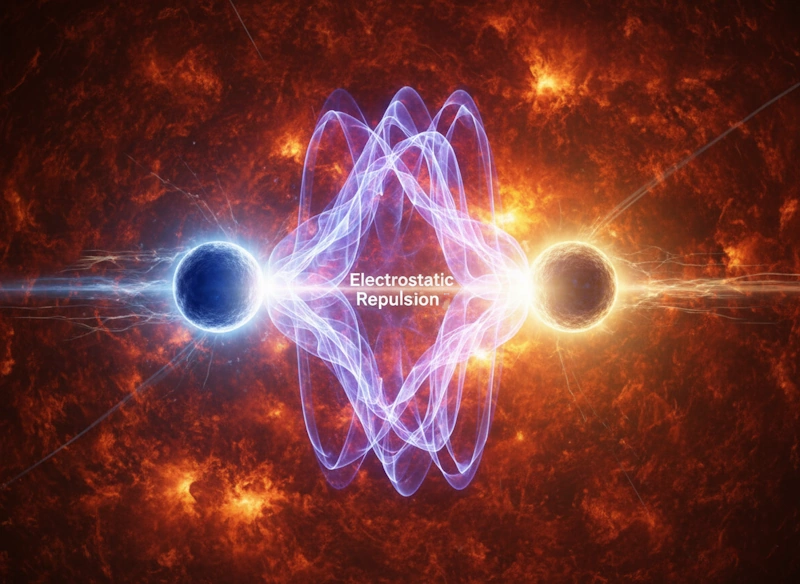
The Sun burns by smashing Hydrogen protons together to make Helium. But protons are positively charged—they repel each other like magnets.
- The Problem: The Sun’s core isn’t actually hot enough to force them together. Classically, the protons should bounce off each other, and the Sun should go dark.
- The Solution: Tunneling. Because there are so many protons colliding billions of times a second, occasionally one “tunnels” through the repulsive barrier and fuses. Without this quantum luck, stars wouldn’t burn, and life wouldn’t exist.
2. Flash Memory (USB Drives & SSDs)
How does your phone store photos when the battery is off?
Inside the chip, there are “Floating Gates”—tiny prisons for electrons separated by an insulating wall.
- Writing Data: We give the electrons a voltage push, forcing them to tunnel through the wall into the prison.
- Storing Data: Once inside, they don’t have enough energy to tunnel back out. They are trapped (representing a “1” in binary).
- Erasing: We apply a reverse voltage, and they tunnel back out.
3. Biology? (Quantum Life)
Recent evidence suggests biology uses quantum mechanics, too. This new field is called Quantum Biology.
- Enzymes (Tunneling): Some proteins in your body use “Hydrogen Tunneling” to teleport protons from one place to another. This speeds up chemical reactions by a factor of millions. Without this quantum shortcut, your metabolism would be too slow to keep you alive.
- Mutations (Tunneling): Your DNA is held together by hydrogen bonds. Occasionally, a proton might tunnel to the wrong side of the bond. If the DNA unzips to replicate while the proton is in the wrong spot, it creates a genetic mutation. Evolution itself might be driven by quantum jumps!
- Bird Navigation (Entanglement): How do European Robins find their way south? They might “see” Earth’s magnetic field using Quantum Entanglement. Special proteins in their eyes (Cryptochromes) hold pairs of entangled electrons that react to the magnetic field, effectively creating a “Quantum Compass” in the bird’s vision.
- The Quantum Brain (Consciousness): This is the most controversial and exciting theory. Physicist Sir Roger Penrose suggests that human consciousness isn’t just electrical signals, but the result of quantum computations happening inside tiny structures in our neurons called Microtubules. If true, your very thoughts might be quantum events.
Part 5: The Nobel Prizes (History Corner)
Tunneling is so important it has won multiple Nobel Prizes.
- 1973: Leo Esaki and Ivar Giaever for tunneling in semiconductors (Tunnel Diodes).
- 1973: Brian Josephson for predicting tunneling in superconductors (Josephson Junctions—now the heart of modern Quantum Computers like IBM’s and Google’s).
- 1986: Gerd Binnig and Heinrich Rohrer for the Scanning Tunneling Microscope (STM), which let us “see” atoms for the first time.
Teacher’s Note: Does it happen instantly?
This is a hot debate! How long does the particle spend inside the wall?
Some calculations suggest it happens instantaneously (faster than light), while others define a “dwell time.”
In 2025, new experiments challenged old theories, showing that this remains one of the active frontiers of physics.
🎓 Quiz: The Quantum Tunneling Effect
1. Why can a particle pass through a solid barrier?
- A) It breaks the wall
- B) It turns into pure energy
- C) Its wave function extends through the barrier
- D) It moves faster than light
👉 Click to check answer
The probability “tail” leaks through, allowing the particle to materialize on the other side.
2. What happens to the probability of tunneling if you make the wall THICKER?
- A) It increases slightly
- B) It drops exponentially (drastically)
- C) It stays the same
- D) It becomes 100%
👉 Click to check answer
Even a tiny increase in thickness makes tunneling nearly impossible.
3. How does the Sun use tunneling?
- A) To escape gravity
- B) To fuse protons together despite repulsion
- C) To create solar flares
- D) To spin faster
👉 Click to check answer
The sun isn’t hot enough to force fusion classically; protons must tunnel to collide.
4. Which modern device relies on “trapping” electrons via tunneling?
- A) Flash Memory (USB Drives)
- B) Car Batteries
- C) Light Bulbs
- D) Speakers
👉 Click to check answer
Electrons tunnel into a floating gate to store data as 0s and 1s.
5. Why don’t people tunnel through walls?
- A) We move too slow
- B) Our mass is too large
- C) We are not made of atoms
- D) The walls are too cold
👉 Click to check answer
The probability decreases as mass increases. For a human, the odds are effectively zero.
Sources & References
- Ashcroft, N.W. and Mermin, N.D. (1976) ‘Solid state physics’, Holt, Rinehart and Winston.
- Binnig, G. and Rohrer, H. (1982) ‘Scanning tunneling microscopy’, IBM Journal of Research and Development, 44(3), 279–293.
- Clarke, J., Devoret, M.H. and Martinis, J.M. (1984, 1985) ‘Resonant activation from the zero-voltage state of a current-biased Josephson Junction and energy-level quantization’, Physical Review Letters, 53, 1260; 55, 1543.
- Condon, E.U. and Gurney, R.W. (1928) ‘Quantum mechanics and radioactive disintegration’, Nature, 122, 439.
- Dingle, R.B. (1973) ‘Asymptotic expansions: their derivation and interpretation’, Academic Press.
- Eigler, D.M. and Schweizer, E.K. (1990) ‘Positioning single atoms with a scanning tunnelling microscope’, Nature, 344, 524–526.
- Esaki, L. and Miyahara, Y. (1960) ‘A new device using the tunneling process in narrow p-n junctions’, Solid-State Electronics, 1, 13–21.
- Gamow, G. (1928) ‘Zur Quantentheorie des Atomkernes’, Zeitschrift für Physik, 51, 204–212.
- Giaever, I. (1960) ‘Energy gap in superconductors measured by electron tunneling’, Physical Review Letters, 5, 147–148.
- Hess, H.F., Robinson, R.B., Dynes, R.C., Valles, J.M. and Waltman, D.E. (1990) ‘Scanning-tunneling-microscope observation of a proximity-induced charge-density wave around a vortex in 2H-NbSe₂’, Physical Review Letters, 62, 214–216.
- Hund, F. (1927) ‘Zur Deutung der Molekelspektren I’, Zeitschrift für Physik, 40, 742–764.
- Jeffreys, H. (1923) ‘On certain approximate solutions of linear differential equations of the second order’, Proceedings of the London Mathematical Society, 23, 428–436.
- Josephson, B.D. (1962) ‘Possible new effects in superconductive tunnelling’, Physics Letters, 1, 251–253.
- Koch, J., Yu, T.M., Gambetta, J., Houck, A.A., Schuster, D.I., Majer, J., Blais, A., Devoret, M.H., Girvin, S.M. and Schoelkopf, R.J. (2007) ‘Charge-insensitive qubit design derived from the Cooper pair box’, Physical Review A, 76, 042319.
- Mandelstam, L.I. and Leontovich, M.A. (1928) ‘Über Rayleighsche Strahlung’, Zeitschrift für Physik, 47, 131–143.
- Martín-Palma, R.J. (2020) ‘Quantum tunneling in low-dimensional semiconductors mediated by virtual photons’, AIP Advances, 10(1), 015145.
- Merzbacher, E. (2002) ‘The early history of quantum tunneling’, Physics Today, 55(8), 44–49.
- Nordheim, L.W. (1927) ‘Zur Theorie der thermionischen Emission und der Elektronenemission aus Metallen’, Zeitschrift für Physik, 46, 833–855.
- Schottky, W. (1931) ‘Zur Wellenmechanik des Tunneleffektes’, Physikalische Zeitschrift, 32, 913–915.
- Schrödinger, E. (1926) ‘An undulatory theory of the mechanics of atoms and molecules’, Physical Review, 28, 1049–1070.
- Shukla, K., Chen, P.S., Chen, J.R., Chang, Y.H. and Liu, Y.W. (2020) ‘Macroscopic matter wave quantum tunnelling’, Nature Communications Physics, 3, 211.
- Tinkham, M. (2004) ‘Introduction to superconductivity’, 2nd edn. Dover Publications.
- Yang, Y.X., Bai, S.Y. and An, J.H. (2025) ‘Long-range quantum tunneling via matter waves’, Nature Communications Physics, 16, 1.
- Young, R., Ward, J. and Scire, F. (1972) ‘The topografiner: An instrument for measuring surface microtopography’, Review of Scientific Instruments, 43, 999–1011.