Mercury: The Sun’s Restless Neighbor
Of all the worlds spinning through our solar system, none lives a stranger double life than Mercury. It is a planet of extremes and contradictions: the closest to the Sun yet not the hottest, the smallest official planet yet among the densest, a world that seems to have stopped growing halfway through its own formation. To stand on its surface — something no human ever has, and likely none will for a very long time — would mean witnessing a sky in which the Sun sometimes appears to stop, reverse course, and set twice in a single day. Mercury rewards close attention precisely because it refuses to behave the way a simple, sun-scorched rock “should.”
For centuries, Mercury was one of the least understood bodies in the solar system, hidden by its own proximity to the Sun’s glare. Only in the last sixty years have spacecraft managed to unravel its secrets, and what they found reshaped our understanding not just of Mercury, but of how rocky planets form throughout the universe.
A Planet Named for a Messenger
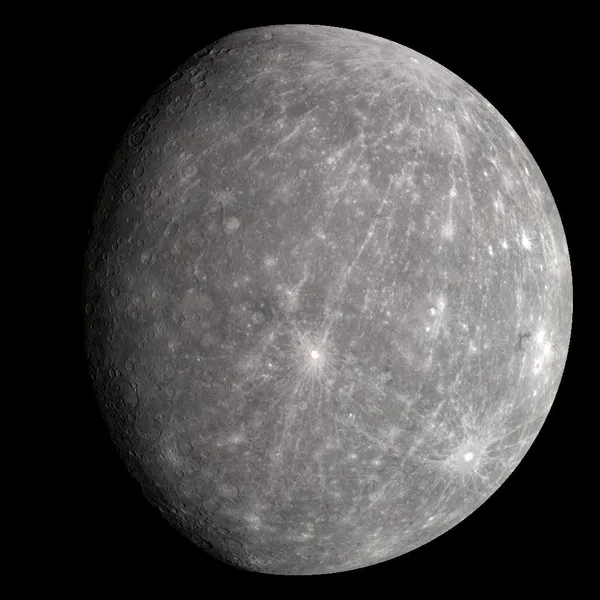
Ancient astronomers noticed something peculiar about the point of light that darted across the twilight sky faster than any other visible object. Because it seemed to complete its journey around the Sun so quickly, Roman astronomers named it after Mercury, the swift messenger god with winged sandals.
The name proved fitting in more ways than one: Mercury really is the fastest-moving planet in the solar system, tearing around the Sun at an average orbital speed of nearly 47 kilometers per second — almost 170,000 kilometers per hour.
Interestingly, ancient civilizations including the Greeks initially believed they were observing two separate objects, since Mercury looks different depending on whether it appears in the morning or evening sky. They called the morning version Apollo and the evening version Hermes before later realizing both were the same wandering point of light.
Orbital Behavior: A World on a Wild Ride
Mercury’s orbit is unlike that of any other planet in the solar system, and this single fact explains most of what makes the planet so strange to experience.
The Closest, Not the Hottest
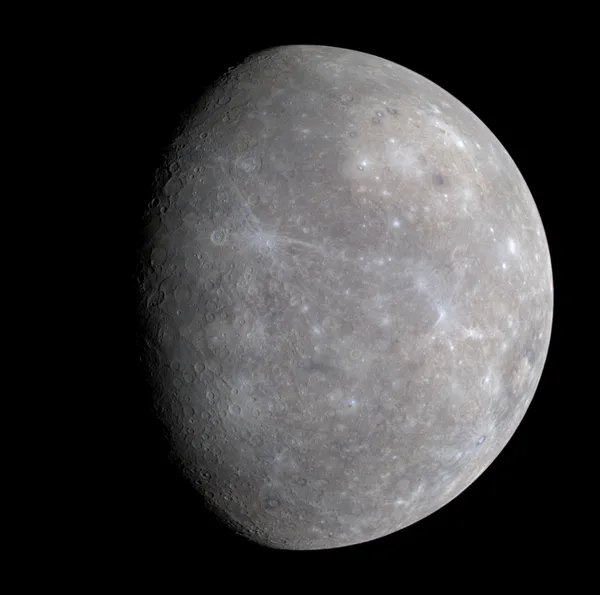
Mercury orbits the Sun at an average distance of about 58 million kilometers, compared to Earth’s 150 million kilometers. Yet despite this proximity, Mercury is not the hottest planet — that title belongs to Venus, whose thick atmosphere traps heat through a runaway greenhouse effect. Mercury has essentially no atmosphere to hold onto heat, so while its sunlit side can soar to 430°C, its night side plunges to a bone-chilling -180°C. This is the largest temperature swing of any planet in the solar system.
A Highly Eccentric Path
Unlike Earth’s nearly circular orbit, Mercury’s path around the Sun is noticeably elliptical. At its closest point (perihelion), it sits about 46 million kilometers from the Sun; at its farthest (aphelion), it drifts out to roughly 70 million kilometers. This eccentricity means the Sun would appear to grow and shrink dramatically in Mercury’s sky over the course of a single Mercurian year.
The 3:2 Spin-Orbit Resonance
For decades, astronomers assumed Mercury was tidally locked to the Sun, always showing the same face, the way our Moon does to Earth. Radar observations in 1965 overturned this assumption, revealing something far more elegant: Mercury rotates on its axis three times for every two orbits it completes around the Sun. This 3:2 spin-orbit resonance is a direct consequence of Mercury’s elongated orbit and the Sun’s powerful gravitational tug on its slightly egg-shaped mass distribution.
The result is a bizarre calendar. A single Mercurian day — from sunrise to sunrise — lasts about 176 Earth days, while a Mercurian year lasts only 88 Earth days. In other words, a day on Mercury is longer than its year.
The Double Sunrise Phenomenon
Because of the interplay between Mercury’s fast, eccentric orbit and its slow rotation, observers standing at certain points near perihelion would witness an astonishing sight: the Sun rising, pausing, briefly reversing direction and setting again, before finally rising once more and continuing its arc across the sky. This happens because, at perihelion, Mercury’s orbital speed temporarily exceeds its rotational speed, causing the Sun’s apparent motion to briefly reverse.
Physical Characteristics
| Property | Value |
|---|---|
| Diameter | 4,879 km (about 38% of Earth’s diameter) |
| Mass | 3.3 × 10²³ kg (about 5.5% of Earth’s mass) |
| Average density | 5.43 g/cm³ (second densest planet after Earth) |
| Surface gravity | 3.7 m/s² (about 38% of Earth’s gravity) |
| Average distance from Sun | 57.9 million km |
| Orbital period (year) | 88 Earth days |
| Rotation period (day) | 59 Earth days (176 Earth days sunrise to sunrise) |
| Axial tilt | 0.03° (virtually no tilt) |
| Known moons | 0 |
| Surface temperature range | -180°C to 430°C |
A Planet That Is Mostly Core
One of Mercury’s most remarkable secrets lies beneath its cratered crust. Despite being the smallest planet, Mercury is surprisingly dense — almost as dense as Earth, which is far larger and subject to much greater gravitational compression. The explanation lies in Mercury’s interior structure: an enormous iron core that takes up about 85% of the planet’s radius, compared to Earth’s core, which occupies only about 55% of our planet’s radius.
If you could peel away Mercury’s rocky mantle and crust, you would find a metallic core so large that it would fill most of the planet’s volume, wrapped in only a thin shell of silicate rock barely a few hundred kilometers thick.
Even more surprising, evidence from NASA’s MESSENGER mission suggests that at least part of this core remains molten, despite Mercury’s small size — smaller worlds are expected to cool and solidify faster than larger ones.
Why Is Mercury So Metal-Rich?
Several competing hypotheses attempt to explain Mercury’s disproportionately massive core:
- The giant impact hypothesis: A massive collision early in Mercury’s history may have blasted away much of its rocky mantle, leaving behind a metal-rich remnant.
- The solar vaporization hypothesis: Intense heat and solar wind from the young, active Sun may have vaporized and stripped away lighter surface materials, leaving denser elements behind.
- The differential condensation hypothesis: In the extreme heat of the inner solar nebula, only metal-rich compounds may have condensed into solid form close to the Sun, meaning Mercury simply formed from denser building blocks than planets farther out.
Data from MESSENGER’s chemical mapping cast doubt on the simplest impact and vaporization models, since Mercury’s surface retains more volatile elements than those theories would predict. The true answer may involve a combination of all three processes, and it remains one of active planetary science’s most engaging unsolved puzzles.
A Battered, Ancient Surface
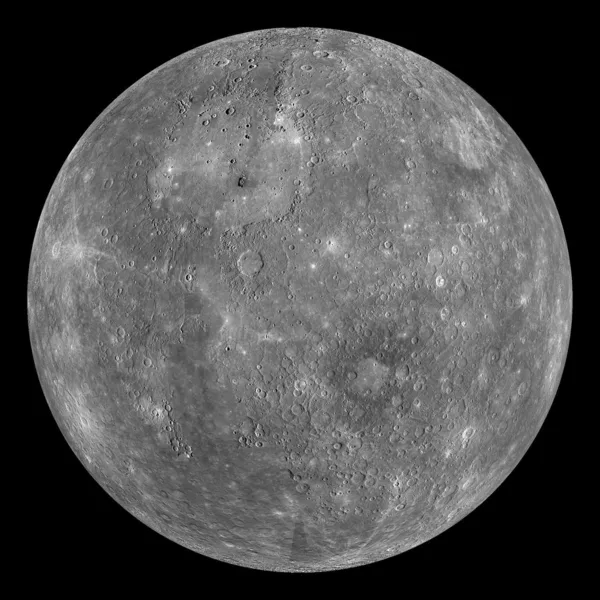
Mercury’s surface looks, at first glance, remarkably similar to our Moon’s: a grey, heavily cratered landscape shaped by billions of years of impacts. But closer study reveals a landscape with its own distinctive character, sculpted by forces unique to a small, sun-scorched, and shrinking world.
The Caloris Basin
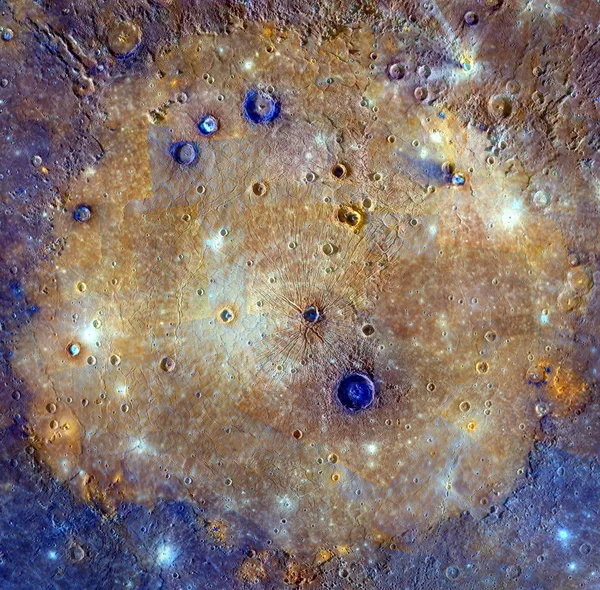
The single most dramatic feature on Mercury’s surface is the Caloris Basin, an impact crater roughly 1,550 kilometers across — large enough to fit the entire state of Texas inside it with room to spare. It formed around 3.8 billion years ago when an asteroid or comet slammed into the young planet with such force that the shockwaves traveled through Mercury’s interior and erupted on the exact opposite side of the planet, creating a bizarre landscape of jumbled, hilly terrain nicknamed “weird terrain” by the scientists who discovered it.
Wrinkle Ridges and a Shrinking Planet
Unlike the Moon, Mercury’s surface is crossed by thousands of long, snaking cliffs called lobate scarps, some over 1,000 kilometers long and up to 3 kilometers high. These features are evidence that Mercury has been shrinking over geological time. As its enormous iron core gradually cooled and contracted, the planet’s crust had nowhere to go but to buckle and fold, like the skin of a grape left out to dry. Measurements suggest Mercury’s radius may have shrunk by as much as 7 kilometers over the past four billion years — making it, quite literally, a planet still wrinkling with age.
Ice in the Shadows
Perhaps the most counterintuitive discovery about Mercury is that this scorching planet harbors water ice. Because Mercury’s axial tilt is almost zero, the floors of certain deep craters near its poles never receive direct sunlight, trapping temperatures permanently below -170°C. Radar observations from Earth in the 1990s first hinted at unusually reflective material inside these permanently shadowed craters, and NASA’s MESSENGER spacecraft later confirmed the presence of water ice, likely delivered over billions of years by comet and asteroid impacts, preserved in these frozen pockets of eternal darkness just kilometers from some of the hottest terrain in the solar system.
A Wisp of an Atmosphere
Mercury does not have an atmosphere in any conventional sense. What it possesses instead is called an exosphere — an extraordinarily thin, fragile envelope of atoms so sparse that they almost never collide with one another, behaving more like a swarm of individual particles in orbit than a true gas.
This exosphere is composed primarily of oxygen, sodium, hydrogen, helium, and potassium, constantly replenished and simultaneously stripped away by several processes:
- Solar wind particles slamming into the surface and kicking up atoms
- Micrometeorite impacts vaporizing tiny amounts of surface material
- Radioactive decay of elements within Mercury’s crust
- Sunlight causing atoms to evaporate directly off the surface, a process called photon-stimulated desorption
Because Mercury lacks any substantial atmosphere to trap heat or distribute it evenly, temperatures swing wildly not just between day and night, but between sunlit craters and permanently shadowed ones just meters away.
A Magnetic Surprise
Given its small size and slow rotation, scientists long assumed Mercury’s core would have solidified completely, extinguishing any magnetic field long ago — a fate that appears to have befallen Mars. Instead, Mariner 10’s flybys in the 1970s detected a genuine, if weak, global magnetic field, about 1% the strength of Earth’s. This finding implied that at least part of Mercury’s core remains liquid and churning, generating a magnetic field through the same dynamo process that powers Earth’s.
MESSENGER later revealed that this magnetic field is oddly offset, centered roughly 20% of the planet’s radius north of Mercury’s geographic equator — an asymmetry that remains an active area of research and hints at unusual internal dynamics within the planet’s molten core layers.
This magnetic field, though faint, is strong enough to carve out a small magnetosphere around Mercury, deflecting solar wind particles and occasionally creating localized magnetic “tornadoes” that funnel charged particles down to the surface — a phenomenon unique among the rocky planets.
Exploring Mercury: A Difficult Destination
It might seem that the closest planet to Earth’s neighborhood in the inner solar system would be the easiest to visit, but the opposite is true. Mercury is, paradoxically, one of the hardest planets to reach.
Why Mercury Is So Hard to Visit
The challenge lies in the Sun’s overwhelming gravity. Any spacecraft heading toward Mercury falls deeper and deeper into the Sun’s gravitational well, accelerating enormously. Without a way to shed that speed, a probe would simply rocket past Mercury rather than settling into orbit. Slowing down requires either enormous amounts of fuel or an elaborate series of gravitational slingshot maneuvers around other planets — a delicate cosmic ballet that can take years to execute.
Mariner 10 (1974–1975)
NASA’s Mariner 10 became the first spacecraft to visit Mercury, using a pioneering gravity-assist flyby of Venus to adjust its trajectory. Over three flybys, it mapped about 45% of the planet’s surface, discovered its surprising magnetic field, and captured the first close-up images of its cratered terrain, forever changing Mercury from a fuzzy telescopic dot into a real, textured world.
MESSENGER (2004–2015)
Decades later, NASA’s MESSENGER spacecraft (an acronym for MErcury Surface, Space ENvironment, GEochemistry, and Ranging) became the first probe to orbit Mercury, after a circuitous seven-year journey involving flybys of Earth, Venus, and Mercury itself to bleed off enough velocity to be captured by Mercury’s gravity. Over four years in orbit, MESSENGER mapped the planet’s entire surface, confirmed polar water ice, revealed Mercury’s true internal structure through gravity measurements, and dramatically deepened our understanding of its exosphere and magnetic field before deliberately crashing into the surface in 2015 once its fuel was exhausted.
BepiColombo: The Current Mission
A joint mission between the European Space Agency and the Japan Aerospace Exploration Agency, BepiColombo launched in 2018 carrying two separate orbiters bundled together for the journey. After a series of flybys of Earth, Venus, and Mercury itself, the spacecraft is scheduled to separate into its two component orbiters to study Mercury’s surface and magnetic environment in unprecedented detail, building on and refining the discoveries made by MESSENGER.
Mercury in Context: Comparing the Inner Planets
| Feature | Mercury | Venus | Earth | Mars |
|---|---|---|---|---|
| Distance from Sun | 57.9 million km | 108.2 million km | 149.6 million km | 227.9 million km |
| Diameter | 4,879 km | 12,104 km | 12,742 km | 6,779 km |
| Moons | 0 | 0 | 1 | 2 |
| Surface atmosphere | Virtually none | Extremely thick | Moderate | Thin |
| Average surface temp | 167°C (wide swings) | 464°C | 15°C | -63°C |
| Global magnetic field | Weak but present | None | Strong | None (remnant only) |
Mercury in Nutshell
It would be easy to dismiss Mercury as a dead, airless rock — a smaller, less dramatic cousin of the Moon parked uncomfortably close to a hostile Sun. But this small planet punches far above its weight in scientific significance. Its oversized core challenges our models of how rocky planets form. Its lingering magnetic field, generated within a body that should have long since gone geologically cold, tests our understanding of planetary dynamos.
Its polar ice deposits demonstrate that even the most extreme environments in the solar system can preserve delicate, unexpected treasures. And its very orbit once served as one of the great triumphs of Einstein’s general relativity, since the tiny, unexplained precession in Mercury’s perihelion — a slight drift in the orientation of its elliptical orbit that Newtonian physics could not fully account for — was finally explained by the warping of spacetime around the Sun’s mass, offering one of the first real-world confirmations of Einstein’s theory in 1915.
Mercury, in other words, is not simply a footnote at the edge of the Sun’s domain. It is a natural laboratory, hiding, beneath its cratered and wrinkled surface, some of the deepest questions in planetary science — questions that spacecraft like BepiColombo are only now beginning to answer, one careful orbit at a time.
References
- NASA Science (n.d.) Mercury overview. Available at: https://science.nasa.gov/mercury/ (Accessed: 3 August 2026).
- NASA Science (n.d.) MESSENGER mission. Available at: https://science.nasa.gov/mission/messenger/ (Accessed: 3 August 2026).
- ESA (n.d.) BepiColombo. Available at: https://www.esa.int/Science_Exploration/Space_Science/BepiColombo (Accessed: 3 August 2026).
- NASA Solar System Exploration (n.d.) Mercury: in depth. Available at: https://solarsystem.nasa.gov/planets/mercury/in-depth/ (Accessed: 3 August 2026).
- USGS Astrogeology (n.d.) Mercury geologic mapping. Available at: https://astrogeology.usgs.gov/ (Accessed: 3 August 2026).
- NASA Photojournal (n.d.) Mercury images archive. Available at: https://photojournal.jpl.nasa.gov/target/Mercury (Accessed: 3 August 2026).