What is Quantum Superposition: How to Be Everywhere at Once?
Introduction: The Coin Flip
Before we look at the math, I want you to imagine flipping a coin. Watch it spin in mid-air. Is it Heads? Is it Tails? Classical physics—the physics of your daily life—says it is definitely one or the other. We just don’t know which one yet because our eyes aren’t fast enough.
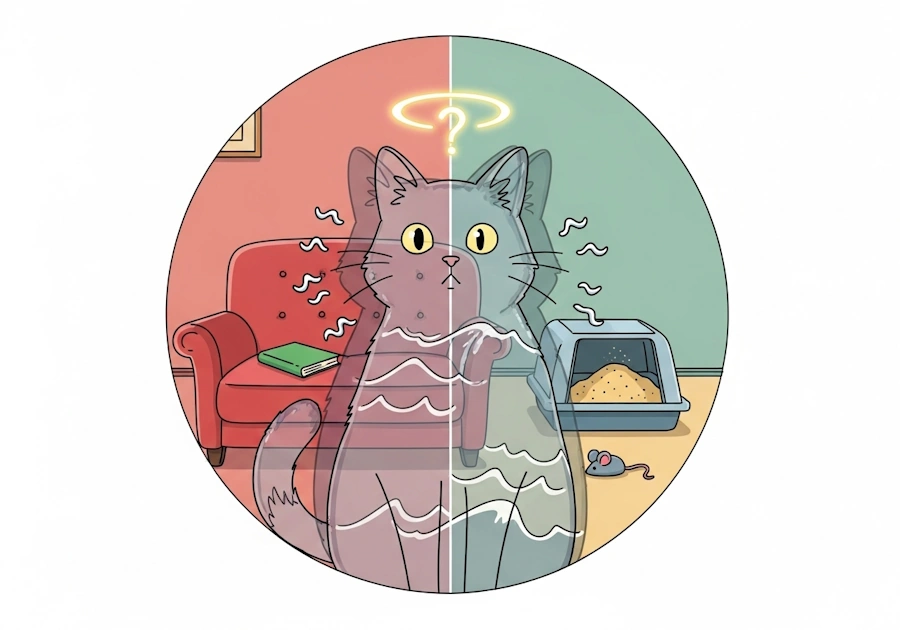
But Quantum Mechanics tells a radically different story. If that coin were an electron, it wouldn’t be Heads or Tails. It would be Heads and Tails at the exact same time.
This is Quantum Superposition. It is not just a mathematical trick; it is the foundation of reality itself. In this lesson, we will explore why particles refuse to make up their minds, how plants use this trick to eat sunlight, and why you don’t see “zombie cats” in real life.
[INTERACTIVE TOOL: SUPERPOSITION SPINNER]
Quantum Coin Flip
Superposition vs. Measurement SimulatorExperiment: Spin the quantum coin. While it spins, it is a blur (Superposition). Stop it (Measure). It snaps to a definite state.
Part 1: What is Superposition?
Superposition allows a quantum system to simultaneously occupy several states at the same time. Unlike our coin, which is secretly either heads or tails, a quantum particle genuinely hasn’t “decided” yet.
The Musical Analogy Think of it like a piano.
- Classical State: Playing a single note (C).
- Superposition: Playing a Chord (C, E, and G together). The chord isn’t just “one note hiding behind another.” It is a combination of notes creating a unique sound. Similarly, a particle in superposition isn’t hiding its location; it is physically occupying a combination of locations.
The Collapse When we measure a quantum system, the superposition “collapses” into one definite state.
- Before measurement: A mathematical combination of possibilities.
- After measurement: A single, boring reality. This isn’t because we finally “found” the particle. The act of measurement forced the particle to choose a spot.
Part 2: Seeing the Impossible (The Double-Slit)
The Double-Slit Experiment stands as the most iconic demonstration of this concept. Physicist Richard Feynman famously called this “the only mystery” of quantum mechanics.
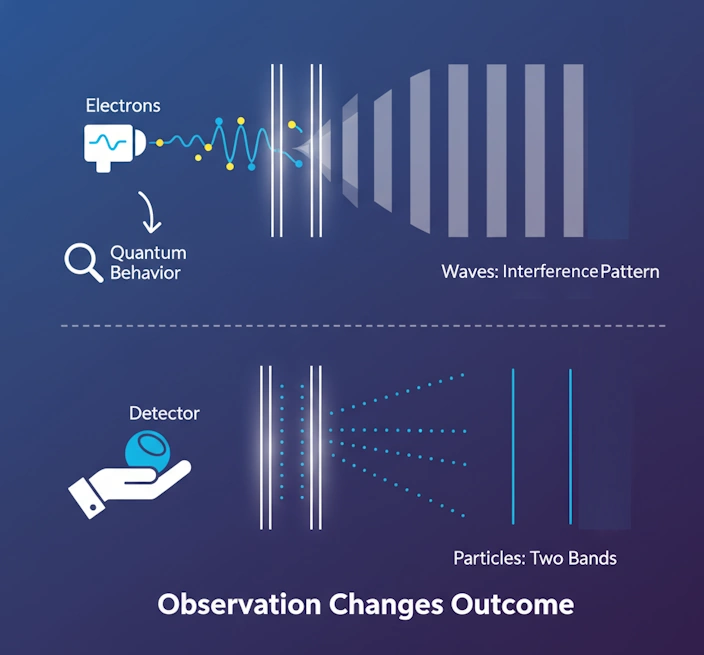
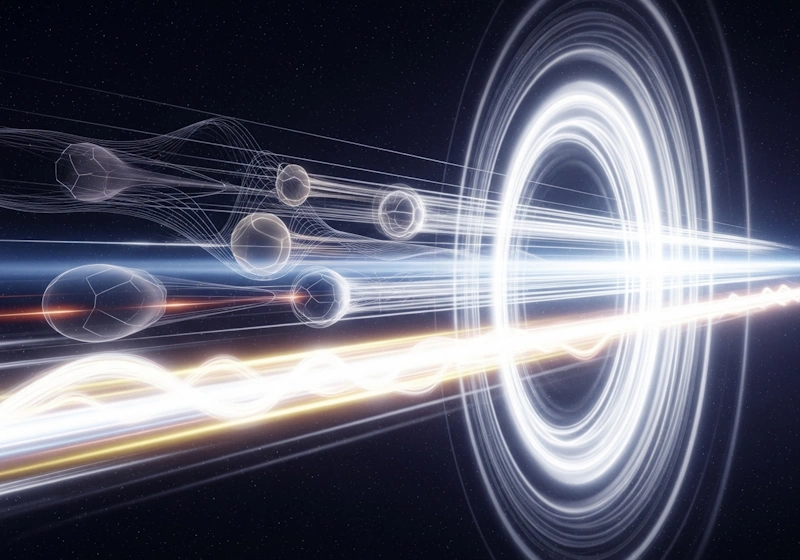
The Setup: We fire particles (electrons or photons) at a wall with two slits cut in it. Behind that wall is a detector screen.
The Weirdness: If you fire particles one by one, you would expect two piles of particles behind the slits. Instead, you get an Interference Pattern—bands of light and dark stripes. This is what waves do when they crash into each other.
- The Question: How can a single particle interfere with itself?
- The Answer: The particle goes through both slits at the same time.
It travels through Slit A and Slit B simultaneously. The “ghost” of the particle in Slit A bumps into the “ghost” in Slit B, creating the wave pattern.
The Collapse: If you put a camera by the slits to see which one it went through, the interference pattern vanishes. The particle gets shy. It behaves like a solid rock again. The moment you measure it, the superposition dies.
Part 3: The Cat Paradox (And Why It’s Misleading)
In 1935, Erwin Schrödinger proposed a thought experiment to show how ridiculous this concept was.

The Box: A cat sits sealed in a box alongside a radioactive atom.
- If the atom decays -> Poison is released -> Cat dies.
- If the atom doesn’t decay -> No poison -> Cat lives.
Because the atom is in superposition (Decayed + Not Decayed), the cat must also be in superposition (Dead + Alive).
Is this real? Yes and No. It captures the math perfectly, but it is deeply misleading about reality. Cats are not quantum objects.
The Problem is Decoherence. This is a critical keyword: Decoherence. A quantum state is incredibly fragile. It relies on isolation. A cat is constantly being hit by air molecules, light photons, and heat. The environment is “measuring” the cat billions of times a second.
- The Result: The delicate superposition collapses instantly. For a macroscopic object like a cat, the collapse happens so fast that the “Zombie State” never meaningfully exists.
Schrödinger wasn’t saying cats are zombies. He was challenging physicists to explain why the rules of atoms don’t apply to the rules of cats. The answer is the environment.
Part 4: Deep Dive — Pushing the Limits (Grades 10-12)
For decades, we thought superposition only worked on single atoms. But modern technology is proving that wrong. We are making bigger and bigger “cats.”
1. Molecules Scientists have put molecules containing over 2,000 atoms into superposition. This proves the effect isn’t limited to the smallest scales.
2. Superconducting Circuits In quantum computers, we create circuits where billions of electrons flow in opposite directions at the same time.
- Update 2024: Researchers recently achieved a coherence time of 1,400 seconds (23 minutes) for a Schrödinger-cat state. That is an eternity in the quantum world.
3. Mechanical Oscillators Physicists have managed to put tiny mirrors and vibrating drums into superposition. They are vibrating and standing still simultaneously. These are objects you could technically see with a microscope!
The Lesson: The boundary between the “Quantum World” and the “Real World” isn’t a hard line. It is determined by how well you can isolate an object from the environment.
Part 5: Real World Applications (It’s Not Just Theory)
You might think this is just blackboard math. It isn’t. It is building the future.
1. Quantum Computing
Classical computers use Bits (0 or 1). Quantum computers use Qubits. Because of superposition, a Qubit can be 0 and 1 at the same time.
- The Power: A quantum computer with just 300 qubits could process more combinations simultaneously than there are atoms in the universe. This allows us to solve problems (like drug discovery) that would take a normal supercomputer a million years.
2. Quantum Biology (Nature did it first)
This is the most surprising discovery of the 21st century. Photosynthesis might be quantum. When a plant captures a photon of light, that energy needs to find its way to the “reaction center” to be turned into food.
- The Old View: The energy bounces around randomly until it finds the hole.
- The Quantum View: The energy enters superposition. It travels every possible path at once, finds the most efficient route, and takes it. This allows plants to transfer energy with nearly 100% efficiency—far better than any solar panel humans have built.
3. Bird Navigation
Migratory birds (like the European Robin) can see the Earth’s magnetic field. Research suggests they have a protein in their eyes that uses Quantum Entanglement and superposition. The magnetic field alters the spin of electrons in their eyes, allowing them to “see” north.
Part 6: Famous Experiments (Advanced Study)
If you want to sound smart at a dinner party, mention these experiments that proved superposition is real.
1. The Stern-Gerlach Experiment (1922) This was the first proof that particles have intrinsic quantum properties. Silver atoms were fired through a magnetic field. Instead of spreading out, they split into two discrete beams. This proved that “Spin” exists in superposition until measured.
2. The Quantum Eraser This is a mind-bending variation of the Double-Slit. Scientists found that even after a particle goes through the slits, if you destroy the information about which path it took, the interference pattern (superposition) comes back.
- The Implication: It isn’t just about physical interaction; it is about Information. If the information exists, the wave collapses. If you erase the information, the wave returns.
3. Leggett-Garg Inequality These tests check if macro objects (big things) follow quantum rules. The results consistently show that even larger systems violate classical physics if they are isolated enough.
Teacher’s Note: Is this Mystical?
You will hear people say superposition proves “Telepathy” or “Parallel Realities.” Be careful. Superposition is a strict mathematical description. It does not mean “anything is possible.” It means the universe is fundamentally probabilistic, not deterministic. It doesn’t mean your thoughts change reality; it means measurement changes reality.
Summary of Key Terms
- Superposition: The ability of a system to be in multiple states at once.
- Wave Function: The mathematical map of those probabilities.
- Collapse: The moment measurement forces a choice.
- Decoherence: The environment messing up the superposition (why cats aren’t zombies).
- Qubit: The basic unit of quantum information.
🎓 Quiz: Understanding Superposition
1. In the Double-Slit experiment, what happens if you DO NOT measure which slit the particle goes through?
- A) It creates two bands (Particle behavior)
- B) It creates an interference pattern (Wave behavior)
- C) It bounces back
- D) It disappears
👉 Click to check answer
The particle goes through both slits simultaneously and interferes with itself.
2. Why don’t we see everyday objects (like cats) in superposition?
- A) They are too heavy
- B) Quantum physics is wrong
- C) Decoherence (interaction with the environment)
- D) Gravity crushes the wave function
👉 Click to check answer
The environment “measures” large objects constantly, destroying the superposition instantly.
3. How does Photosynthesis potentially use superposition?
- A) To create chlorophyll
- B) To find the most efficient path for energy transfer
- C) To block UV rays
- D) To generate heat
👉 Click to check answer
Energy explores all possible paths at once to reach the reaction center.
4. What is a “Qubit”?
- A) A unit of length
- B) A classical computer bit (0 or 1)
- C) A quantum bit that can be 0 and 1 simultaneously
- D) A measure of radiation
👉 Click to check answer
This property allows massive parallel computing power.
5. What happens when you “measure” a system in superposition?
- A) The Wave Function Collapses
- B) The particle duplicates
- C) Time reverses
- D) The particle speeds up
👉 Click to check answer
The probability cloud vanishes, and the system chooses a single, definite state.
Sources & References
Foundational Quantum Mechanics Sources
- Feynman, R. P., Leighton, R. B., & Sands, M. (1964). The Feynman Lectures on Physics, Vol. III: Quantum Mechanics. Addison-Wesley. (Covers double-slit experiment and superposition basics.)
- Schrödinger, E. (1935). “Die gegenwärtige Situation in der Quantenmechanik.” Naturwissenschaften, 23(48), 807-812. (Original Schrödinger’s cat paper.)
Superposition and Experiments
- Young, T. (1804). “Experiments and calculations relative to physical optics.” Philosophical Transactions of the Royal Society. (Historical double-slit foundation.)
- Stern, O., & Gerlach, W. (1922). “Der experimentelle Nachweis des magnetischen Moments des Silberatoms.” Zeitschrift für Physik, 9(1), 349-352. (Stern-Gerlach experiment on spin superposition.)
- Scully, M. O., & Drühl, K. (1982). “Quantum eraser: A proposed photon correlation experiment concerning observation and ‘delayed choice’ in quantum mechanics.” Physical Review A, 25(4), 2208-2213. (Quantum eraser experiment.)
Decoherence and Modern Interpretations
- Zurek, W. H. (2003). “Decoherence and the transition from quantum to classical.” Physics Today, 56(11), 33-39. (Explains why macroscopic superposition like cats doesn’t persist.)
- Joos, E., et al. (2003). Decoherence and the Appearance of a Classical World in Quantum Theory. Springer.
Applications (Quantum Computing, Biology)
- Nielsen, M. A., & Chuang, I. L. (2010). Quantum Computation and Quantum Information. Cambridge University Press. (Qubits and superposition in computing.)
- Engel, G. S., et al. (2007). “Evidence for wavelike energy transfer through quantum coherence in photosynthetic systems.” Nature, 446(7137), 782-786. (Quantum superposition in photosynthesis.)
- Ritz, T., et al. (2000). “A model for photoreceptor-based magnetoreception in birds.” Biophysical Journal, 78(2), 707-718. (Quantum effects in bird navigation.)
Educational Overviews
- HyperPhysics: Quantum Superposition. Georgia State University. (http://hyperphysics.phy-astr.gsu.edu/hbase/quantum/sup1.html)
- PBS Space Time: “Quantum Superposition Explained.” (YouTube series on double-slit and cat paradox.)
- Stanford Encyclopedia of Philosophy: “Many-Worlds Interpretation” and “Quantum Mechanics.” (plato.stanford.edu)