Quantum Gravity — The Quest for the “Theory of Everything”
Introduction to Quantum Gravity: The Edge of Reality
Let’s imagine this: You are standing at the edge of a black hole. According to Einstein, you are sliding down a smooth, infinite curve of spacetime. But according to quantum mechanics, the space around you is boiling with particles popping in and out of existence.
Which theory is right? This isn’t science fiction—it is the bizarre realm where Quantum Mechanics meets General Relativity. Physicists call this quest Quantum Gravity, and it is widely considered the most important unsolved puzzle in all of science.
In this lesson, we will explore why our two best theories hate each other, the wild ideas (like String Theory and Loop Quantum Gravity) trying to fix them, and why space itself might be made of “pixels.”
[INTERACTIVE TOOL: THE FABRIC OF SPACE]
Fabric of Space
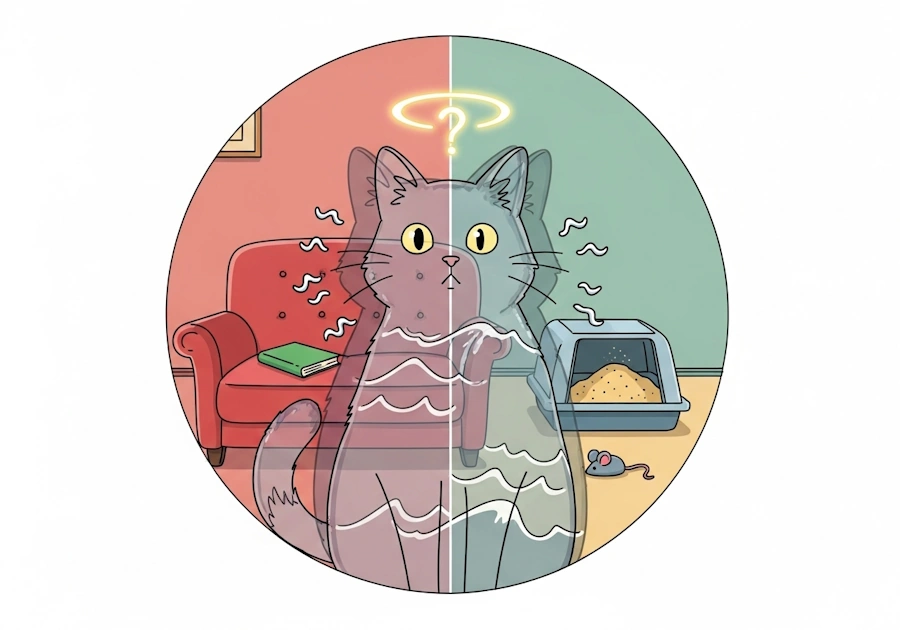
Experiment: Zoom in on a piece of space.
- Level 1 (Einstein): It looks smooth like a trampoline.
- Level 2 (Quantum): It looks like a foaming, bubbling ocean of energy.
Part 1: The Great Conflict (Classical vs. Quantum)
For over a century, physicists have lived with an uncomfortable truth: our two most successful theories simply refuse to play nice together.
1. General Relativity (The Smooth World)
This paints gravity as the curvature of spacetime. It is elegant, smooth, and predictable. It rules the macroscopic world of stars, galaxies, and Cosmology.
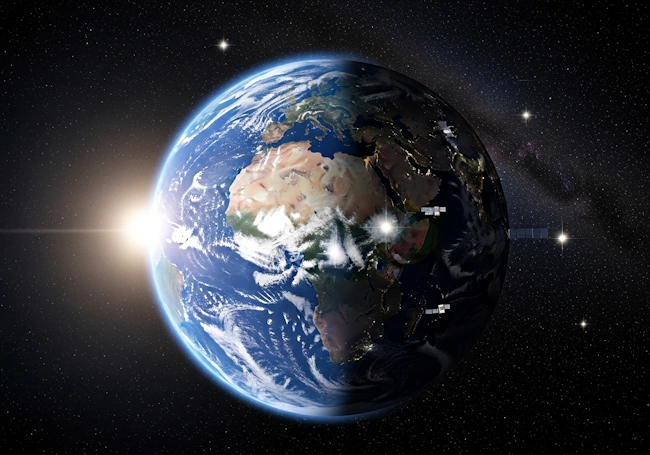
Without it: GPS satellites wouldn’t work.
2. Quantum Field Theory (The Pixelated World)
This describes everything else (electromagnetism, nuclear forces) through probabilities and uncertain particles.
Without it: Your smartphone and computer wouldn’t exist.
The Breakdown:
Both theories work brilliantly in their own domains. But ask what happens when you need both—say, inside a Black Hole (which is heavy like a star but small like an atom)—and the math explodes.
Infinities appear where they shouldn’t. Causality gets murky. It is as if nature speaks two completely different languages depending on the scale you are examining.
Part 2: The Granular Universe (Loop Quantum Gravity)
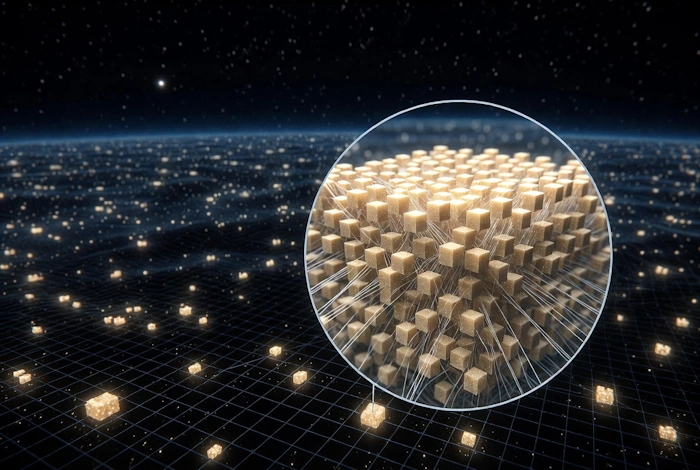
One of the most mind-bending possibilities emerging from Loop Quantum Gravity Theory is that spacetime itself might be “granular”—made of discrete chunks rather than being smoothly continuous like we have always assumed.
The “Space Pixel”
Loop Quantum Gravity suggests that space comes in tiny, indivisible units about 10−35 meters across (The Planck Length).
- At this scale, the smooth fabric of Einstein’s spacetime gives way to a “Quantum Foam.”
- Analogy: Look at a T-shirt from across the room; it looks like smooth fabric. Look at it under a microscope; it is made of individual threads. Space might be woven from threads of gravity.
Carlo Rovelli, one of the theory’s architects, describes it poetically: Space isn’t a container that holds things; it emerges from the quantum relationships between objects.
Part 3: The Landscape of Theories (Strings, Loops, and Liouville)
The world of quantum gravity looks less like a neat roadmap and more like a wild brainstorming session. Instead of a single clear theory, physicists are locked in a fierce clash of competing ideas.
1. String Theory
This proposes that fundamental particles (electrons, quarks) aren’t points, but tiny vibrating strings.
- The Catch: It requires 10 or 11 dimensions.
- The Link: Quantum gravity and string theory are often discussed together because strings naturally produce a particle called a “graviton“—the theoretical carrier of gravity.
2. Liouville Quantum Gravity
While String Theory adds dimensions, Liouville Quantum Gravity tries to simplify things. It is a mathematical framework that focuses on 2D surfaces to understand how quantum gravity works in simpler models. It helps physicists test their math before applying it to our complex 4D universe.
3. Emergent Gravity
Some researchers propose that gravity might be an illusion. It might be a side effect of how quantum information gets entangled across space (Entropy). Just as “Heat” isn’t a particle but the movement of atoms, “Gravity” might just be the movement of information.
Part 4: The Black Hole Information Paradox
Perhaps nowhere is the clash more dramatic than in Quantum Gravity and Black Holes.
When Stephen Hawking showed that black holes should evaporate by emitting radiation (Hawking Radiation), he accidentally created a crisis.
The Problem:
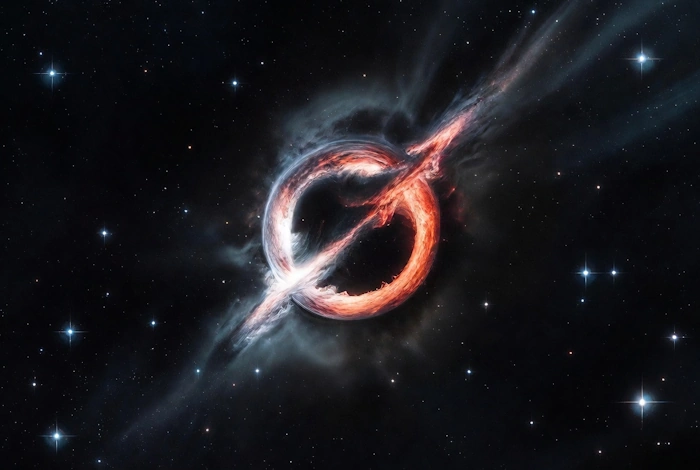
Quantum mechanics insists that information is never destroyed. But if a black hole evaporates completely, where does the information about the stuff that fell inside go?
-
Does it vanish? (Violates Quantum Mechanics).
-
Does it stay? (Violates Relativity).
The Solution? The Holographic Principle
This leads to the concept of Quantum Gravity and the Holographic Mass.
The theory suggests that all the information inside the black hole is actually encoded on its surface (The Event Horizon), like a 2D hologram projecting a 3D image. If this is true, our entire universe might be a hologram.
Part 5: Time and Consciousness (The Wild Frontier)
In the realm of quantum gravity, even “Time” itself is up for debate. Some theories suggest time is just an emergent property—an illusion created by quantum correlations, much like heat is just the movement of atoms.
Quantum Gravity and Consciousness
This is where things get controversial. Standard physics usually keeps the brain and black holes in separate categories. But Nobel Laureate Sir Roger Penrose has a different idea. He suggests that Quantum Gravity and Consciousness are deeply intertwined.
The Theory (Orch-OR): Penrose argues that consciousness isn’t just neurons firing electricity. He believes it is the result of gravity causing quantum states to collapse inside tiny structures in our brain cells called microtubules. Is it true? Most physicists remain skeptical. But it stands as a fascinating attempt to link the biology of our minds with the fundamental physics of the universe.
Part 6: Testing the Untestable
Here is the bad news: Testing Quantum Gravity Theory is a nightmare. The energy required to see these effects is insane. You would need a particle accelerator the size of the Milky Way to see space “pixelate.” The Large Hadron Collider isn’t even close.
So, how do we find it? We have to look at the sky.
1. Gravitational Waves
When black holes crash into each other, they send ripples through spacetime. If we look closely enough, those ripples might look “fuzzy” or pixelated—a signature of quantum gravity.
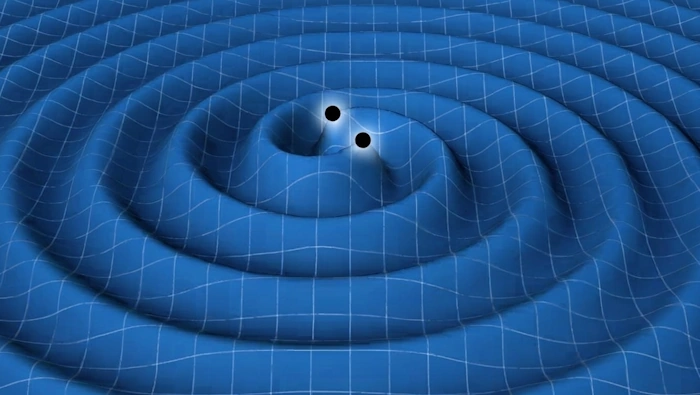
What do you see on this picture? It’s one of the classic ways we visualize two black holes that are orbiting each other, getting closer and closer in what we call a binary system.
Imagine spacetime (the fabric that combines space + time) as a stretchy rubber sheet. A single black hole already bends it into a deep funnel — the heavier the black hole, the deeper and steeper the funnel.
Now put two black holes close together: each one tries to make its own funnel, but because they’re moving around each other very fast, the whole sheet gets twisted and pulled into this dramatic double-dip shape with circular waves/ripples spreading outward.
Those blue grid lines that look like they’re being sucked into a whirlpool? That’s our coordinate system getting horribly distorted by extreme gravity. The two dark spots are the event horizons — the points of no return.
As the black holes spiral inward (inspiral phase), they lose orbital energy by sending out gravitational waves (those outgoing ripples). Eventually they collide and merge into one bigger black hole.
2. The CMB
We can look at the Cosmic Microwave Background—the baby picture of the universe. It might hold “scars” or patterns left over from quantum events that happened seconds after the Big Bang.
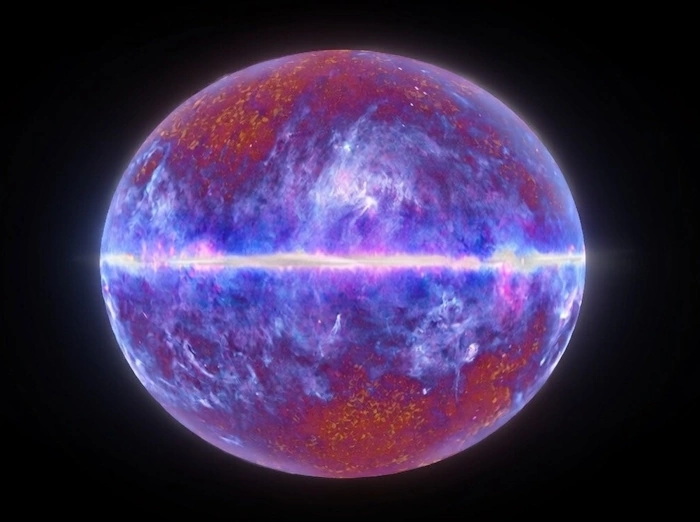
What do you see on this picture? Imagine the universe right after the Big Bang: for the first ~380,000 years it was a hot, dense plasma of particles and light — so hot and dense that light couldn’t travel very far without bumping into electrons. It was completely opaque, like being inside a thick fog (or the inside of a star).
Then, as the universe expanded and cooled to about 3000 K, electrons combined with protons to form neutral atoms for the first time. Suddenly the fog cleared — light could travel freely across the cosmos. That moment is called “recombination” or “decoupling”.
The light that was set free at that exact time has been traveling ever since — for ~13.8 billion years. Because the universe keeps expanding, that light has been stretched (redshifted) from visible/infrared light all the way down to microwave wavelengths today. That’s why we call it the Cosmic Microwave Background.
Today this radiation fills every cubic centimeter of space, coming from every direction equally. It’s incredibly uniform, with an average temperature of just 2.725 K (that’s -270.425 °C — only 2.725 degrees above absolute zero!). But when we look very carefully (with satellites like COBE, WMAP, and Planck), we see tiny temperature differences — only about 1 part in 100,000 (±0.00003 K or so). Those minuscule hot and cold spots are incredibly important: they are the seeds of all the structure we see today — galaxies, clusters of galaxies, filaments, and voids.
3. The Handbook of Quantum Gravity
Since we can’t build the machine, physicists are building a “rulebook.” By observing what space doesn’t do, they are narrowing down the possibilities, creating a handbook of constraints that any future theory must obey to be taken seriously.
Conclusion: The Holy Grail
So, why does this matter? Why spend billions chasing invisible pixels?
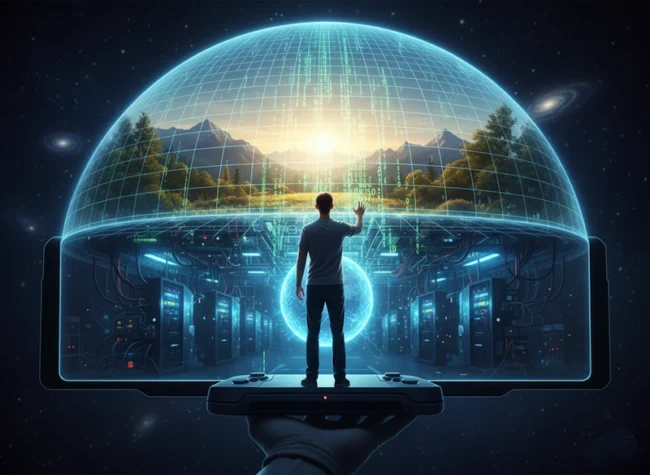
Because a working theory of quantum gravity is the Theory of Everything. It is the missing key. It would explain how the Big Bang started. It would solve the annoying mystery of Dark Energy. It might even tell us, once and for all, if our universe is “base reality” or just a holographic simulation.
We aren’t there yet. But the fact that human beings—living on a rock orbiting an average star—can even ask these questions? That is the real miracle.
🎓 Quiz: The Search for Quantum Gravity
1. Why do General Relativity and Quantum Mechanics conflict?
- A) One uses math, the other uses philosophy
- B) Relativity is smooth, Quantum Mechanics is discrete/probabilistic
- C) Einstein didn’t like quantum mechanics
- D) They describe different universes
👉 Click to check answer
The math breaks down when you try to combine smooth curves with jittery particles.
2. What does Loop Quantum Gravity propose about space?
- A) It is made of vibrating strings
- B) It is a smooth fabric
- C) It is made of discrete “loops” or chunks (Granular)
- D) It doesn’t exist
👉 Click to check answer
At the Planck scale, space becomes pixelated like a cosmic foam.
3. What is the “Holographic Principle”?
- A) The universe is a fake simulation
- B) Information in a 3D volume is encoded on a 2D surface
- C) Black holes are actually stars
- D) Gravity is a hologram
👉 Click to check answer
This theory emerged from studying black hole entropy.
4. Why is String Theory difficult to test?
- A) It requires extra dimensions we cannot see
- B) The math is too easy
- C) It only works for planets
- D) It has been disproven
👉 Click to check answer
It predicts 10 or 11 dimensions, but we only experience 4 (3 space + 1 time).
5. What is the Planck Length?
- A) The size of an atom
- B) The distance light travels in a year
- C) The smallest possible unit of space
- D) The size of a black hole
👉 Click to check answer
Below this scale ($10^{-35}$ meters), classical geometry breaks down.
Sources & References
- Rovelli, C. (2008) ‘Loop Quantum Gravity’, Living Reviews in Relativity, 11(5). Available at: https://link.springer.com/article/10.12942/lrr-2008-5 (Accessed: 15 August 2025).
- Ashtekar, A. & Lewandowski, J. (2004) ‘Background independent quantum gravity: A status report’, Classical and Quantum Gravity, 21(15), pp. R53–R152.
- Harlow, D. (2016) ‘Jerusalem Lectures on Black Holes and Quantum Information’, Reviews of Modern Physics, 88(1), 015002.
- Bekenstein, J.D. (2003) ‘Information in the Holographic Universe’, Scientific American, 289(2), pp. 58–65.
- Hawking, S.W. (1976) ‘Breakdown of Predictability in Gravitational Collapse’, Physical Review D, 14(10), pp. 2460–2473.
- Maldacena, J. (1999) ‘The Large N Limit of Superconformal Field Theories and Supergravity’, International Journal of Theoretical Physics, 38, pp. 1113–1133.
- Polchinski, J. (1998) ‘String Theory’ Vols 1 and 2, Cambridge: Cambridge University Press.
- Smolin, L. (2001) ‘Three Roads to Quantum Gravity’, New York: Basic Books.
- Susskind, L. (2008) ‘The Black Hole War: My Battle with Stephen Hawking to Make the World Safe for Quantum Mechanics’, New York: Little, Brown and Company.
- Seiberg, N. (2020) ‘Emergent Spacetime’, Annual Review of Nuclear and Particle Science, 70, pp. 263–284.
- Sorkin, R.D. (2005) ‘Causal Sets: Discrete Gravity’, in Gibbons, G.W., Shellard, E.P.S. & Rankin, S.J. (eds.) The Future of Theoretical Physics and Cosmology. Cambridge: Cambridge University Press, pp. 603–617.
- Wald, R.M. (2001) ‘The Thermodynamics of Black Holes’, Living Reviews in Relativity, 4(6).