Quantum Entanglement: Einstein’s “Spooky Action”
Introduction to Quantum Entanglement: The Telepathic Dice
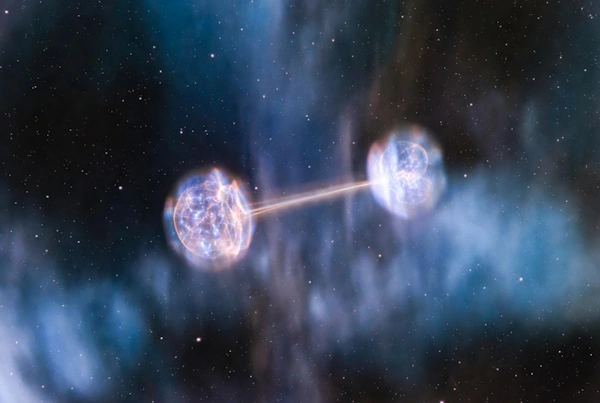
Imagine you have two dice. You fly one to the Moon, and you keep one on Earth.
You roll your die on Earth. It lands on a 6.
At that exact same instant, the die on the Moon also lands on a 6.
You try again. You roll a 2. The Moon die rolls a 2.
This sounds like magic (or cheating). But in the quantum world, this is real.
This phenomenon is called Quantum Entanglement. It suggests that two particles can become so deeply linked that they share the same existence, no matter how far apart they are. Einstein hated it. He called it “spooky action at a distance.”
In this lesson, we will explore how this connection works, why it breaks the rules of space, and whether your own brain might be a quantum computer.
[INTERACTIVE TOOL: THE MAGIC SPINNERS]
Quantum Link
State: CollapsedExperiment: Spin two entangled wheels. Stop the red one. Notice how the blue one instantly snaps to the opposite color, no matter where you move it on the screen.
Part 1: The Basics of Quantum Entanglement – What is it?
At its core, quantum entanglement occurs when two particles (like electrons or photons) interact and become mathematically linked.
- The Link: They stop being two separate objects. They become one single system sharing a wave function.
- The Spookiness: Even if you separate them by light-years, measuring one instantly determines the state of the other.
It means that distance doesn’t matter – two particles will be connected no matter what, even millions of light years between each other. It goes against laws of classical physics, because normally objects cannot travel faster than light, so it seems that one object cannot affect another one instantly, if they are so far away from each other.
The 1935 Argument (EPR Paradox)
Albert Einstein, Boris Podolsky, and Nathan Rosen (EPR) wrote a famous paper arguing that this was impossible.
Locality Principle: They believed objects are only influenced by their immediate surroundings. Nothing travels faster than light.
Einstein’s Conclusion: If quantum mechanics predicts instant connection, the theory must be incomplete. There must be “hidden variables” (secret instructions inside the particles) that decided the outcome before they separated.
Spoiler Alert: Einstein was wrong. Decades of experiments have proven that the particles do not have hidden instructions. They genuinely decide their state at the moment of measurement, and that decision travels instantly across space.
Part 2: How Quantum Entanglement Works (The Mechanics)
The mechanism comes down to Superposition (which we learned in Lesson 6).
Imagine we generate two entangled photons.
- Before Measurement: Both photons are in a superposition. They are both Vertical AND Horizontal polarization at the same time.
- The Measurement: You catch Photon A and measure it. The superposition collapses. It becomes Vertical.
The Instant Effect: Because they are one system, Photon B instantly collapses too. It becomes Horizontal (the opposite).
It doesn’t matter if Photon B is in the next room or the Andromeda Galaxy. The collapse is simultaneous.
Faster than Light?
Does this imply we could transmit signals faster than light? No.
You cannot force Photon A to be Vertical. The result is random. Therefore, you cannot use this link to send Morse Code or data to the other side. This is known as the No-Communication Theorem.
Part 3: Deep Dive — Macroscopic Entanglement (Grades 11-12)
For a long time, we thought entanglement only happened to tiny, invisible particles.
We thought the “noise” of the real world (heat, air) would destroy the delicate link (Decoherence).
The 2021 Breakthrough
That changed in 2021. Two teams (Aalto University and NIST) managed to entangle Macroscopic Objects.

The Objects: Tiny aluminum drums (about the width of a hair).
The Result: These drums vibrated in perfect entangled synchronization.
What does it mean: These drums contain trillions of atoms. This proves that quantum rules don’t just apply to the subatomic world; they apply to big things, too, if we can isolate them enough.
Part 4: The Consciousness Question (Is Your Brain Quantum?)
This is the most controversial frontier in science.
Could entanglement explain Consciousness?
The Skeptics (Classical Neuroscience)
Most neuroscientists say No.
The brain is “wet, warm, and noisy.” Quantum states are fragile; they usually collapse in femtoseconds (trillionths of a second) in warm environments.
Argument: The brain works like a classical computer, using chemical signals (neurotransmitters) that are too slow for quantum effects.
The Believers (Quantum Biology)
However, physicist Sir Roger Penrose and anesthesiologist Stuart Hameroff have a theory called Orch-OR.
Microtubules: Inside your neurons, there are tiny protein structures called microtubules. Penrose argues these tubes might be small enough to shelter quantum states from the noise.
The Evidence (2024): A study found that anesthetics (drugs that knock you out) specifically bind to these microtubules. This suggests that consciousness might indeed be linked to quantum vibrations inside these structures.
What about Telepathy?
Does this mean we are entangled with our loved ones?
Scientific Consensus: No.
Why: Even if your brain uses quantum effects internally, there is no mechanism for entanglement to jump between two separate brains across the air. The “connection” you feel is likely empathy and psychology, not physics.
Part 5: Real World Tech That Uses Quantum Entanglement
Entanglement isn’t just philosophy; it is engineering.
1. Quantum Cryptography
We can use entangled photons to create “unhackable” keys. If a spy tries to intercept the key, the entanglement breaks (collapses). The receiver knows instantly that the line is tapped.
2. Quantum Teleportation
We have already teleported information.
How: You take Particle A and entangle it with Particle B. You perform a measurement on A, and the state of A is transferred instantly to B.
Note: We teleport the information (the quantum state), not the physical matter. Star Trek transporters are still a long way off.
Summary of Key Terms
Entanglement: A state where multiple particles share a single wave function.
Non-Locality: The ability of particles to influence each other across space instantly.
Bell’s Theorem: The mathematical proof that “Hidden Variables” (Einstein’s idea) are wrong.
Microtubules: Tiny structures in neurons that might host quantum processing.
🎓 Quiz: Understanding Entanglement
1. What did Einstein call quantum entanglement?
- A) The God Particle
- B) Spooky Action at a Distance
- C) The Unified Theory
- D) A Cosmic Mistake
👉 Click to check answer
He was disturbed by the idea that particles could communicate instantly.
2. Can you use entanglement to send a text message faster than light?
- A) Yes, instantly
- B) Only if the particles are close
- C) No, because the outcome is random
- D) Yes, but only in space
👉 Click to check answer
You cannot force the particle to be a “1” or “0,” so you cannot encode data.
3. What macroscopic (large) object was successfully entangled in 2021?
- A) A Cat
- B) Tiny Aluminum Drums
- C) A Diamond
- D) A Gold Ring
👉 Click to check answer
This proved quantum mechanics applies to objects with trillions of atoms.
4. Which part of the neuron might host quantum processes?
- A) The Axon
- B) The Nucleus
- C) Microtubules
- D) Mitochondria
👉 Click to check answer
Sir Roger Penrose theorizes these structures protect quantum states in the brain.
5. What does measuring one entangled particle do to its partner?
- A) Nothing
- B) Destroys it
- C) Instantly determines its state
- D) Makes it spin faster
👉 Click to check answer
The wave function for both particles collapses simultaneously.
Sources & References for the lesson
Foundational Papers & History
- Einstein, A., Podolsky, B., & Rosen, N. (1935). “Can Quantum-Mechanical Description of Physical Reality Be Considered Complete?” Physical Review, 47(10), 777-780. (EPR Paradox introducing “spooky action.”)
- Bell, J. S. (1964). “On the Einstein Podolsky Rosen Paradox.” Physics Physique Fizika, 1(3), 195-200. (Bell’s Theorem disproving hidden variables.)
Experiments & Macroscopic Entanglement
- Hensen, B., et al. (2015). “Loophole-free Bell inequality violation using electron spins separated by 1.3 km.” Nature, 526(7575), 682-686. (Loophole-free Bell test.)
- Teufel, J. D., et al. (2021). “Entanglement of macroscopic mechanical oscillators.” Nature, 596(7872), 357-361. (NIST/Aalto aluminum drums macroscopic entanglement.)
Quantum Biology & Applications
- Hameroff, S., & Penrose, R. (2014). “Consciousness in the universe: A review of the ‘Orch OR’ theory.” Physics of Life Reviews, 11(1), 39-78. (Orch-OR theory on microtubules.)
- Aspect, A., Dalibard, J., & Roger, G. (1982). “Experimental Test of Bell’s Inequalities Using Time-Varying Analyzers.” Physical Review Letters, 49(25), 1804-1807. (Key Bell test experiment.)