Key takeaways about Russula nobilis
- Russula nobilis is a common but toxic mushroom often found in beech woodlands, known for its bright red cap and brittle structure, making it a classic example of nature’s warning colors.
- It should not be consumed, as it can cause gastrointestinal distress like vomiting and stomach pain, though it’s rarely fatal in healthy adults.
- Foragers should avoid confusion with similar red-capped species, such as the Sickener (Russula emetica), which grows in different habitats but shares toxicity risks.
- It’s widespread in temperate regions, but always confirm local presence and expert identification before any interaction.
- Look for a 3-9 cm red cap that’s slightly sticky when wet, white brittle gills, and a firm white stem. It has a faint coconut smell in youth but tastes intensely hot if sampled (spit out immediately). Avoid picking without expertise, as misidentification can lead to discomfort.
- Though not deadly for most, it causes nausea and cramps due to unidentified toxins, possibly sesquiterpenes. Safer edible Russulas exist, but always use multiple field guides. If symptoms occur after ingestion, seek medical advice promptly.
What is Russula nobilis?
This striking red-capped mushroom, a member of the extensive Russula genus, serves as a vital component in forest ecosystems while posing risks to unwary foragers. Discovered and classified in the early 20th century, it has garnered attention for its ecological role, distinctive morphology, and toxic properties.
Taxonomy
The scientific taxonomy of Russula nobilis places it firmly within the fungal kingdom, reflecting its evolutionary adaptations as a basidiomycete. Below is the full hierarchical classification, based on modern phylogenetic analyses from databases like MycoBank and NCBI:
- Kingdom: Fungi – Heterotrophic organisms with chitinous cell walls, absorbing nutrients from their environment.
- Subkingdom: Dikarya – Characterized by dikaryotic hyphae, uniting Basidiomycota and Ascomycota.
- Phylum (Division): Basidiomycota – Produces spores on basidia; includes many macroscopic mushrooms with over 30,000 species.
- Class: Agaricomycetes – Encompasses fleshy fruiting bodies like agarics, emphasizing gilled structures.
- Order: Russulales – Features brittle-fleshed mushrooms; known for mycorrhizal associations.
- Family: Russulaceae – Includes genera like Russula and Lactarius; noted for brittle gills and absence of latex in Russula.
- Genus: Russula – Comprises brittlegills with colorful caps, brittle gills, and mycorrhizal habits; over 750 species worldwide.
- Species: nobilis – Specific epithet meaning “noble” or “distinct”; binomial Russula nobilis Velen., 1920.
Synonyms include Russula mairei Singer (honoring French mycologist René Maire), Russula barlae, and Russula patouillardii, reflecting historical taxonomic revisions. The type specimen originates from the Czech Republic, with no subspecies noted. Phylogenetic studies using ribosomal RNA confirm its placement, linking it to other acrid-tasting Russulas.
Common names and etymology
Russula nobilis is widely known as the Beechwood Sickener, a name that underscores its habitat preference and toxic effects. Other vernacular names include Tegyll Brau Nobl (Welsh), Gołąbek Buczynowy (Polish), and Bükkfa-Galambgomba (Hungarian). The genus name Russula derives from Latin for “reddish,” alluding to the frequent red hues in the group, while nobilis implies nobility or distinction.
These names often highlight its association with beech trees and the sickness it induces, serving as mnemonic warnings for foragers.
Geography and distribution
Russula nobilis thrives in temperate climates, forming ectomycorrhizal partnerships exclusively with beech trees (Fagus species), which it aids in nutrient uptake.
It is very common and widespread in Europe, including Britain, Ireland, France, Germany, Italy, and the Czech Republic, where beech woodlands dominate.
Records extend to mainland Europe, several Asian countries (e.g., Turkey, Israel), and parts of North America, though less frequently in the latter due to varying beech distributions. In the UK, it’s abundant in southern beech-dominated areas but rarer northward.
Seasonally, fruiting bodies emerge from August to November, peaking in late summer rains. Climate change may influence its range, potentially expanding with warmer conditions, but current data from platforms like GBIF and iNaturalist confirm its preference for moist, calcareous soils in mixed or pure beech forests.
Anatomy of Russula nobilis
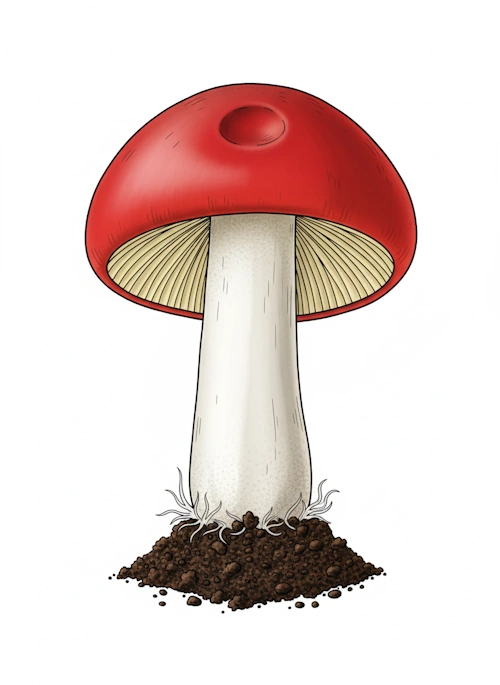
The anatomy of Russula nobilis is quintessential of brittlegills, with fragile tissues that crumble easily—a defense against herbivores. Here’s a breakdown:
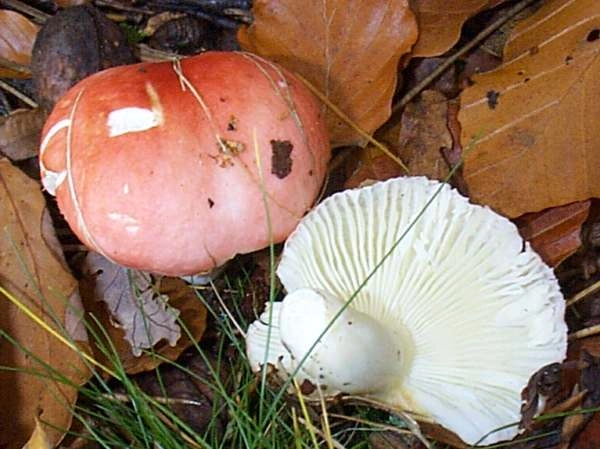
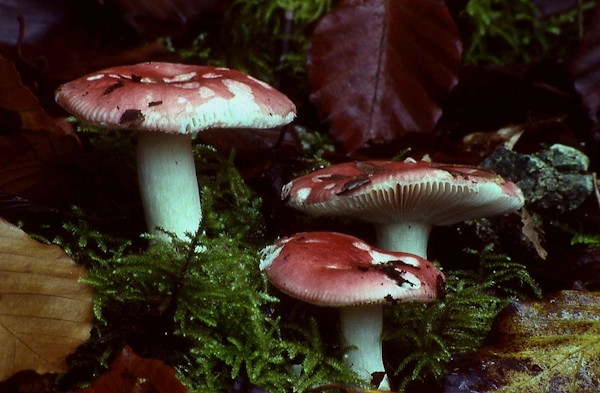
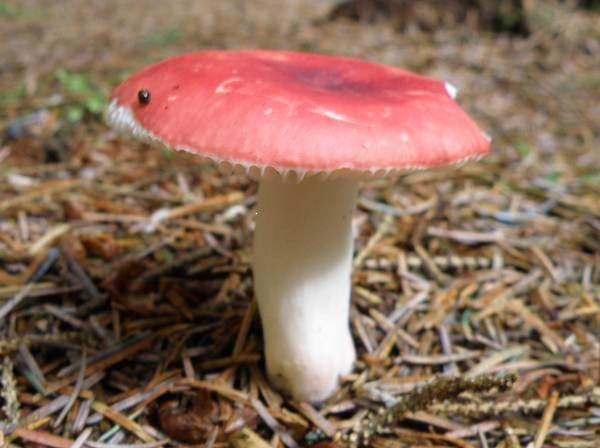
- Cap (Pileus): 3-9 cm in diameter, initially convex and inrolled at the margins, flattening with age and sometimes developing a shallow central depression. Color varies from bright crimson or rosy-red to pale pink or rarely white, with a slightly sticky (viscid) surface when wet that dries matte. The cuticle peels only 1/3 to the center, revealing pinkish flesh beneath. Non-striate and smooth, it’s often slug-damaged.
- Gills (Lamellae): Adnexed (narrowly attached to the stem), crowded, and white to cream, sometimes with a faint greenish or blue-green tinge. Extremely brittle, they fork occasionally and measure 4-8 mm deep. Edges are even, and the hymenium produces a white spore print.
- Stem (Stipe): Cylindrical to slightly clavate (club-shaped), 2-5 cm tall and 1-1.5 cm wide, firm and white throughout. Snaps like chalk due to brittle flesh; no ring or volva present. Base may be slightly bulbous.
- Flesh and sensory traits: White, firm, and unchanging when cut, though yellowish in age. Odor faint, reminiscent of coconut in young specimens; taste rapidly acrid and peppery, a key identifier.
- Microscopic features: Spores ovoid, 7-8 x 6-6.5 µm, amyloid, with warts up to 0.5 µm tall forming a nearly complete reticulum. Basidia clavate, four-spored; cystidia fusiform. Spore print white to off-white.
Growth occurs singly or in small troops on leaf litter or soil, often amid moss.
Why this mushroom is inedible: toxicity and health risks
Russula nobilis is classified as inedible and toxic, primarily due to its acrid compounds that induce gastrointestinal symptoms. The bitter, peppery taste—detectable in a safe “taste test” (spit out immediately)—signals poison, likely from sesquiterpenes like those in related species.
Ingestion causes nausea, vomiting, abdominal cramps, and diarrhea within hours, lasting 1-2 days. While not typically fatal in healthy adults, it poses risks to children, the elderly, or immunocompromised individuals.
Cooking may reduce but not eliminate toxins, so authorities advise against consumption. Unlike deadly Russulas like R. subnigricans, its effects are mainly self-limiting, but medical attention is recommended for severe cases.
Mushrooms it can be confused with
Misidentification is a primary risk, as Russula nobilis resembles other red-capped brittlegills. Key confusions include:
- Russula emetica (The Sickener): Similar red cap and toxicity, but associates with pines, has a more depressed mature cap, and peels 2/3+ to center.
- Other Red Russulas: Edible ones like R. vesca have milder tastes; test cautiously. R. nigricans blackens when bruised, unlike nobilis.
Macroscopic features alone may not suffice; microscopic or chemical tests (e.g., FeSO4 reaction) aid experts.
| Similar Species | Key Differences | Habitat | Edibility |
|---|---|---|---|
| Russula emetica | Deeper red cap, peels more, depressed when mature | Conifers | Toxic |
| Russula vesca | Milder taste, edible | Broadleaves | Edible |
| Lactarius spp. | Latex exudes when cut | Various | Varies |
| Russula nigricans | Blackens on bruising | Broadleaves | Inedible |
Ecological role and conservation
As an ectomycorrhizal fungus, Russula nobilis enhances beech tree health by facilitating nutrient exchange, contributing to forest biodiversity. It’s consumed by slugs and insects despite toxicity, and its presence indicates healthy beech ecosystems. Conservation status is stable (not endangered), but habitat loss from deforestation could impact it.
Sources
- Russula nobilis, Beechwood Sickener mushroom – First Nature
- Beechwood Sickener (Russula nobilis) – Woodland Trust
- Beechwood Sickener – Wild Food UK
- Beechwood sickener (Russula Nobilis) – Identification – Totally Wild UK
- Russula nobilis – Mycobank
- Beechwood Sickener (Russula nobilis) – iNaturalist
- Russula nobilis Velen. – GBIF
- Russula nobilis – Index Fungorum