Jupiter: The King That Never Quite Became a Star
Beyond the asteroid belt, the character of the solar system changes entirely. The small, rocky worlds of the inner system give way to something on a completely different scale: Jupiter, a planet so massive that it contains more material than all the other planets combined, more than twice over. It has no solid surface to stand on, no defined boundary between its atmosphere and its interior, and a storm larger than Earth that has raged continuously for at least the last few centuries. Jupiter is, in many ways, less a planet in the traditional sense and more a planet-sized experiment in what happens when a world grows large enough to begin behaving like the outer layers of a star, without ever quite crossing that threshold.
Studying Jupiter means confronting questions that stretch the definitions we usually rely on: where does its atmosphere end and its interior begin, what does it mean for hydrogen to behave like a metal, and how close did this solar system come to having two suns instead of one?
Named for the King of the Gods
Jupiter takes its name from the king of the Roman gods, ruler of the sky and the most powerful deity in the Roman pantheon, a fitting title for the largest planet in the solar system. This naming convention was far from unique to Rome; ancient Babylonian astronomers associated the same planet with Marduk, their chief deity, while other cultures across the ancient world similarly linked its steady, majestic movement across the sky with supreme authority.
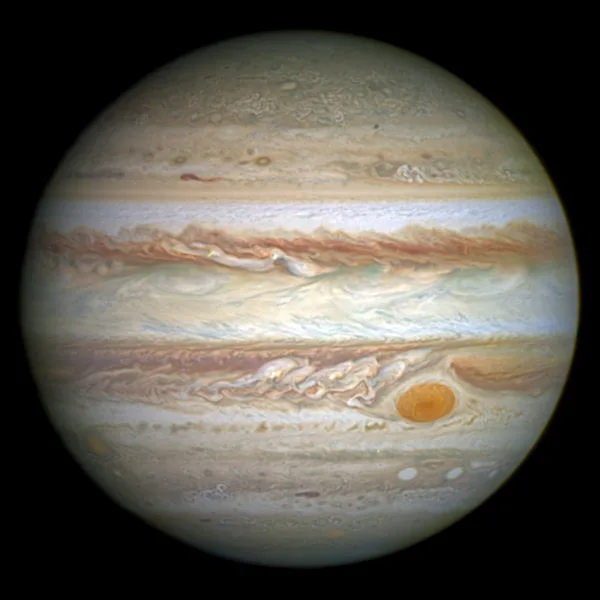
Jupiter’s brightness in the night sky, third only to the Moon and Venus among naturally visible objects, made it impossible for ancient observers to overlook, and its slow, stately progression through the zodiac over roughly twelve years likely reinforced associations with kingship, patience, and cosmic order.
Orbital and Physical Scale
A Planet of Superlatives
Jupiter orbits the Sun at an average distance of about 778 million kilometers, roughly 5.2 times farther from the Sun than Earth. At this distance, completing a single orbit takes almost 12 Earth years, yet despite this immense orbital period, Jupiter rotates faster than any other planet in the solar system, completing a full spin on its axis in under 10 hours. This rapid rotation causes the entire planet to bulge noticeably at its equator and flatten slightly at its poles, an effect visible even through a modest backyard telescope.
Physical Characteristics
| Property | Value |
|---|---|
| Diameter | 139,820 km (about 11 times Earth’s diameter) |
| Mass | 1.898 × 10²⁷ kg (about 318 times Earth’s mass) |
| Average density | 1.33 g/cm³ (lower than water in bulk terms, though the interior is far denser) |
| Surface gravity (cloud tops) | 24.79 m/s² (about 2.5 times Earth’s gravity) |
| Average distance from Sun | 778.5 million km (5.2 AU) |
| Orbital period (year) | 11.86 Earth years |
| Rotation period (day) | 9 hours, 56 minutes |
| Axial tilt | 3.1° |
| Known moons | 95 confirmed (as of current counts) |
| Cloud-top temperature | -145°C |
To grasp the scale involved, consider that Jupiter’s mass is roughly 2.5 times greater than the combined mass of every other planet in the solar system. Earth could fit inside Jupiter well over 1,300 times over, and Jupiter’s Great Red Spot alone, a single storm feature, is wide enough to swallow one to two Earths depending on its size at a given moment, since the storm’s dimensions fluctuate somewhat over time.
A Planet Without a Surface
Layers of Increasingly Strange Hydrogen
Jupiter is classified as a gas giant, but this label somewhat undersells the bizarre physics occurring within its interior. There is no solid surface anywhere on Jupiter; instead, its atmosphere gradually transitions into denser and denser layers of hydrogen and helium as depth and pressure increase, without ever encountering a clearly defined boundary.
Beginning at the visible cloud tops, Jupiter’s outer atmosphere consists of hydrogen and helium gas, gradually compressing under increasing pressure and temperature as one descends. At roughly 20,000 kilometers deep, conditions become extreme enough that hydrogen transitions into a liquid state. Deeper still, at pressures exceeding 2 million times Earth’s atmospheric pressure, hydrogen is believed to enter an exotic state called metallic hydrogen, in which the normally insulating element behaves like an electrically conductive metal. This layer of metallic hydrogen, churning and convecting deep within the planet, is thought to be the source of Jupiter’s extraordinarily powerful magnetic field.
A Possible Rocky Core
At Jupiter’s center likely lies a core of heavier elements, though its precise nature remains one of the more actively debated questions in planetary science. Data from NASA’s Juno mission, which has been directly measuring Jupiter’s gravitational field since 2016, suggests the core may not be a compact, well-defined solid ball as once assumed, but rather a diffuse, partially dissolved region where heavier elements gradually blend into the surrounding metallic hydrogen layer over a substantial fraction of the planet’s radius, a structure some researchers have described as a “fuzzy core.”
Immense Internal Heat
Remarkably, Jupiter radiates roughly 1.6 times more energy into space than it receives from the Sun. This excess heat is thought to originate primarily from the Kelvin-Helmholtz mechanism, in which the planet continues to slowly contract under its own gravity, converting gravitational potential energy into heat, a process left over from the planet’s formation billions of years ago and still ongoing today, if extremely gradually.
The Great Red Spot and Jupiter’s Turbulent Atmosphere
A Storm Older Than Modern Astronomy
Jupiter’s most iconic feature is the Great Red Spot, a colossal anticyclonic storm that has been observed continuously since at least the 1830s, with less certain observations potentially extending back to the 1600s. Winds within the storm’s outer bands can reach speeds of up to 640 kilometers per hour, and the storm’s characteristic reddish-orange coloration is thought to result from complex chemical reactions involving compounds such as ammonia, phosphorus, and sulfur being altered by ultraviolet sunlight, though the precise chemistry responsible remains under active investigation.
Long-term observations have revealed that the Great Red Spot has been steadily shrinking over the past century, prompting ongoing scientific debate about whether it may eventually dissipate entirely or stabilize at a smaller, but still storm-scale, size.
Banded Clouds and Powerful Jet Streams
Jupiter’s recognizable banded appearance comes from alternating light zones and dark belts of clouds, driven by powerful east-west jet streams that circle the planet at different latitudes, some reaching sustained speeds exceeding 600 kilometers per hour. These bands are composed primarily of ammonia ice crystals in the uppermost visible clouds, with deeper layers likely containing ammonium hydrosulfide and water ice, based on atmospheric modeling and limited direct probe measurements.
Lessons from the Galileo Probe
In 1995, NASA’s Galileo spacecraft released an atmospheric probe that descended directly into Jupiter’s clouds, transmitting data for about 58 minutes before succumbing to extreme pressure and heat roughly 150 kilometers below the cloud tops. The probe delivered a surprising result: it detected significantly less water vapor than atmospheric models had predicted, likely because it happened to descend through an unusually dry region called a “hot spot,” a finding that illustrated just how much local atmospheric variation exists within Jupiter’s turbulent weather systems.
An Enormous Magnetic Field and Radiation Environment
Jupiter possesses the strongest planetary magnetic field in the solar system, roughly 20,000 times stronger than Earth’s, generated by the churning layer of metallic hydrogen deep within its interior. This field creates a magnetosphere so vast that, if it were visible to the naked eye from Earth, it would appear several times larger than the full Moon in our sky, despite Jupiter’s enormous distance.
This powerful magnetic field traps intense radiation belts around the planet, creating one of the most hazardous radiation environments encountered anywhere in the solar system, a significant engineering challenge for any spacecraft, including Juno, attempting close, extended study of the planet, and a major consideration for any future missions to Jupiter’s inner moons.
A Miniature Solar System of Moons
The Galilean Moons
Jupiter’s four largest moons, discovered by Galileo Galilei in 1610 using one of the earliest telescopes, remain among the most scientifically significant satellites in the solar system:
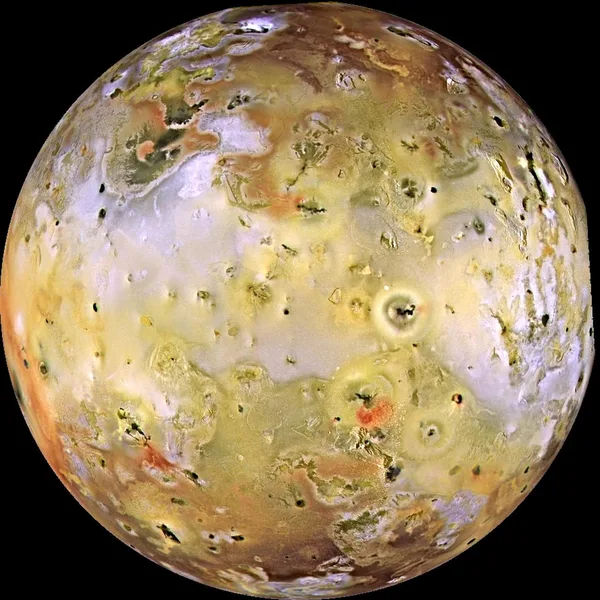
- Io: The most volcanically active body known in the solar system, its surface constantly reshaped by hundreds of active volcanoes driven by intense tidal heating from Jupiter’s gravity.
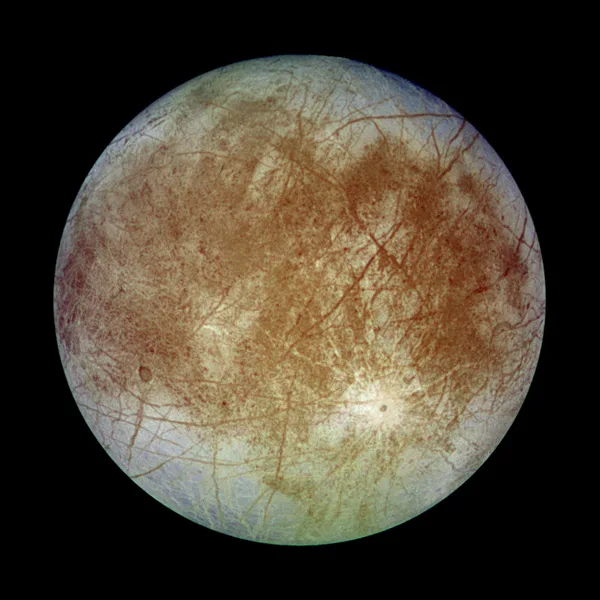
- Europa: An icy moon believed to harbor a liquid water ocean beneath its frozen surface, containing potentially more liquid water than all of Earth’s oceans combined, making it one of the leading candidates in the search for life beyond Earth.
- Ganymede: The largest moon in the solar system, even larger than the planet Mercury, and the only moon known to generate its own internal magnetic field.
- Callisto: An ancient, heavily cratered moon with one of the oldest, most unaltered surfaces in the solar system, suggesting minimal ongoing geological activity.
Tidal Heating: A Different Source of Warmth
Unlike the inner rocky planets, whose internal heat derives primarily from radioactive decay and residual formation heat, several of Jupiter’s moons are warmed significantly by tidal heating, a process in which the constantly shifting gravitational pull between Jupiter and neighboring moons flexes and stretches their interiors, generating friction and heat. This mechanism is understood to be the driving force behind Io’s extreme volcanism and is considered a leading explanation for the subsurface liquid ocean suspected beneath Europa’s icy shell, despite its considerable distance from the Sun.
A Vast and Growing Family
Beyond the four Galilean moons, Jupiter hosts dozens of smaller satellites, many likely captured asteroids given their irregular shapes and orbits, some of which circle the planet in retrograde directions or highly inclined paths. The total confirmed count has grown substantially in recent years as improved detection techniques have identified increasingly small and distant moons, and further discoveries remain likely as observational technology continues to improve.
Jupiter’s Thin Ring System
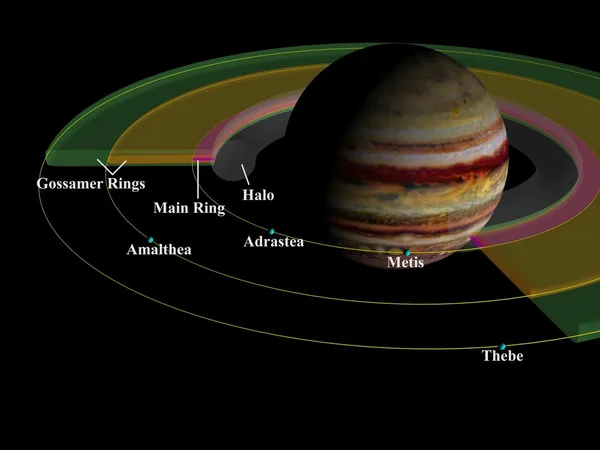
Unlike Saturn’s famous, brilliant rings, Jupiter possesses a much fainter, subtler ring system, discovered only in 1979 by NASA’s Voyager 1 spacecraft. These rings are composed primarily of fine dust particles, likely originating from micrometeorite impacts striking Jupiter’s smaller inner moons and knocking debris into orbit, rather than from any large-scale icy composition like Saturn’s more famous rings.
Exploring the King of Planets
Early Flybys
Jupiter has been visited by numerous spacecraft since the 1970s, beginning with Pioneer 10 and 11, which provided the first close-up images and measurements of the planet’s radiation environment, followed by Voyager 1 and 2, which delivered dramatically improved imagery, discovered Jupiter’s faint ring system, and revealed Io’s active volcanism for the first time.
Galileo: The First Dedicated Orbiter
NASA’s Galileo spacecraft became the first mission to orbit Jupiter directly, studying the planet and its major moons in unprecedented detail from 1995 to 2003, and deploying the atmospheric probe described earlier. Galileo’s extended study of the Galilean moons provided the strongest early evidence for Europa’s likely subsurface ocean, permanently elevating that moon’s status as a prime target in the search for extraterrestrial life.
Juno: Peering Beneath the Clouds
NASA’s Juno mission, in orbit since 2016, was designed specifically to study Jupiter’s interior structure, gravitational field, and magnetic field with far greater precision than any previous mission, using a highly elliptical polar orbit to minimize prolonged exposure to the planet’s intense radiation belts. Juno’s findings have substantially revised scientific understanding of Jupiter’s core structure, revealed unexpected complexity in its deep atmospheric jet streams, and provided detailed new imagery of its polar regions, which display a striking arrangement of cyclonic storms unlike anything seen at Jupiter’s equator.
Looking Ahead: Europa Clipper
NASA’s Europa Clipper mission, launched in 2024, is en route to conduct dozens of close flybys of Europa, specifically designed to assess the moon’s habitability by studying its ice shell thickness, subsurface ocean, and surface chemistry in unprecedented detail, representing one of the most significant efforts yet undertaken in the search for potentially habitable environments beyond Earth.
Jupiter in Context: Comparing the Giant Planets
| Feature | Jupiter | Saturn | Uranus | Neptune |
|---|---|---|---|---|
| Distance from Sun | 778.5 million km | 1.43 billion km | 2.87 billion km | 4.5 billion km |
| Diameter | 139,820 km | 116,460 km | 50,724 km | 49,244 km |
| Known moons | 95 | 146+ | 28 | 16 |
| Ring system | Faint, dusty | Bright, extensive | Narrow, dark | Faint, dusty |
| Rotation period | 9.9 hours | 10.7 hours | 17.2 hours | 16.1 hours |
| Internal heat excess | High | High | Minimal | Moderate |
Why Jupiter Still Matters
Jupiter’s importance extends well beyond its record-setting size. As by far the most massive planet in the solar system, Jupiter’s gravity played, and continues to play, an outsized role in shaping the orbits of everything around it, from clearing out and organizing material during the solar system’s early formation to gravitationally deflecting or capturing asteroids and comets that might otherwise threaten the inner planets, a protective role sometimes referred to, somewhat controversially among researchers, as Jupiter acting as a cosmic shield for Earth. Its extreme internal pressures offer scientists a natural laboratory for studying exotic states of matter, such as metallic hydrogen, that are exceptionally difficult to reproduce even briefly under laboratory conditions on Earth. And its diverse family of large moons, particularly Europa, has become one of the central destinations in the modern search for life beyond our home planet, suggesting that habitability in the universe may not require a world anything like Earth itself, so long as liquid water, chemical energy, and long-term stability can be found, even if hidden many kilometers beneath a frozen shell, orbiting a planet that never quite became a star.
References
- NASA Science (n.d.) Jupiter overview. Available at: https://science.nasa.gov/jupiter/ (Accessed: 3 August 2026).
- NASA Science (n.d.) Juno mission. Available at: https://science.nasa.gov/mission/juno/ (Accessed: 3 August 2026).
- NASA Solar System Exploration (n.d.) Jupiter: in depth. Available at: https://solarsystem.nasa.gov/planets/jupiter/in-depth/ (Accessed: 3 August 2026).
- NASA Science (n.d.) Europa Clipper. Available at: https://science.nasa.gov/mission/europa-clipper/ (Accessed: 3 August 2026).
- ESA (n.d.) JUICE mission. Available at: https://www.esa.int/Science_Exploration/Space_Science/Juice (Accessed: 3 August 2026).
- NASA Photojournal (n.d.) Jupiter images. Available at: https://photojournal.jpl.nasa.gov/target/Jupiter (Accessed: 3 August 2026).