Mars: The Red Planet That Refuses to Give Up Its Secrets
No planet in the solar system has captured human imagination quite like Mars. Long before spacecraft ever approached it, its distinctive rust-colored glow in the night sky led ancient civilizations to associate it with war and bloodshed, while later generations of astronomers, peering through early telescopes, imagined canals, seasons, and perhaps even civilizations on its surface. Modern exploration has replaced those speculative visions with something arguably more compelling: a real, physically detailed world that once had rivers, lakes, and possibly oceans, a planet whose climate underwent one of the most dramatic transformations documented anywhere in the solar system, and a landscape still actively investigated by rovers, orbiters, and helicopters in the ongoing search for signs that life may have existed there before Mars became the cold, dry desert we see today.
Mars occupies a unique position in planetary science: close enough, and similar enough to Earth in certain respects, that it remains our most plausible candidate for future human exploration, yet transformed enough by billions of years of atmospheric loss and climate change that studying it offers profound lessons about the limits of planetary habitability.
Named for the God of War
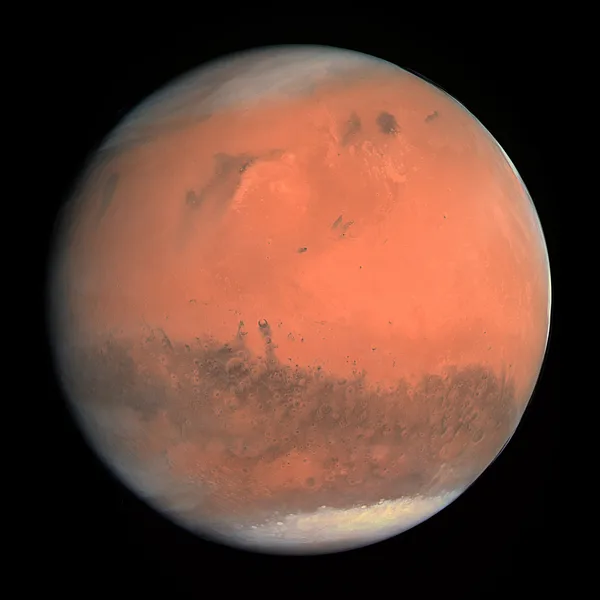
Mars owes its name to its distinctive blood-red appearance in the sky, which led Roman astronomers to name it after their god of war, a naming convention echoed independently by numerous other ancient cultures, including the Babylonians and Egyptians, who also associated the planet’s reddish hue with conflict, fire, or destruction. This color comes from iron oxide, more commonly known as rust, which coats much of the Martian surface and gives the planet its enduring nickname, the Red Planet.
Orbital Characteristics
A Distant, Eccentric Orbit
Mars orbits the Sun at an average distance of about 228 million kilometers, roughly 1.5 times farther from the Sun than Earth. Its orbit is considerably more eccentric than Earth’s, varying between about 207 million kilometers at perihelion and 249 million kilometers at aphelion — a difference substantial enough to noticeably affect the planet’s seasons, since Mars moves faster through its orbit when closer to the Sun and slower when farther away, making its southern hemisphere summers shorter and more intense than its northern counterparts.
A Familiar Day, an Unfamiliar Year
Among all the rocky planets, Mars offers perhaps the most Earth-like rotational rhythm. A single Martian day, called a sol, lasts 24 hours and 37 minutes, remarkably close to Earth’s own rotation period. A Martian year, however, stretches to 687 Earth days, nearly twice as long as our own, since Mars’s greater distance from the Sun requires a longer orbital path at generally slower speeds.
An Axial Tilt That Mirrors Earth’s
Mars’s axis is tilted at approximately 25.2 degrees, remarkably similar to Earth’s 23.4-degree tilt, meaning Mars experiences four distinct seasons much like Earth does, though each season lasts roughly twice as long due to the planet’s extended year. Unlike Earth, however, Mars lacks a large stabilizing moon, and computer models suggest its axial tilt may have varied wildly over geological timescales, swinging between roughly 15 and 35 degrees or more, producing dramatic long-term climate shifts unlike anything Earth has experienced in recent geological history.
Physical Characteristics
| Property | Value |
|---|---|
| Diameter | 6,779 km (about 53% of Earth’s diameter) |
| Mass | 6.42 × 10²³ kg (about 11% of Earth’s mass) |
| Average density | 3.93 g/cm³ (lowest among the rocky planets) |
| Surface gravity | 3.72 m/s² (about 38% of Earth’s gravity) |
| Average distance from Sun | 227.9 million km (1.52 AU) |
| Orbital period (year) | 687 Earth days |
| Rotation period (day) | 24 hours, 37 minutes |
| Axial tilt | 25.2° |
| Known moons | 2 (Phobos and Deimos) |
| Average surface temperature | -63°C |
| Surface pressure | About 0.6% of Earth’s sea-level pressure |
A Planet Frozen in Its Own Geological Adolescence
An Interior That Cooled Too Quickly
Mars’s small size relative to Earth had profound consequences for its internal evolution. With a smaller volume-to-surface-area ratio, Mars lost its internal heat far more rapidly than larger rocky planets. Data from NASA’s InSight lander, which placed the first seismometer on the Martian surface, revealed a core roughly 1,830 kilometers in radius, larger than once expected, and confirmed the core remains at least partially liquid, though the mantle above it now appears geologically sluggish compared to Earth’s dynamic layer.
A Magnetic Field That Died Long Ago
Unlike Earth, Mars today possesses no global magnetic field. However, patches of strongly magnetized crust discovered in its southern highlands provide compelling evidence that Mars once generated a planetary dynamo similar to Earth’s, likely within its first half billion years of existence. As the planet’s interior cooled and its liquid outer core’s convective churning slowed, this global magnetic field shut down, leaving Mars vulnerable to a slow, ongoing process of atmospheric stripping by the solar wind, a process actively measured today by NASA’s MAVEN orbiter.
Olympus Mons and the Tharsis Bulge
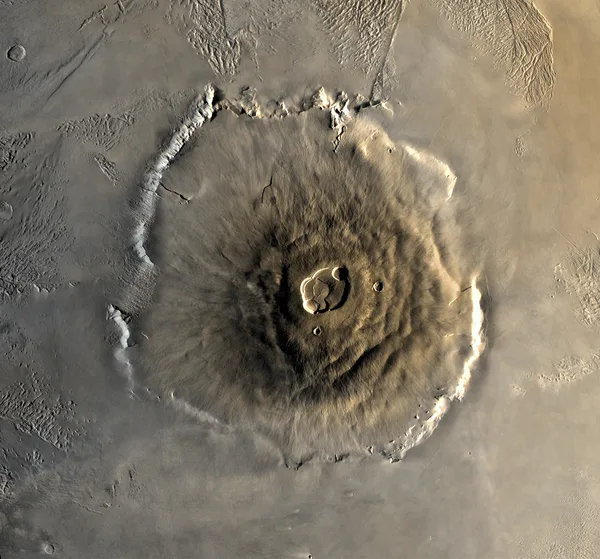
Mars hosts the largest known volcano in the solar system: Olympus Mons, a shield volcano roughly 22 kilometers tall and about 600 kilometers across at its base, nearly three times the height of Mount Everest measured from sea level. Its immense size is possible largely because Mars lacks the kind of mobile tectonic plates found on Earth; rather than a plate gradually shifting away from a stationary hotspot, as occurred with the Hawaiian island chain, Mars’s crust remained fixed over a single persistent plume of rising magma, allowing the volcano to grow continuously over hundreds of millions of years without interruption.
Olympus Mons sits within the Tharsis region, a vast volcanic plateau whose sheer accumulated mass is thought to have been significant enough to have caused the entire planet to shift slightly on its axis over geological time, a phenomenon called true polar wander.
Valles Marineris: A Canyon System Beyond Earthly Scale
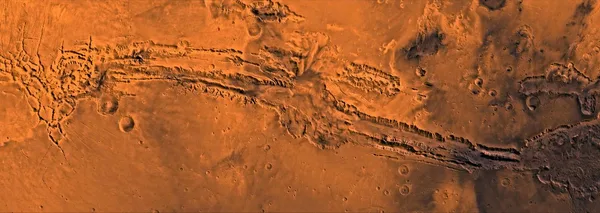
Stretching roughly 4,000 kilometers across the Martian equator, Valles Marineris dwarfs Earth’s Grand Canyon in every dimension, plunging as deep as 7 kilometers in places and spanning widths of up to 200 kilometers. Unlike the Grand Canyon, which was carved primarily by sustained river erosion, Valles Marineris appears to have originated largely as a tectonic rift, formed as the Tharsis bulge’s formation stretched and fractured the surrounding crust, though later erosion by water and wind likely widened and reshaped its walls considerably.
Water on Mars: Past and Present
Evidence of an Ancient Wet World
Perhaps no discovery about Mars has proven more scientifically consequential than the mounting evidence that liquid water once flowed extensively across its surface. Orbital imagery reveals dried river valley networks, ancient shorelines, and layered sedimentary deposits consistent with long-standing bodies of water. NASA’s Curiosity rover, exploring Gale Crater since 2012, discovered mineral and geological evidence indicating the crater once held a long-lived freshwater lake, with conditions that appear to have been chemically suitable for microbial life, had it existed. Perseverance, exploring Jezero Crater since 2021, has been investigating what appears to be an ancient river delta, methodically collecting rock samples specifically selected for eventual return to Earth for detailed laboratory analysis.
Where Did the Water Go?
The central mystery surrounding Martian water is not whether it existed, but what happened to it. Several processes likely worked in combination:
- Loss of the global magnetic field left the atmosphere vulnerable to gradual stripping by solar wind, a process MAVEN has directly measured as continuing today at a slow but steady rate
- As atmospheric pressure dropped, liquid water on the surface became increasingly unstable, tending to either freeze or boil away rather than persist in liquid form
- Significant quantities of water appear to have become chemically locked into surface minerals through weathering processes
- Remaining water retreated underground and toward the poles, forming the ice deposits detected today
Ice Hiding in Plain Sight
While liquid water no longer flows openly across the Martian surface, substantial quantities of water ice remain. Both polar ice caps contain significant water ice layered beneath seasonal carbon dioxide frost, and radar surveys from orbiting spacecraft have detected what appear to be extensive subsurface ice deposits at various latitudes, some potentially accessible to future crewed missions as a resource for drinking water, breathable oxygen, or rocket fuel production. Some researchers have also proposed the existence of small pockets of liquid brine beneath the southern polar ice cap, though this interpretation remains contested and is not universally accepted within the planetary science community.
A Thin, Fragile Atmosphere
Mars’s atmosphere today is composed of roughly 95% carbon dioxide, with small amounts of nitrogen and argon, but it is remarkably thin, exerting less than one percent of Earth’s sea-level atmospheric pressure. This thinness carries significant consequences:
- It cannot trap enough heat to keep the surface consistently above freezing, despite the presence of carbon dioxide, a known greenhouse gas
- It provides minimal shielding against harmful solar and cosmic radiation reaching the surface
- It is too thin to support liquid water stability across most of the planet’s surface, causing exposed liquid water to rapidly freeze or vaporize
- It nonetheless remains thick enough to generate significant seasonal dust storms, occasionally growing severe enough to envelop the entire planet in dust for weeks at a time
Evidence suggests Mars once possessed a considerably thicker atmosphere, likely necessary to support the liquid water features observed in its geological record, before solar wind stripping and other loss processes reduced it to its current fragile state over billions of years.
Phobos and Deimos: Captured Wanderers
Mars possesses two small, irregularly shaped moons, Phobos and Deimos, both discovered in 1877. Unlike Earth’s large, round Moon, these satellites resemble asteroids more than proper moons, and most planetary scientists believe they were originally captured asteroids from the nearby asteroid belt, gravitationally trapped by Mars rather than formed alongside it, though some competing models suggest they may have instead formed from debris left over after a major impact on Mars itself, similar to theories about our own Moon’s origin.
Phobos, the larger and closer of the two moons, orbits so near to Mars that it completes a full orbit in under eight hours, faster than Mars itself rotates, causing it to rise in the west and set in the east, the opposite pattern seen with Earth’s Moon. Phobos is also gradually spiraling closer to Mars due to tidal forces, and current models predict it will eventually either crash into the Martian surface or break apart to form a temporary ring system within the next 30 to 50 million years.
Exploring Mars: The Most Visited World Beyond Earth
A Long History of Robotic Exploration
Mars has been the target of more space missions than any planet besides Earth itself, though the planet has also earned a reputation for a notoriously high mission failure rate, particularly among early attempts, leading some engineers to half-jokingly refer to a “Mars Curse.” Despite this, successful missions have transformed our understanding of the planet dramatically.
Notable Rovers and Landers
| Mission | Arrival | Key Contribution |
|---|---|---|
| Viking 1 and 2 | 1976 | First successful landers; conducted early biological experiments |
| Mars Pathfinder / Sojourner | 1997 | First successful rover, demonstrating low-cost rover technology |
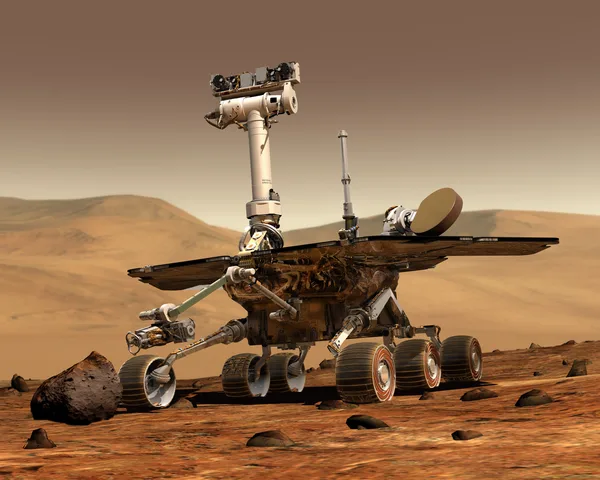
| Spirit and Opportunity | 2004 | Found extensive mineral evidence of ancient liquid water |
| Curiosity | 2012 | Confirmed ancient habitable lake environment in Gale Crater |
| InSight | 2018 | First detailed seismic and internal structure measurements |
| Perseverance and Ingenuity | 2021 | Sample collection for future return; first powered flight on another planet |
The Search for Biosignatures
Modern Mars exploration increasingly centers on the search for biosignatures, chemical or physical traces that might indicate past or present microbial life. Perseverance’s carefully selected rock samples, cached for eventual return to Earth through a planned joint NASA-ESA sample return campaign, represent the most sophisticated effort yet to search for definitive evidence of ancient Martian life using far more advanced laboratory techniques than could ever be miniaturized for use aboard a rover.
Mars in Context: Comparing the Rocky Planets
| Feature | Mercury | Venus | Earth | Mars |
|---|---|---|---|---|
| Distance from Sun | 57.9 million km | 108.2 million km | 149.6 million km | 227.9 million km |
| Diameter | 4,879 km | 12,104 km | 12,742 km | 6,779 km |
| Day length | 176 Earth days | 243 Earth days | 24 hours | 24 hours 37 min |
| Year length | 88 Earth days | 225 Earth days | 365.25 days | 687 Earth days |
| Known moons | 0 | 0 | 1 | 2 |
| Evidence of past liquid water | No | Possible (debated) | Yes (present) | Yes (extensive) |
| Tallest known volcano | N/A | Maat Mons (~8 km) | Mauna Kea (~10 km base to peak) | Olympus Mons (~22 km) |
Why Mars Still Matters
Few planetary stories carry as much cautionary and inspirational weight as Mars’s transformation from what may once have been a relatively temperate, water-rich world into today’s frozen desert. Understanding precisely how and why Mars lost its atmosphere and surface water offers essential context for understanding the boundaries of long-term planetary habitability, informing both the broader search for life elsewhere in the universe and our appreciation for the specific, fragile conditions that keep Earth’s own atmosphere and oceans intact.
At the same time, Mars stands as the most plausible near-term destination for eventual human exploration beyond the Earth-Moon system, its accessible ice deposits, moderate gravity, and day length close to Earth’s own making it a uniquely compelling target, even as its thin atmosphere, radiation exposure, and immense distance present formidable engineering and biological challenges. Whether Mars ultimately reveals itself as a planet that once hosted life, or one that came remarkably close to habitability without ever crossing that threshold, its rust-red surface continues to hold answers to some of the most significant questions in all of planetary science.
References
- NASA Science (n.d.) Mars overview. Available at: https://science.nasa.gov/mars/ (Accessed: 3 August 2026).
- NASA Mars Exploration (n.d.) Mars Exploration Program. Available at: https://mars.nasa.gov/ (Accessed: 3 August 2026).
- NASA Science (n.d.) Perseverance rover. Available at: https://science.nasa.gov/mission/mars-2020-perseverance/ (Accessed: 3 August 2026).
- ESA (n.d.) Mars Express. Available at: https://www.esa.int/Science_Exploration/Space_Science/Mars_Express (Accessed: 3 August 2026).
- USGS Astrogeology (n.d.) Mars maps and geology. Available at: https://astrogeology.usgs.gov/ (Accessed: 3 August 2026).
- NASA Photojournal (n.d.) Mars images. Available at: https://photojournal.jpl.nasa.gov/target/Mars (Accessed: 3 August 2026).