Neptune: The Windiest World in the Solar System
At the outer edge of the solar system’s planetary family sits a deep blue world so distant that sunlight, traveling at nearly 300,000 kilometers per second, still takes over four hours to reach it. Neptune was not discovered by accident or through patient telescopic sweeping of the sky, as every other planet before it had been. It was discovered through mathematics alone, predicted to exist before anyone ever laid eyes on it, based on tiny, unexplained wobbles in the orbit of Uranus that hinted at the gravitational pull of an unseen, more distant world. When astronomers finally pointed their telescopes to the precise coordinates calculated on paper, Neptune was waiting almost exactly where the numbers said it should be, one of the great triumphs of predictive physics in the history of astronomy.
Despite orbiting nearly three billion kilometers beyond Uranus, Neptune turned out to be anything but a quiet, sluggish world. It hosts the fastest winds ever measured on any planet, a churning atmosphere marked by short-lived but violent storms, and a peculiar internal heat budget that continues to puzzle scientists who expected an ice giant this distant to have gone cold and still long ago.
A Discovery Written in Mathematics
By the early nineteenth century, astronomers tracking the orbit of Uranus, the outermost known planet at the time, noticed persistent, unexplained discrepancies between where the planet was predicted to be and where it actually appeared. Two mathematicians working independently, Urbain Le Verrier in France and John Couch Adams in England, calculated that these deviations could be explained by the gravitational influence of an undiscovered planet orbiting even farther out, and each produced predictions for where such a planet ought to be found.
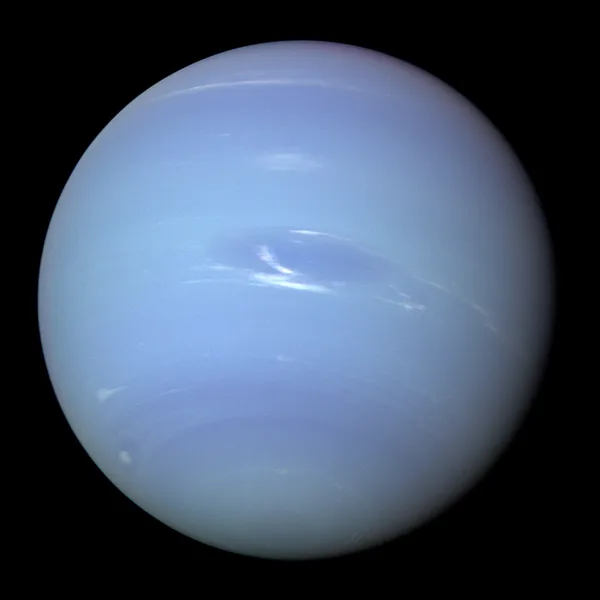
In September 1846, astronomer Johann Galle at the Berlin Observatory used Le Verrier’s calculations to locate Neptune within about one degree of its predicted position on his very first night of searching, a stunning validation of Newtonian gravitational theory and one of the most celebrated moments in the history of observational astronomy. The subsequent naming of the planet after Neptune, the Roman god of the sea, continued the mythological naming tradition established by the planets known since antiquity, and its deep blue coloration made the maritime association feel almost inevitable.
Orbital Characteristics
The Solar System’s Outermost Major Planet
Following Pluto’s 2006 reclassification as a dwarf planet, Neptune holds the distinction of being the outermost recognized planet in the solar system, orbiting the Sun at an average distance of about 4.5 billion kilometers, roughly 30 times farther from the Sun than Earth. At this immense distance, completing a single orbit takes approximately 165 Earth years, meaning Neptune has completed barely more than a single full orbit since its discovery in 1846, an anniversary that arrived, fittingly, in 2011.
A Notably Circular Orbit
Compared to several of its planetary neighbors, Neptune’s orbit is quite close to circular, with relatively little variation between its closest and farthest points from the Sun. Interestingly, Neptune’s orbit occasionally brings it slightly closer to the Sun than Pluto, whose own highly eccentric, tilted orbit periodically carries it inside Neptune’s path, though a stable orbital resonance between the two bodies, in which Pluto completes two orbits for every three completed by Neptune, ensures the two never come close enough to risk a collision.
Physical Characteristics
| Property | Value |
|---|---|
| Diameter | 49,244 km (about 3.9 times Earth’s diameter) |
| Mass | 1.02 × 10²⁶ kg (about 17 times Earth’s mass) |
| Average density | 1.64 g/cm³ (densest of the giant planets) |
| Surface gravity (cloud tops) | 11.15 m/s² (slightly greater than Earth’s gravity) |
| Average distance from Sun | 4.5 billion km (30.1 AU) |
| Orbital period (year) | 165 Earth years |
| Rotation period (day) | 16 hours, 6 minutes |
| Axial tilt | 28.3° |
| Known moons | 16 confirmed |
| Cloud-top temperature | -201°C |
An Ice Giant With a Vivid Blue Face
Composition and Structure
Like Uranus, Neptune belongs to the ice giant category of planets, distinguished from the hydrogen-and-helium-dominated gas giants Jupiter and Saturn by an interior composed largely of dense fluids formed from water, methane, and ammonia, often described collectively as “ices” despite existing in superheated, highly pressurized fluid states rather than anything resembling frozen ice as experienced on Earth. Beneath a comparatively thin outer envelope of hydrogen and helium gas, Neptune’s interior is thought to consist of an extremely hot, dense mantle of these icy fluids surrounding a solid core of rock and metal roughly comparable in mass to Earth itself.
The Deepest, Most Saturated Blue
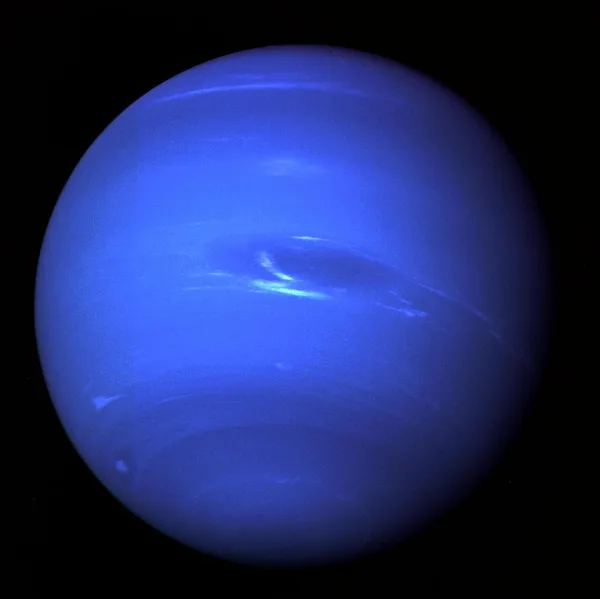
Neptune’s striking, richly saturated blue coloration comes from methane in its upper atmosphere absorbing red wavelengths of sunlight while reflecting blue light back into space, the same basic mechanism responsible for Uranus’s paler blue-green hue. However, Neptune’s color appears considerably more vivid and saturated than Uranus’s, suggesting the presence of an additional, currently unidentified atmospheric component contributing to its distinctive deep blue appearance, a genuine open question that continues to intrigue atmospheric scientists studying both ice giants.
A Genuine Mystery of Internal Heat
Neptune presents one of the more perplexing puzzles among the outer planets: despite orbiting significantly farther from the Sun than Uranus, and therefore receiving considerably less solar energy, Neptune radiates roughly 2.6 times more energy into space than it absorbs from the Sun, a far greater excess than seen on Uranus, which shows little to no measurable internal heat surplus at all. Since both planets share a broadly similar size, composition, and formation history, this stark difference remains difficult to fully explain, and some researchers suspect it may relate to whatever ancient event knocked Uranus onto its side, potentially having disrupted that planet’s internal heat flow in ways Neptune’s presumably calmer formation history did not experience.
The Fastest Winds in the Solar System
Storms Driven by Extraordinary Energy
Neptune’s substantial internal heat output appears to power the most violent winds ever recorded on any planet, with sustained speeds measured as high as 2,100 kilometers per hour in certain atmospheric bands, dramatically faster than the strongest hurricane winds ever measured on Earth. This is a genuinely counterintuitive finding, since Neptune receives barely 40% of the sunlight that reaches Uranus, and yet its atmosphere behaves with dramatically more energy and turbulence, reinforcing the connection between the planet’s internal heat surplus and its extreme atmospheric dynamics.
The Great Dark Spot and Its Successors
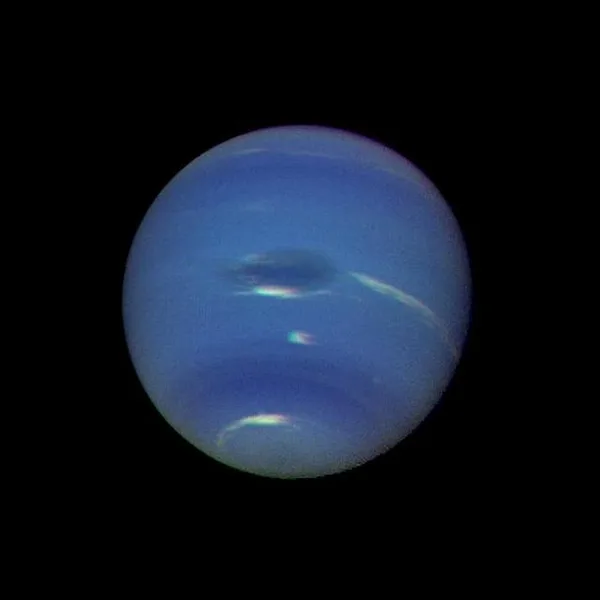
When Voyager 2 conducted its flyby of Neptune in 1989, it photographed a massive, dark storm system roughly the size of Earth, promptly named the Great Dark Spot, superficially reminiscent of Jupiter’s more famous Great Red Spot. Unlike Jupiter’s centuries-old storm, however, later observations by the Hubble Space Telescope revealed that Neptune’s Great Dark Spot had vanished entirely by 1994, replaced instead by new dark storm systems appearing at different locations in the planet’s atmosphere. This pattern suggests Neptune’s atmospheric storms are considerably more transient and short-lived than the remarkably stable, long-duration storm systems observed on Jupiter, appearing and dissipating over a span of just a few years rather than persisting for centuries.
Seasonal Changes Across a Distant World
Because a full Neptunian year lasts 165 Earth years, each of its four seasons stretches across roughly four decades. Despite this glacial seasonal pace, Hubble Space Telescope observations have documented measurable changes in Neptune’s cloud activity and brightness correlated with its long seasonal cycle, indicating that even at such an extreme distance from the Sun, with correspondingly weak seasonal solar variation, Neptune’s atmosphere remains responsive enough to register these subtle, decades-long shifts.
A Faint Ring System of Arcs
Neptune possesses a faint system of rings, composed of dark, dust-sized particles likely including significant amounts of organic compounds altered by long-term radiation exposure, similar in general character to the dark rings observed around Uranus. Neptune’s rings display a genuinely unusual feature not clearly duplicated elsewhere in the solar system: several of the rings appear clumped into distinct arcs rather than being evenly distributed around the entire circumference of the planet, an arrangement that ordinary orbital mechanics would predict should smooth out into a uniform ring relatively quickly.
The leading explanation proposes that the gravitational influence of a nearby small moon, Galatea, helps confine ring particles into these persistent clumped arcs through a delicate gravitational resonance, though the precise long-term stability of this arrangement remains an active subject of study, and some of the ring arcs observed by Voyager 2 in 1989 appear to have changed noticeably in subsequent observations, suggesting the arcs may be less permanently stable than initially assumed.
Triton: A Moon That Doesn’t Belong
An Orbit Running Backward
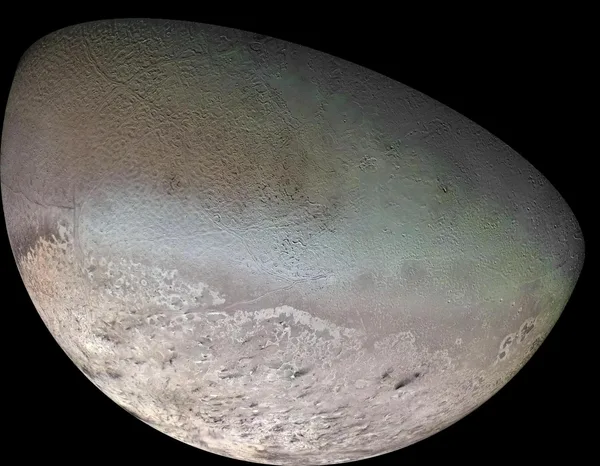
Neptune’s largest moon, Triton, stands out immediately for its retrograde orbit, circling Neptune in the opposite direction to the planet’s own rotation, a highly unusual configuration among large moons throughout the solar system. This backward orbital motion is considered strong evidence that Triton did not form alongside Neptune the way most large moons form alongside their host planets, but was instead captured later, likely originating as a large object from the distant Kuiper Belt that wandered too close to Neptune’s gravity and became permanently trapped in orbit.
Active Geysers on a Distant, Frozen World
Despite its extreme distance from the Sun and correspondingly frigid average surface temperature of roughly -235°C, among the coldest measured surface temperatures of any body in the solar system, Voyager 2 detected active geysers erupting from Triton’s surface during its 1989 flyby, launching plumes of nitrogen gas and dark dust particles several kilometers into the moon’s thin atmosphere. These geysers are thought to be driven by a subtle form of solar heating: sunlight penetrating a translucent layer of nitrogen ice warms trapped material beneath the surface, building pressure that eventually vents explosively through weak points in the surface ice, a mechanism sometimes described as a solid-state greenhouse effect.
A Moon Living on Borrowed Time
Because Triton orbits Neptune in the opposite direction to the planet’s rotation, tidal forces are gradually causing its orbit to decay over time, slowly spiraling the moon closer to Neptune. Current models suggest that within the next 3.6 billion years, Triton will eventually pass within a critical distance known as the Roche limit, at which point Neptune’s gravity is expected to tear the moon apart, potentially forming a spectacular ring system considerably more substantial than Neptune’s current faint rings, before that debris eventually falls into the planet itself.
A Brief but Transformative Visit
Voyager 2’s Grand Tour Finale
Neptune has been visited by only a single spacecraft in history: Voyager 2, which completed its flyby in August 1989 as the final planetary encounter of its remarkable grand tour of the outer solar system, a mission trajectory made possible by a rare alignment of the outer planets that occurs only once every 175 years. In this single close pass, Voyager 2 delivered nearly all of the direct, close-up data humanity currently possesses about Neptune, including detailed imagery of the Great Dark Spot, discovery of six previously unknown moons, direct detection of Triton’s active geysers, and the first confirmed measurements of Neptune’s magnetic field and ring system structure.
An Offset Magnetic Field, Much Like Uranus
Voyager 2’s measurements revealed that Neptune’s magnetic field, much like Uranus’s, is significantly tilted and offset from the planet’s rotational axis and geometric center, tilted by about 47 degrees and displaced considerably from the planet’s core. This similarity between the two ice giants’ unusual magnetic configurations reinforces the idea that both planets generate their magnetic fields within a churning layer of electrically conductive fluid in their outer mantles, rather than deep within a compact metallic core as occurs on Jupiter, Saturn, and Earth, representing a genuinely distinct category of planetary magnetic field generation.
The Case for a Return Mission
Given that Voyager 2’s historic flyby remains, decades later, our only direct source of close-up data about Neptune and its moons, the scientific community has increasingly advocated for a dedicated orbiter mission capable of conducting extended, detailed study of the Neptune system, with particular emphasis on Triton, whose likely origin as a captured Kuiper Belt object and evidence of ongoing geological activity make it a compelling target for understanding both ice giant systems and the broader population of icy bodies in the distant outer solar system. While such a mission remains unfunded and unscheduled as of now, mission planners have proposed concepts capable of reaching Neptune within roughly a decade of launch using modern propulsion and gravity-assist trajectories.
Neptune in Context: Comparing the Giant Planets
| Feature | Jupiter | Saturn | Uranus | Neptune |
|---|---|---|---|---|
| Distance from Sun | 778.5 million km | 1.43 billion km | 2.87 billion km | 4.5 billion km |
| Diameter | 139,820 km | 116,460 km | 50,724 km | 49,244 km |
| Fastest recorded winds | ~360 km/h | ~1,800 km/h | ~900 km/h | ~2,100 km/h |
| Internal heat excess | High | High | Minimal | High |
| Largest moon | Ganymede | Titan | Titania | Triton (captured) |
| Spacecraft visits | 9 | 4 | 1 | 1 |
A Distant World Still Rich With Questions
Neptune’s discovery through calculation alone remains one of the great demonstrations of gravitational theory’s predictive power, but the planet itself has proven far stranger and more dynamic than its icy, distant origins might suggest. Its record-breaking winds, driven by an internal heat surplus that defies easy comparison with its neighboring ice giant, continue to challenge atmospheric scientists attempting to model how such extreme energy can persist so far from the Sun’s warmth. Its captured moon Triton, orbiting backward and slowly spiraling toward eventual destruction, offers a rare, actively geologically evolving sample of the distant Kuiper Belt brought conveniently into range of a single spacecraft flyby. And its offset, mantle-generated magnetic field, shared in general character with Uranus but found nowhere among the solar system’s other planets, points toward processes of planetary magnetism that remain only partially understood.
With only a single, decades-old flyby to draw from, Neptune stands as perhaps the most under-explored major planet in the solar system relative to the scale of its scientific significance, a deep blue world at the edge of the Sun’s influence that continues to hold far more questions than answers, waiting for the next spacecraft patient enough, and well-funded enough, to make the long journey out to study it properly.
References
- NASA Science (n.d.) Neptune overview. Available at: https://science.nasa.gov/neptune/ (Accessed: 3 August 2026).
- NASA Solar System Exploration (n.d.) Neptune: in depth. Available at: https://solarsystem.nasa.gov/planets/neptune/in-depth/ (Accessed: 3 August 2026).
- NASA Science (n.d.) Voyager 2 at Neptune. Available at: https://science.nasa.gov/mission/voyager/ (Accessed: 3 August 2026).
- NASA Science (n.d.) Triton. Available at: https://science.nasa.gov/neptune/moons/triton/ (Accessed: 3 August 2026).
- NASA Science (n.d.) Kuiper Belt. Available at: https://science.nasa.gov/solar-system/kuiper-belt/ (Accessed: 3 August 2026).
- NASA Photojournal (n.d.) Neptune images. Available at: https://photojournal.jpl.nasa.gov/target/Neptune (Accessed: 3 August 2026).