Saturn: The Planet That Would Float
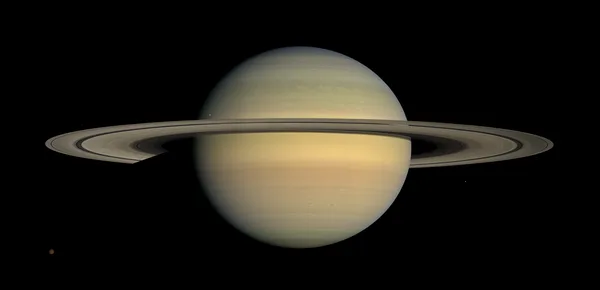
If there existed a bathtub large enough to hold it, Saturn would float. This is not a whimsical exaggeration but a direct consequence of physics: Saturn’s average density is lower than that of water, the only planet in the solar system for which this is true. Beyond this curious fact, Saturn has earned its reputation as the most visually spectacular object in the solar system, encircled by a ring system so vast, intricate, and luminous that it single-handedly transformed our understanding of what a planet could look like the moment Galileo first turned a telescope toward it in 1610, even though the crude optics of his era left him puzzled by what he saw, initially describing the planet as having “ears” rather than rings.
Saturn is far more than a beautiful curiosity, however. Its rings serve as an accessible, dynamic laboratory for studying the physics of orbital mechanics and disk formation on a scale relevant to how planets and moons themselves may originally form. Its largest moon possesses a thick atmosphere and liquid seas unlike anywhere else in the solar system besides Earth. And an icy moon barely 500 kilometers across has emerged as one of the most compelling candidates in the search for extraterrestrial life, thanks to geysers erupting directly from a hidden subsurface ocean.
Named for the God of Time and Agriculture
Saturn takes its name from the Roman god of agriculture, time, and generational renewal, a deity who, notably, was also considered the father of Jupiter in Roman mythology, mirroring the planet’s position as the next major world beyond Jupiter as seen from Earth. This naming pattern echoes a broader ancient tradition of associating the visible planets, moving in stately, predictable arcs across the sky, with figures of authority and cosmic order. Saturn’s slow orbital period, requiring nearly 30 Earth years to complete a single circuit around the Sun, likely reinforced its association with time itself among ancient skywatchers who tracked its position across entire human lifetimes.
Orbital and Physical Characteristics
A Long, Stately Orbit
Saturn orbits the Sun at an average distance of about 1.43 billion kilometers, nearly twice as far as Jupiter and almost ten times farther than Earth. At this distance, sunlight takes over an hour to reach Saturn, and the planet receives only about 1% of the solar energy per unit area that Earth does. Despite this immense orbital distance, Saturn rotates remarkably quickly, completing a full spin on its axis in just over 10 hours, a rotation rate exceeded only by Jupiter among the planets.
Physical Characteristics
| Property | Value |
|---|---|
| Diameter | 116,460 km (about 9.1 times Earth’s diameter) |
| Mass | 5.68 × 10²⁶ kg (about 95 times Earth’s mass) |
| Average density | 0.687 g/cm³ (less dense than water) |
| Surface gravity (cloud tops) | 10.44 m/s² (close to Earth’s own gravity) |
| Average distance from Sun | 1.43 billion km (9.5 AU) |
| Orbital period (year) | 29.5 Earth years |
| Rotation period (day) | 10 hours, 33 minutes |
| Axial tilt | 26.7° |
| Known moons | 146 confirmed, with more likely awaiting discovery |
| Cloud-top temperature | -178°C |
A Gas Giant Built Like Jupiter’s Sibling
Composition and Interior Structure
Saturn shares a broadly similar internal architecture with Jupiter, composed primarily of hydrogen and helium, transitioning through increasingly dense states as depth increases: gaseous hydrogen near the visible cloud tops, liquid hydrogen at greater depths, and metallic hydrogen deeper still, surrounding a core of heavier elements at the planet’s center. However, Saturn’s lower overall mass means the pressures required to produce metallic hydrogen occur much deeper within the planet than on Jupiter, and current models suggest Saturn’s core, like Jupiter’s, may be less a compact solid sphere and more a diffuse, partially mixed region blending gradually into the surrounding metallic hydrogen layer.
An Unusual Excess of Internal Heat
Like Jupiter, Saturn radiates substantially more energy into space, roughly 1.8 times as much, than it receives directly from the Sun. However, Saturn’s excess heat cannot be fully explained by simple gravitational contraction, the Kelvin-Helmholtz mechanism responsible for most of Jupiter’s excess heat, since calculations suggest Saturn should have cooled more than observations indicate. The leading explanation involves a process called helium rain: as Saturn’s interior gradually cooled over billions of years, droplets of helium are thought to condense out of the surrounding metallic hydrogen and sink deeper into the planet, releasing gravitational potential energy as friction-generated heat along the way, and simultaneously helping explain why Saturn’s outer atmosphere appears somewhat depleted in helium compared to the Sun’s overall composition.
A Turbulent, Banded Atmosphere
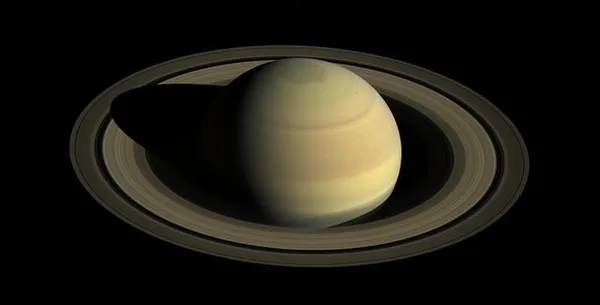
Saturn’s visible atmosphere displays the same banded cloud structure as Jupiter’s, though muted by a thicker haze layer that gives the planet its characteristically softer, more pastel appearance in photographs. Wind speeds near Saturn’s equator can reach an extraordinary 1,800 kilometers per hour, among the fastest sustained winds recorded anywhere in the solar system. At Saturn’s north pole lies one of the atmosphere’s strangest features: a persistent, hexagonal-shaped jet stream pattern, roughly 30,000 kilometers across, first observed by the Voyager spacecraft in the 1980s and confirmed in exquisite detail by Cassini decades later. This hexagon has proven remarkably stable over the decades of observation, and while laboratory experiments have successfully reproduced similar hexagonal patterns using rotating fluid systems, the precise atmospheric conditions sustaining Saturn’s version over such an extended period remain an active subject of research.
The Rings: A Signature Unlike Any Other
Structure and Composition
Saturn’s rings are composed overwhelmingly of water ice, mixed with smaller amounts of rocky material, ranging in size from microscopic dust grains to chunks several meters across. Despite their visually striking, seemingly solid appearance, the ring system is extraordinarily thin relative to its diameter, spanning roughly 280,000 kilometers across while measuring, in most locations, less than a kilometer in vertical thickness, a proportion often compared to a sheet of paper stretched across a football field.
The Main Ring Divisions
Saturn’s rings are organized into several main sections, traditionally labeled alphabetically in the order of their discovery rather than their position:
- D Ring: The faintest and innermost ring, composed of extremely fine particles.
- C Ring: A relatively dim, wide ring located inside the brighter main rings.
- B Ring: The brightest and most opaque ring, containing the greatest concentration of visible material.
- Cassini Division: A prominent gap between the B and A rings, kept largely clear of material through gravitational resonance with the moon Mimas.
- A Ring: A broad, bright ring containing several smaller gaps of its own, including the Encke Gap.
- F Ring: A narrow, notably active outer ring, its structure continuously shaped and disturbed by two small “shepherd moons” orbiting on either side of it.
How Old Are the Rings?
Whether Saturn’s rings are ancient, dating back to the planet’s formation, or comparatively young, having formed within just the last few hundred million years, remains a genuinely contested question in planetary science. Detailed gravitational measurements collected during Cassini’s final orbits suggested the rings may be surprisingly young, possibly forming from the tidal disruption of a wandering icy moon or comet sometime within the last 100 to 400 million years, a timeframe recent enough that dinosaurs might have walked Earth beneath a Saturn that had not yet developed its rings. However, this interpretation remains debated, with some researchers proposing mechanisms by which the rings’ apparent youthfulness might instead reflect ongoing recycling and replenishment of ring material rather than a genuinely recent formation event.
Shepherd Moons and Ring Maintenance
Several of Saturn’s smaller moons orbit directly within or alongside the ring system, gravitationally confining ring particles into their observed sharp-edged bands through repeated close gravitational interactions, a role that has earned them the descriptive name “shepherd moons.” Without this ongoing gravitational sculpting, models suggest Saturn’s rings would likely spread out and disperse over a comparatively short astronomical timescale, reinforcing the idea that the rings represent a dynamic, actively maintained system rather than a static, unchanging structure.
Titan: A World With Its Own Weather
The Only Moon With a Substantial Atmosphere
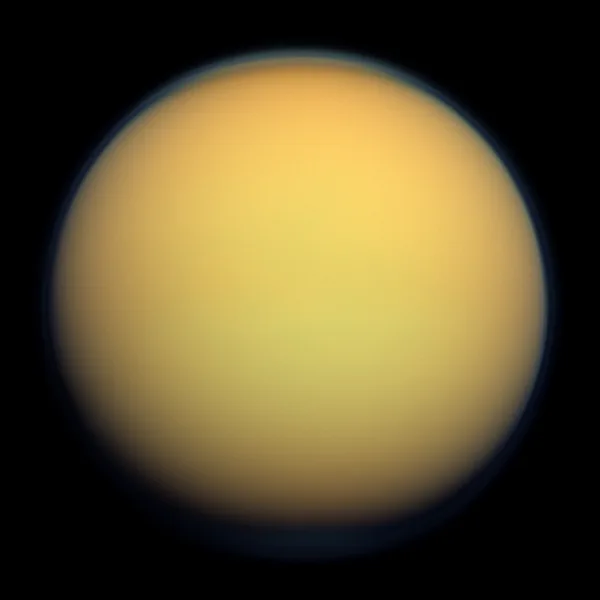
Saturn’s largest moon, Titan, stands apart from every other satellite in the solar system by possessing a thick, nitrogen-dominated atmosphere considerably denser than Earth’s own, dense enough that a human visitor, while requiring protection from Titan’s extreme cold and could not breathe its atmosphere directly, would not need a pressurized suit to avoid being crushed, a genuinely unique circumstance among the solar system’s moons.
Lakes and Rivers of Liquid Methane
Titan’s surface hosts stable lakes, rivers, and seas, but rather than liquid water, these bodies are composed of liquid methane and ethane, kept in a liquid state by Titan’s extremely cold surface temperature of roughly -179°C. This gives Titan the distinction of being the only other body in the solar system, besides Earth, confirmed to have stable liquid on its surface, complete with an active hydrological cycle involving methane evaporation, cloud formation, and rainfall, closely paralleling Earth’s water cycle despite operating with an entirely different chemistry.
A Possible Subsurface Ocean
Beneath its icy crust, gravitational and rotational measurements collected by the Cassini spacecraft suggest Titan likely harbors a substantial subsurface ocean of liquid water, potentially in contact with a rocky core beneath it, raising intriguing questions about whether Titan’s unusual combination of surface organic chemistry and a subsurface liquid water ocean might create conditions relevant to prebiotic chemistry, if not life itself.
Enceladus: A Small Moon With Big Implications
Geysers From a Hidden Ocean
Enceladus, a modestly sized icy moon only about 500 kilometers in diameter, emerged as one of the most significant discoveries of the entire Cassini mission. Observations revealed dramatic plumes of water vapor and ice particles erupting from cracks near its south pole, dubbed “tiger stripes,” conclusively demonstrating the presence of a substantial liquid water ocean hidden beneath Enceladus’s icy shell.
Chemistry Suggestive of Habitability
Cassini flew directly through several of these plumes, allowing its instruments to directly sample their chemical composition. These measurements detected molecular hydrogen, a chemical signature consistent with ongoing hydrothermal activity occurring on Enceladus’s ocean floor, similar in principle to the hydrothermal vent systems on Earth’s own seafloor that support rich, independent ecosystems without any reliance on sunlight. Combined with detections of simple organic molecules within the plumes, these findings have made Enceladus, despite its small size and considerable distance from the Sun, one of the most scientifically compelling targets in the ongoing search for life beyond Earth.
Exploring the Ringed Giant
Early Flybys
Saturn’s modern exploration began with Pioneer 11’s flyby in 1979, followed shortly afterward by Voyager 1 and Voyager 2, both of which delivered dramatically detailed imagery of the ring system, discovered several new moons, and provided the first clear evidence of Titan’s thick, hazy atmosphere, though its opaque orange clouds prevented Voyager’s cameras from directly imaging the moon’s surface.
Cassini-Huygens: A Landmark Mission
The Cassini-Huygens mission, a collaborative effort between NASA, the European Space Agency, and the Italian Space Agency, arrived at Saturn in 2004 and spent the next thirteen years conducting the most detailed study of the Saturn system ever undertaken. In January 2005, the mission’s Huygens probe successfully descended through Titan’s thick atmosphere and landed on its surface, transmitting data and images from another moon’s surface for the first time in history, revealing a landscape shaped by liquid methane erosion, complete with dry riverbeds and rounded, water-worn-looking pebbles composed of ice.
Cassini itself continued studying the Saturn system until 2017, when, with its fuel supplies nearly exhausted, mission controllers deliberately steered the spacecraft into a final, dramatic plunge directly into Saturn’s atmosphere, a maneuver known as the “Grand Finale,” designed specifically to prevent any risk of the spacecraft eventually contaminating Titan or Enceladus with Earth microbes, thereby preserving the scientific integrity of those moons for future astrobiological investigation.
Looking Ahead: Dragonfly
NASA’s upcoming Dragonfly mission, currently planned for launch later this decade, will deploy a nuclear-powered, rotorcraft-style drone directly onto Titan’s surface, taking advantage of the moon’s thick atmosphere and low gravity to fly between multiple sites across its surface, an approach impossible on airless or thin-atmosphere worlds, allowing unprecedented direct sampling and analysis of Titan’s complex surface chemistry.
Saturn in Context: Comparing the Giant Planets
| Feature | Jupiter | Saturn | Uranus | Neptune |
|---|---|---|---|---|
| Distance from Sun | 778.5 million km | 1.43 billion km | 2.87 billion km | 4.5 billion km |
| Diameter | 139,820 km | 116,460 km | 50,724 km | 49,244 km |
| Average density | 1.33 g/cm³ | 0.687 g/cm³ | 1.27 g/cm³ | 1.64 g/cm³ |
| Known moons | 95 | 146+ | 28 | 16 |
| Ring system | Faint, dusty | Bright, extensive | Narrow, dark | Faint, dusty |
| Notable moon of astrobiological interest | Europa | Enceladus, Titan | None confirmed | Triton (possible) |
Why Saturn Still Matters
Saturn’s rings offer scientists something genuinely rare: an accessible, close-up analog for the kinds of particle disks thought to have surrounded the young Sun itself, out of which the planets originally formed, allowing direct observation of gravitational sculpting, orbital resonance, and particle collision dynamics playing out in real time on a scale that would otherwise be impossible to study firsthand. At the same time, Saturn’s moon system has repeatedly upended assumptions about where life-friendly conditions might exist within the solar system, revealing that a small, icy moon barely large enough to see easily from Earth can nonetheless harbor a liquid ocean, active hydrothermal chemistry, and plumes of water erupting directly into space, offering a uniquely accessible sample of potentially habitable material without ever needing to drill through kilometers of ice.
Between Titan’s alien hydrological cycle, Enceladus’s hidden ocean and geysers, and the rings’ ongoing lessons about the physics of planetary formation, Saturn has proven, again and again, that its beauty is far from merely decorative. It is a planet that continues to reshape our understanding of where, and how, the conditions necessary for life might arise across a solar system far stranger and more varied than we once assumed.
References
- NASA Science (n.d.) Saturn overview. Available at: https://science.nasa.gov/saturn/ (Accessed: 3 August 2026).
- NASA Science (n.d.) Cassini mission. Available at: https://science.nasa.gov/mission/cassini/ (Accessed: 3 August 2026).
- NASA Solar System Exploration (n.d.) Saturn: in depth. Available at: https://solarsystem.nasa.gov/planets/saturn/in-depth/ (Accessed: 3 August 2026).
- NASA Science (n.d.) Enceladus. Available at: https://science.nasa.gov/saturn/moons/enceladus/ (Accessed: 3 August 2026).
- NASA Science (n.d.) Titan. Available at: https://science.nasa.gov/saturn/moons/titan/ (Accessed: 3 August 2026).
- ESA (n.d.) Huygens probe. Available at: https://www.esa.int/Science_Exploration/Space_Science/Cassini-Huygens (Accessed: 3 August 2026).