Uranus: The Planet Knocked on Its Side
Every planet in the solar system spins with at least some resemblance to a top, tilted at a modest angle as it circles the Sun. Uranus abandoned this pattern entirely. Tilted at more than 97 degrees, it does not so much spin as it rolls along its orbital path, its poles taking turns pointing almost directly at the Sun while its equator briefly faces outward into space. This single, extreme feature reshapes nearly everything about the planet, from its seasons, which last decades apiece, to its magnetic field, which behaves unlike that of any other planet in the solar system. Uranus is often treated as the least remarkable of the giant planets, visited only once by a passing spacecraft and rarely mentioned outside of its unfortunate name becoming schoolyard fodder. That reputation undersells a planet that is, in its own quiet way, one of the strangest and least understood worlds orbiting the Sun.
Part of what makes Uranus so difficult to characterize is simply how little direct data exists about it. A single flyby, decades ago, remains our only close-up look at this world, leaving enormous gaps in our understanding compared to the more thoroughly studied Jupiter and Saturn. Much of what scientists know about Uranus today comes from patient ground- and space-based telescope observations, painstaking modeling, and the occasional surprising discovery that forces a reconsideration of what this ice giant is really like beneath its pale blue-green haze.
Named for the Sky Itself
Uranus holds the distinction of being the only planet named after a Greek deity rather than a Roman one, honoring Ouranos, the primordial Greek personification of the sky and, according to myth, the father of Saturn, continuing the family lineage established by Saturn’s own naming as Jupiter’s father. The planet was discovered by the astronomer William Herschel in 1781, marking the first time in recorded history that a planet was identified through telescopic observation rather than being known since antiquity through naked-eye observation alone.
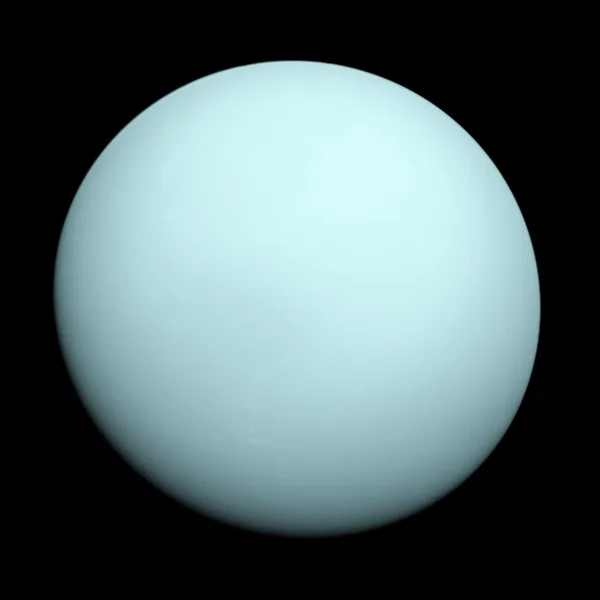
Herschel initially believed he had discovered a comet, given the object’s small, fuzzy telescopic appearance, and it took several years of continued observation and orbital calculation before the astronomical community accepted that this new object was in fact a planet, doubling the known size of the solar system overnight. Herschel initially proposed naming his discovery “Georgium Sidus,” or “George’s Star,” in honor of King George III, a suggestion that proved unpopular outside of Britain and was eventually replaced by the mythologically consistent name Uranus, proposed by the astronomer Johann Bode.
Orbital Characteristics
A Distant, Slow Orbit
Uranus orbits the Sun at an average distance of about 2.87 billion kilometers, roughly 19 times farther from the Sun than Earth. At this considerable distance, a single Uranian year lasts approximately 84 Earth years, meaning the planet has completed less than three full orbits since its discovery in 1781.
The Extreme Axial Tilt
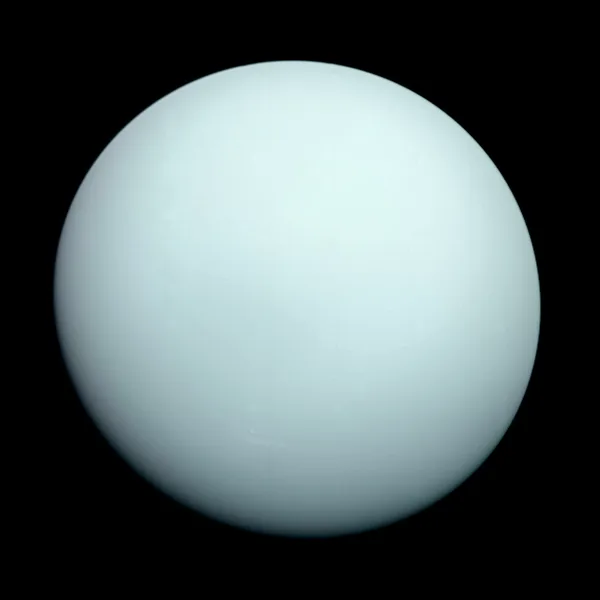
Uranus’s defining characteristic is its axial tilt of roughly 97.8 degrees, so extreme that the planet effectively orbits the Sun on its side rather than spinning upright like most other planets. The cause of this dramatic tilt remains debated, though the leading hypothesis proposes one or more massive collisions with other large protoplanetary bodies during the early, chaotic period of solar system formation, powerful enough to knock the young planet over without destroying it entirely.
This extreme tilt produces genuinely bizarre seasonal patterns. During certain portions of its 84-year orbit, one of Uranus’s poles points almost directly at the Sun while the opposite pole remains in continuous darkness for an extended period, and each pole experiences roughly 21 years of continuous sunlight followed by 21 years of continuous darkness, an extreme seasonal cycle unmatched by any other planet in the solar system.
Physical Characteristics
| Property | Value |
|---|---|
| Diameter | 50,724 km (about 4 times Earth’s diameter) |
| Mass | 8.68 × 10²⁵ kg (about 14.5 times Earth’s mass) |
| Average density | 1.27 g/cm³ |
| Surface gravity (cloud tops) | 8.69 m/s² (slightly less than Earth’s gravity) |
| Average distance from Sun | 2.87 billion km (19.2 AU) |
| Orbital period (year) | 84 Earth years |
| Rotation period (day) | 17 hours, 14 minutes (retrograde) |
| Axial tilt | 97.8° |
| Known moons | 28 confirmed |
| Cloud-top temperature | -224°C (coldest planetary atmosphere in the solar system) |
A Backward Spin as Well as a Sideways Tilt
Compounding its unusual orientation, Uranus also rotates in a retrograde direction relative to its orbit, similar to Venus, though the practical effect looks quite different given its sideways tilt. Depending on how the tilt is measured and described, Uranus’s rotation can be characterized either as an extreme tilt with retrograde spin or, equivalently, as a more modest tilt if one considers the planet “upside down” relative to its original orientation, a distinction that reflects genuine ambiguity in how planetary scientists classify such an extreme case rather than any error in measurement.
An Ice Giant, Not a Gas Giant
A Different Category of Giant Planet
Although often grouped casually with Jupiter and Saturn as a “gas giant,” Uranus, along with Neptune, is more accurately classified as an ice giant, a distinct category reflecting significant differences in bulk composition. While Jupiter and Saturn consist overwhelmingly of hydrogen and helium, Uranus’s interior is dominated by a dense, hot fluid mixture of water, methane, and ammonia ices surrounding a relatively small rocky core, with a comparatively thin outer envelope of hydrogen and helium gas.
The Mysterious Interior
Because no spacecraft has ever directly probed Uranus’s atmosphere with a descent module, our understanding of its interior structure relies heavily on models constrained by its overall mass, size, and gravitational field measurements taken during Voyager 2’s brief flyby. These models generally suggest a layered structure consisting of a small rocky core, surrounded by a vast mantle of hot, dense, and electrically conductive fluid often described as a “water-ammonia ocean,” despite bearing little resemblance to any ocean found on Earth given its extreme temperature and pressure, all wrapped in a comparatively thin outer atmosphere.
The Coldest Atmosphere in the Solar System
Despite not being the most distant planet from the Sun, Uranus holds the record for the coldest measured planetary atmospheric temperature in the solar system, dropping as low as -224°C in its upper atmosphere. This is particularly puzzling given that Neptune, despite orbiting significantly farther from the Sun and thus receiving even less solar energy, radiates noticeably more internal heat than Uranus does. Uranus, unlike every other giant planet, shows little to no evidence of significant internal heat escaping from its interior, a genuine scientific puzzle that some researchers speculate may be connected to the same ancient collision responsible for the planet’s extreme axial tilt, potentially having disrupted the planet’s internal heat distribution in ways not yet fully understood.
A Faint Blue-Green Haze
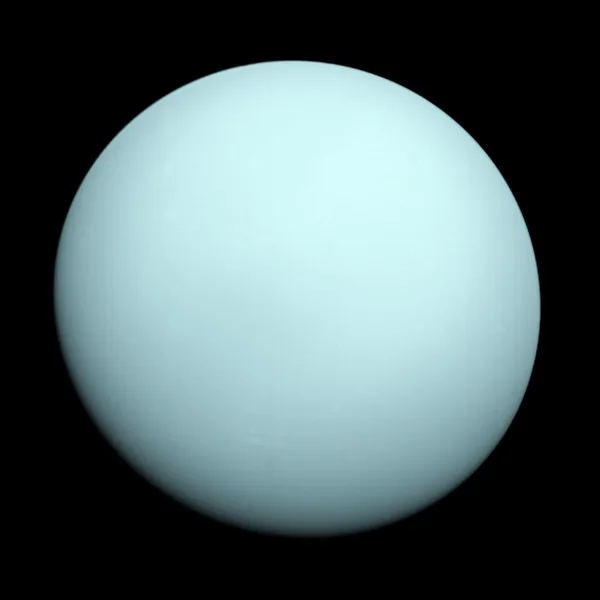
Uranus’s pale blue-green coloration comes from methane gas in its upper atmosphere, which absorbs red wavelengths of sunlight while reflecting blue and green wavelengths back into space. Compared to Neptune’s more vivid, saturated blue, Uranus appears notably paler and more washed out, likely due to a haze layer that obscures much of the deeper atmospheric structure and cloud detail that might otherwise be visible.
A Faint but Genuinely Strange Ring System
Uranus possesses a system of narrow, dark rings, first discovered indirectly in 1977 when astronomers observed a star’s light flicker in an unusual pattern as Uranus passed in front of it, revealing the presence of previously unknown rings through their gravitational and light-blocking effects rather than through direct visual observation. Unlike Saturn’s bright, ice-rich rings, Uranus’s rings are composed of much darker material, possibly organic compounds altered by radiation exposure over long timescales, and are considerably narrower and less reflective, making them far more difficult to observe from Earth.
Because of its extreme axial tilt, Uranus’s ring system appears to circle the planet from top to bottom, rather than around its equator in the more familiar horizontal orientation seen with Saturn, when viewed from Earth’s typical vantage point within the solar system’s orbital plane.
An Unusual Magnetic Field
Voyager 2’s 1986 flyby revealed that Uranus’s magnetic field is significantly offset and tilted relative to its rotational axis, tilted by nearly 60 degrees and displaced substantially from the planet’s actual center. This lopsided configuration is thought to result from the planet’s magnetic field being generated not deep within a compact metallic core, as is the case with Jupiter and Saturn, but rather within the electrically conductive fluid mantle surrounding a smaller, less influential core, producing a far less orderly and more complex magnetic structure than seen on other giant planets.
This unusual configuration causes Uranus’s magnetosphere to behave in a genuinely unique way as the planet rotates: because the magnetic field is so severely offset from the rotational axis, the entire magnetosphere appears to wobble and corkscrew behind the planet as it moves along its orbit, a structure unlike that observed around any other planet in the solar system.
A Diverse Family of Moons
Named for Literary Characters
Breaking from the mythological naming conventions used for nearly every other body in the solar system, Uranus’s moons are traditionally named after characters from the works of William Shakespeare and Alexander Pope, a tradition begun by William Herschel’s son John, who discovered several additional moons and named them Titania and Oberon after characters from Shakespeare’s “A Midsummer Night’s Dream.”
The Five Major Moons
| Moon | Notable Feature |
|---|---|
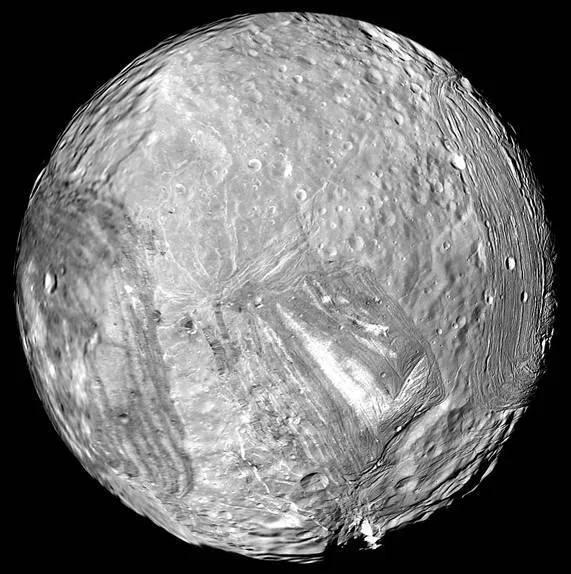
| Miranda | Extreme, jumbled terrain suggesting a violent geological history, possibly reassembled after a near-total disruption |
| Ariel | Relatively young surface with extensive canyon systems, suggesting past geological activity |
| Umbriel | Notably dark surface with few distinguishing features, among the least reflective moons known |
| Titania | The largest Uranian moon, featuring large canyons and evidence of past internal geological activity |
| Oberon | Heavily cratered, ancient surface with limited evidence of subsequent geological modification |
Miranda’s Puzzling Patchwork
Among Uranus’s moons, Miranda stands out for its extraordinarily varied and disjointed surface terrain, featuring huge cliffs, oddly angular grooved regions, and a patchwork appearance suggesting the moon may have been catastrophically disrupted by a major impact at some point in its history, with the resulting debris subsequently reassembling into its current, geologically jumbled form, though this remains one of several competing explanations for its unusual appearance.
A Single Visit From Earth
Voyager 2: Our Only Close Encounter
To date, Uranus has been visited by only a single spacecraft: Voyager 2, which conducted a flyby in January 1986 during its broader grand tour of the outer solar system. In just a matter of hours, Voyager 2 provided nearly all of the direct, close-up data humanity currently possesses about Uranus, including the discovery of ten previously unknown moons, detailed measurements of its unusual magnetic field, and the first clear images of its major moons’ surfaces.
Voyager 2’s flyby occurred during a period of unusually quiet atmospheric activity on Uranus, leading early analysis to characterize the planet as a relatively featureless, uniform sphere, a somewhat misleading impression later corrected by improved ground- and space-based telescope observations, including data from the Hubble Space Telescope, which have since revealed distinct seasonal storm activity, changing cloud bands, and other signs of a more dynamic atmosphere than Voyager’s brief snapshot initially suggested.
A Growing Case for Return
Given the enormous gaps in direct knowledge about Uranus, the National Academies’ most recent planetary science decadal survey identified a dedicated Uranus orbiter and atmospheric probe mission as one of the highest priorities for future flagship-class exploration, citing the planet’s unique combination of extreme axial tilt, unusual internal heat behavior, complex magnetic field, and potentially ocean-bearing moons as compelling scientific justification. While no such mission has yet been formally approved for launch, sustained scientific advocacy suggests Uranus may finally receive a proper follow-up mission within the coming decades.
Uranus in Context: Comparing the Giant Planets
| Feature | Jupiter | Saturn | Uranus | Neptune |
|---|---|---|---|---|
| Distance from Sun | 778.5 million km | 1.43 billion km | 2.87 billion km | 4.5 billion km |
| Diameter | 139,820 km | 116,460 km | 50,724 km | 49,244 km |
| Axial tilt | 3.1° | 26.7° | 97.8° | 28.3° |
| Classification | Gas giant | Gas giant | Ice giant | Ice giant |
| Internal heat excess | High | High | Minimal | Moderate |
| Spacecraft visits | 9 | 4 | 1 | 1 |
Why Uranus Still Matters
Uranus occupies a strange scientific position: simultaneously one of the least-visited major planets in the solar system and one of the most useful for understanding the broader diversity of planetary systems throughout the galaxy. Modern exoplanet surveys have revealed that ice giants roughly the size of Uranus and Neptune may represent one of the most common types of planet in the universe, considerably more common than Jupiter-sized gas giants or Earth-sized rocky worlds, making Uranus an unusually relevant natural laboratory for understanding a category of world that appears to dominate planetary demographics elsewhere in the galaxy, despite receiving comparatively little attention within our own solar system.
Its extreme axial tilt continues to challenge planetary formation models, its unexplained lack of significant internal heat remains an open puzzle with implications for understanding heat retention and loss across ice giants generally, and its unusually structured magnetic field offers a valuable contrast to the more familiar, dipole-dominated fields observed at Jupiter, Saturn, and Earth. A planet often dismissed as simply strange, or overlooked entirely in favor of its more dramatic neighbors, Uranus may in fact hold answers relevant to understanding a majority of the planets that exist across the wider universe.
References
- NASA Science (n.d.) Uranus overview. Available at: https://science.nasa.gov/uranus/ (Accessed: 3 August 2026).
- NASA Solar System Exploration (n.d.) Uranus: in depth. Available at: https://solarsystem.nasa.gov/planets/uranus/in-depth/ (Accessed: 3 August 2026).
- NASA Science (n.d.) Voyager 2. Available at: https://science.nasa.gov/mission/voyager/ (Accessed: 3 August 2026).
- ESA (n.d.) Ice giants science context. Available at: https://www.esa.int/Science_Exploration/Space_Science (Accessed: 3 August 2026).
- NASA Photojournal (n.d.) Uranus images. Available at: https://photojournal.jpl.nasa.gov/target/Uranus (Accessed: 3 August 2026).
- IAU (n.d.) Planetary nomenclature. Available at: https://planetarynames.wr.usgs.gov/ (Accessed: 3 August 2026).