Earth: Our Home Planet Online Test
Here is the test for you with 10 questions and 4 variants of answers for each question, where only one is correct.
Before you take this test, here are some things to remember about planet Earth.
Earth is the third planet from the Sun and the only world known to host a living biosphere — oceans of liquid water, oxygen-rich air, a protective magnetic field, active geology, and a climate that has stayed within a livable range for long stretches of deep time. Studying Earth as a planet (not only as “home”) is the key that unlocks comparative planetology: why Venus became an oven, why Mars became a cold desert, and why our blue world still works.
Key Characteristics
Orbit & Rotation
- Third planet from the Sun at 1 astronomical unit (about 149.6 million km) — the standard measuring stick for Solar System distances.
- Year: about 365.25 days.
- Day: about 24 hours (solar day); sidereal rotation is slightly shorter.
- Axial tilt: about 23.4°, the main reason for seasons (not Earth’s small change in distance from the Sun).
Size & Structure
- Largest of the four terrestrial planets; diameter about 12,742 km.
- Densest major planet, with a large iron-nickel core.
- Layers: thin crust, mantle, liquid outer core, solid inner core.
- Motion in the electrically conducting outer core helps generate Earth’s global magnetic field (the geodynamo).
Atmosphere & Ocean
- Air is about 78% nitrogen and 21% oxygen, plus argon, water vapor, carbon dioxide, and trace gases.
- Free oxygen is largely maintained by photosynthesis — life is a planetary force on Earth.
- Oceans cover roughly 71% of the surface and store vast heat, shaping climate and weather.
- A moderate greenhouse effect keeps Earth warmer than a bare rock at 1 AU would be; too much greenhouse gas can push climate out of balance (Venus shows the extreme).
Geology & the Living Planet
- Plate tectonics: Earth’s outer shell is broken into plates that move, collide, dive, and spread — recycling crust and helping regulate carbon over long ages.
- Earthquakes, volcanoes, and mountain building are expressions of a restless interior.
- The carbonate–silicate cycle links volcanoes, weathering, sediments, and climate on geologic timescales.
The Moon
- Earth has one large natural satellite — unusually big relative to its planet compared with most terrestrial-planet moons.
- The Moon raises tides, stabilizes aspects of Earth’s axial tilt over long timescales, and preserves ancient impact history on its surface.
- The leading scientific model for the Moon’s origin is a giant impact early in Earth’s history.
Earth Among Its Neighbors
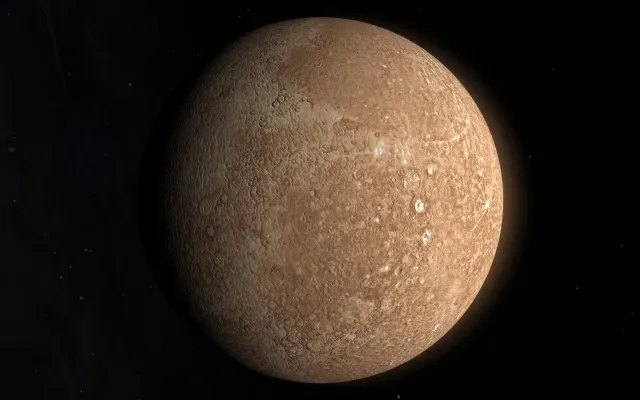
- Mercury: airless extremes and a metal-rich interior.
- Venus: nearly Earth’s size, runaway greenhouse furnace.
- Mars: cold, thin air, wetter past, ice today.
- Earth: liquid water, oxygen air, magnetic shield, tectonics, biosphere.
Earth is not a boring default world. It is the rare combination of size, location, atmosphere, magnetism, geology, and life that makes rain, forests, coral reefs, and human cities possible under the same sky. Understanding it carefully makes every other planet easier to interpret.
Sources: NASA Earth Science, NOAA, USGS, peer-reviewed Earth and planetary science literature.