The Microscopic Cities Inside Us: A Deep Dive into Animal, Plant, and Fungal Cells
If you look at your hand, you see skin. If you look at a tree, you see bark. But if you could switch your eyes to “microscope mode,” the world would dissolve into a staggering array of trillions of tiny, self-contained universes.
These are cells. They are the fundamental building blocks of life, but calling them “blocks” is a disservice. A brick is simple; a cell is arguably more complex than a modern city.
Inside every single one of your 37 trillion cells, there is a power plant, a recycling center, a library of blueprints, a transport network, and a defensive perimeter.
But not all cities are built the same. A plant cell is built like a fortress, designed to stand tall against gravity. An animal cell is built like a flexible tent, designed for movement and speed. And then there are fungi—the strange “middle children” of the biological world—that break all the rules.
In this lesson, we are going to move beyond the 2D drawings you saw in school. We are going to explore the 3D machinery of life to understand exactly how these three types of cells differ, and why those differences matter.
[INTERACTIVE TOOL: CELL LAB]
Cell Structure Explorer
Interactive 3D comparison. Click parts to highlight.
...
...
Parts Menu
Experiment: Rotate cell 3D models and click on the parts inside them to learn how they are functioning.
Part 1: The Universal Machinery (What They Share)
Before we look at what makes them different, we have to look at what makes them the same. Whether you are a mushroom, a maple tree, or a human, your cells share a common heritage. We are all Eukaryotes.
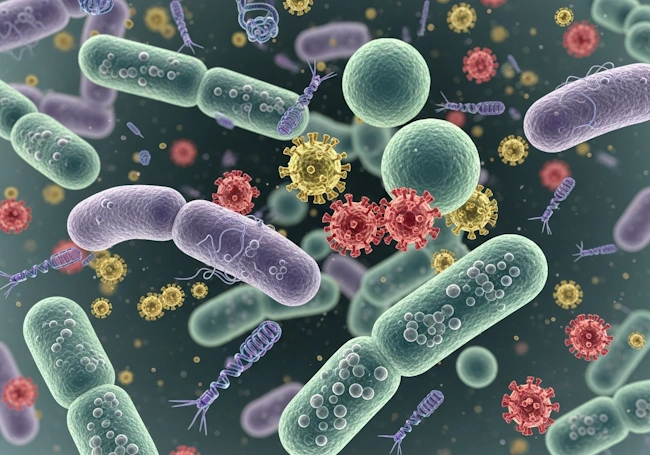
This means our cells have a “true kernel” (nucleus). This distinguishes us from bacteria (Prokaryotes), which are essentially messy bags of chemicals with no internal organization.
Here are the “Public Utilities” found in almost every eukaryotic city:
1. The Nucleus: The City Hall and Library
If the cell is a city, the Nucleus is the heavily guarded City Hall. Inside, you won’t find bureaucrats; you will find the Master Blueprints (DNA). In all three types of cells (Animal, Plant, Fungi), the nucleus serves the same purpose: it protects the genetic code from damage. It has a double-membrane “security gate” (the nuclear envelope) that only lets specific messenger molecules (mRNA) in and out.
2. The Cytoplasm: The Atmosphere
Everything inside the cell floats in a jelly-like substance called Cytoplasm. It isn’t just water; it’s a cytoskeleton scaffolding that holds organelles in place, like steel beams holding up buildings. Without this, the cell would collapse on itself.
3. The Mitochondria: The Power Plants
This is the most famous organelle for a reason. Life requires energy. Mitochondria are the power plants that burn fuel (glucose) to generate electricity (ATP).
The Evolutionary Secret: Mitochondria have their own separate DNA. Scientists believe they were once ancient bacteria that got swallowed by a larger cell billions of years ago. Instead of being digested, they struck a deal: “I’ll give you energy if you give me protection.” This is called Endosymbiosis, and it occurred in the ancestor of plants, animals, and fungi.
4. Ribosomes: The 3D Printers
If DNA is the blueprint, Ribosomes are the construction workers (or 3D printers). They float around the city reading instructions sent from the Nucleus and snapping amino acids together to build proteins. Every physical part of you—your hair, enzymes, muscle fibers—was printed by a ribosome.
Part 2: The Animal Cell (The Agile Hunter)
Animal cells are defined not by what they have, but by what they lack.
If you look at an animal cell under a microscope, it looks squishy, irregular, and round. It lacks the rigid armor found in plants. Why? Because Animals need to move.
The Cell Membrane: The Border Patrol
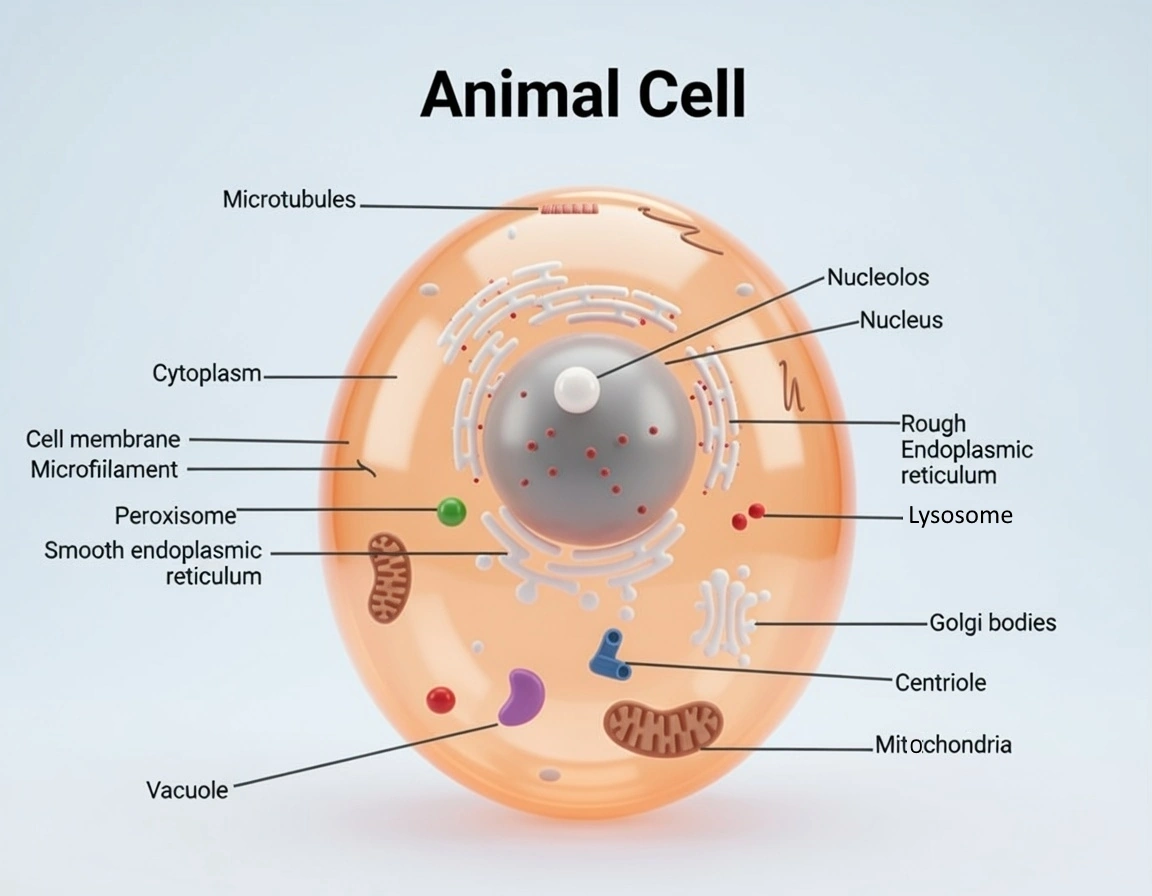
Instead of a thick wall, animal cells are wrapped in a thin, flexible Plasma Membrane. Think of it like a water balloon. It is strong enough to hold the contents in, but flexible enough to squeeze through tight spaces.
Why this matters: This flexibility allows your white blood cells to squeeze between tissue layers to hunt bacteria. It allows your muscle cells to contract and expand. If animal cells had walls, you would be a statue.
Centrioles: The Logistics Managers
Here is something unique to animals: Centrioles. These look like churros or distinct tubes. Their job is to help the cell divide (mitosis) by organizing the cytoskeleton. While some lower plants have them, they are primarily an animal feature. They act like the logistics team that ensures when the city splits in two, each side gets exactly half the buildings.
Lysosomes: The Recycling Center
Animal cells are aggressive eaters. They often engulf food or waste. The Lysosome is a floating stomach filled with acid. It digests old organelles, food particles, and viruses. While plants and fungi have similar degradation processes (often in their vacuoles), the lysosome is the hallmark of the animal cell’s “metabolic hunger.”
Part 3: The Plant Cell (The Solar Fortress)
Plant cells are engineering marvels. Unlike animals, plants cannot run away from predators or hunt for food. They must stand their ground, endure the weather, and make their own food from sunlight. To do this, they evolved to be Fortresses.

The Cell Wall: The Medieval Fortification
The most obvious difference is the Cell Wall. It sits outside the membrane. It is made of Cellulose—a tough, fibrous carbohydrate.
The Trade-off: The wall makes the cell rigid. A plant cell cannot “squeeze” or move. However, this rigidity allows trees to grow 300 feet tall against gravity. Without cell walls, a tree would be a puddle of green slime on the ground.
Chloroplasts: The Solar Panels
This is the defining feature of the plant kingdom. Chloroplasts are green, bean-shaped organs that capture photon energy from the sun and convert it into sugar (Photosynthesis). Just like Mitochondria, Chloroplasts have their own DNA, suggesting they were also ancient bacteria (Cyanobacteria) that plants adopted eons ago. Animals do not have these; we have to eat plants (or things that ate plants) to get our energy.
The Central Vacuole: The Water Tower
If you look at your 3D model of the plant cell, you will notice a massive bubble taking up 90% of the space. This is the Central Vacuole. It acts like a water balloon inside a cardboard box.
- How it works: The plant pumps this vacuole full of water. The water pushes outward against the rigid cell wall. This creates Turgor Pressure.
- Why it matters: This pressure is what makes a plant stand up straight. When you forget to water your houseplant, the vacuole empties, the pressure drops, and the plant wilts.
Part 4: The Fungi Cell (The Alien Hybrid)
Now we get to the weird part. For centuries, biologists classified Fungi (mushrooms, yeast, mold) as plants. It made sense: they grow out of the ground and don’t move.
But genetically and structurally, Fungi are actually closer to Animals than Plants.

The Cell Wall… With a Twist
Like plants, Fungi have a cell wall. But it isn’t made of cellulose (wood). It is made of Chitin.
The Mind-Blowing Fact: Chitin is the exact same material used to make the exoskeletons of insects, crabs, and lobsters.
This proves that Fungi are more related to the beetle crawling on the tree than the tree itself.
No Solar Panels Here
Fungi do not have chloroplasts. They cannot make energy from the sun. Like animals, they are Heterotrophs—they must consume other living (or dead) things for energy.
The Difference: Animals put food inside their bodies to digest it. Fungi digest food outside their bodies (by secreting enzymes) and then absorb the nutrients through their cell walls.
The Septum: The Open Door
In multicellular fungi (like mushrooms), the cells form long strands called hyphae. Separating these cells are walls called Septa. Unlike plant walls, which seal the cell off, fungal septa often have large pores (holes) in the middle. This allows cytoplasm and even organelles to flow freely between cells. It’s as if the “apartments” in the fungal building have open doors, allowing resources to rush quickly to wherever they are needed.
Part 5: The Ultimate Comparison Table
To help you visualize the differences, here is a breakdown of the architectural choices each kingdom made.
| Feature | Animal Cell | Plant Cell | Fungal Cell |
|---|---|---|---|
| Primary Strategy | Mobility (Hunt & Move) | Stability (Photosynthesis) | Absorption (Decomposition) |
| Outer Boundary | Flexible Membrane | Rigid Cell Wall (Cellulose) | Rigid Cell Wall (Chitin) |
| Energy Source | Mitochondria (Eat Food) | Chloroplasts (Sunlight) | Mitochondria (Absorb Food) |
| Storage | Small, temporary vacuoles | Huge Central Vacuole | Medium Vacuoles |
| Shape | Irregular / Round | Fixed / Rectangular | Fixed / Tubular (Hyphae) |
| Unique Feature | Centrioles / Lysosomes | Chloroplasts | Septum / Chitin |
Why The Differences Matter: The Evolutionary Trade-Off
When I study these cells, I don’t just see biology; I see economics. Every cell type is a result of a specific evolutionary trade-off.
- The Plant Trade-off: Plants chose Security and Autonomy. By building thick walls and solar panels, they ensured they would never go hungry as long as the sun shines, and they could grow tall. But the cost was Freedom. They are locked in place. If a fire comes, they burn.
- The Animal Trade-off: Animals chose Freedom and Speed. By stripping away the heavy cell wall, they became agile. They could run, swim, and fly. But the cost was Security. We are constantly hungry. We must hunt to survive. We cannot just sit in the sun and get full.
- The Fungal Trade-off: Fungi chose the Niche of the Recycler. They kept the wall for protection (like plants) but abandoned the sun (like animals). They evolved to eat the world’s leftovers. Without the specialized fungal cell, the world would be buried in dead trees and leaves. They are the cleanup crew of the planet.
Conclusion
It is easy to look at a diagram and just memorize “Mitochondria is the powerhouse.” But the reality is so much richer.
These three cellular designs represent the three dominant strategies for complex life on Earth. They are the result of billions of years of trial and error. The next time you eat a salad (Plant cells) with mushrooms (Fungal cells) and a side of steak (Animal cells), remember: you aren’t just eating food. You are eating three completely different architectural masterpieces of nature.
🎓 Quiz: Cell Biology Basics
1. Which organelle is responsible for generating energy (ATP)?
- A) The Nucleus
- B) The Ribosome
- C) The Mitochondria
- D) The Vacuole
👉 Click to check answer
It acts as the power plant of the cell.
2. What material makes the Fungal cell wall unique?
- A) Cellulose
- B) Chitin
- C) Plasma
- D) Bone
👉 Click to check answer
This is the same material found in insect exoskeletons!
3. Why does a plant wilt when you forget to water it?
- A) The chloroplasts stop working
- B) The cell wall dissolves
- C) The Central Vacuole empties and pressure drops
- D) It gets too hot
👉 Click to check answer
Without water pressure (Turgor), the plant cannot stand up straight.
4. Which feature allows Animal cells to be mobile/flexible?
- A) They lack a rigid Cell Wall
- B) They have extra Mitochondria
- C) They are smaller
- D) They have Centrioles
👉 Click to check answer
They only have a flexible membrane, like a water balloon.
5. What is the main function of the Ribosome?
- A) To store water
- B) To protect the DNA
- C) To build proteins (3D Printer)
- D) To digest waste
👉 Click to check answer
They read the genetic code and assemble amino acids.
Sources& References
- Alberts, B., et al. (2014). Molecular Biology of the Cell. Garland Science.
- Keeling, P. J. (2019). “The evolutionary history of eukaryotic cells”. Annual Review of Microbiology.
- Nature Education. (2014). “Plant Cells, Chloroplasts, and Cell Walls”. Scitable.
- Moore, D., et al. (2011). 21st Century Guidebook to Fungi. Cambridge University Press.