Is Earth Round?
The question “Is Earth round?” seems simple, but the answer reveals fascinating aspects of astronomy, physics, history, and human understanding of our place in the universe. Earth’s shape has been the subject of scientific inquiry for thousands of years, evolving from ancient observations to modern space-based measurements.
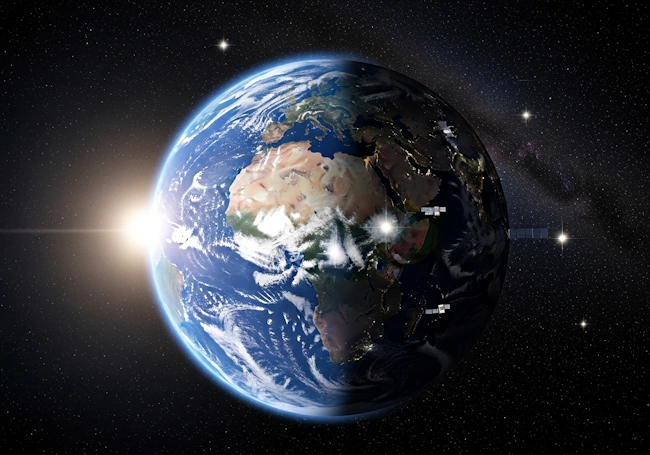
The study of Earth’s shape has evolved from ancient philosophers watching ships disappear on the horizon to modern satellites measuring gravity fields. In this lesson, we will explore why Earth looks the way it does, how ancient Greeks measured it with sticks, and why you weigh slightly less at the Equator than at the North Pole.
[INTERACTIVE TOOL: THE GRAVITY SHAPER]
Planetary Gravity Shaper
Observe how Rotation Speed (Centrifugal Force) battles Gravity
Experiment: Spin a planet.
- Slow Spin: Gravity wins. The planet is a perfect sphere.
- Fast Spin: Centrifugal force pushes out. The equator bulges.
- Super Fast: The planet flattens into a disc!
History — How We Knew That Earth Is Not Flat Before Space Travel
Long before we had rockets or satellites, observant humans knew the Earth wasn’t flat. The myth that medieval people believed in a Flat Earth is actually a modern invention (mostly from the 19th century). Educated people have known the truth for over 2,000 years.
1. Ancient Observations (Aristotle)
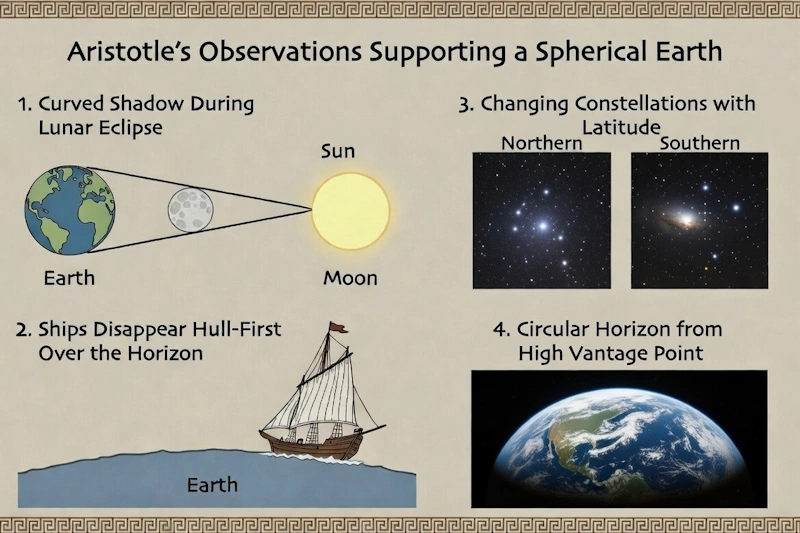
Around 350 BCE, the Greek philosopher Aristotle documented three key proofs:
- The Ship: When a ship sails away, the hull disappears first, then the sails. If the Earth were flat, the whole ship would just get smaller.
- The Eclipse: During a lunar eclipse, Earth casts a shadow on the Moon. That shadow is always curved. Only a sphere casts a round shadow from every angle.
- The Stars: As you travel North, new stars appear on the horizon, and southern stars disappear.
2. The First Measurement (Eratosthenes)
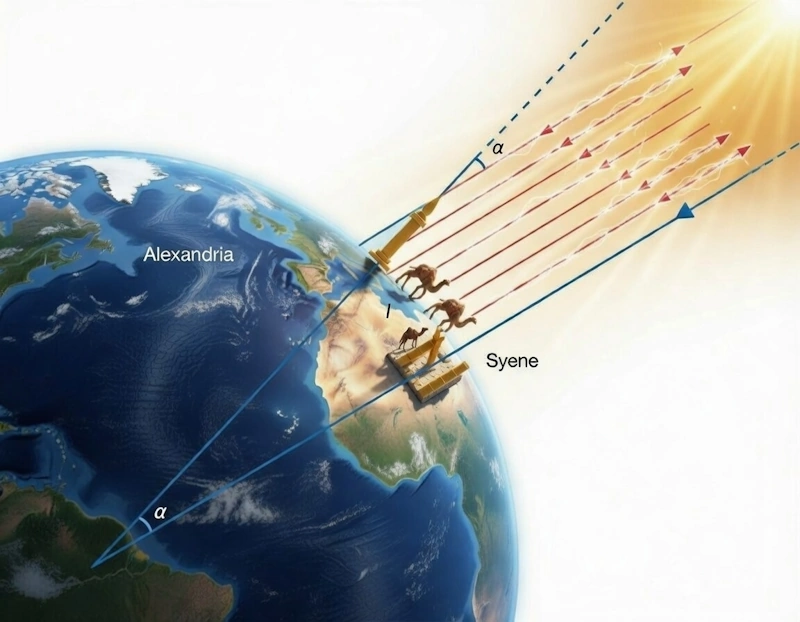
This is one of the greatest experiments in history. In 240 BCE, Eratosthenes noticed a shadow anomaly:
- In Syene (South), at noon on the solstice, the sun was directly overhead (no shadow).
- In Alexandria (North), at the same time, a stick cast a shadow of 7.2 degrees.
He realized the Earth must be curved. By measuring the distance between the cities and using simple geometry, he calculated Earth’s circumference at roughly 40,000 km. He was accurate to within 1% of modern measurements!
3. The Ultimate Proof (Magellan)
In 1519, Ferdinand Magellan launched an expedition to sail West and return from the East. Although he died en route, his crew completed the circumnavigation in 1522, proving empirically that the world is a globe.
Modern scientific understanding
Is earth round or a perfect sphere?
When asking this question, we must recognize that while Earth is approximately spherical, it’s not a perfect sphere. Modern measurements reveal Earth is an oblate spheroid – slightly flattened at the poles and bulging at the equator.
Earth is not oval in the sense of being egg-shaped, but rather is slightly wider at the equator than from pole to pole. When considering “is earth round or oblong,” the answer is that Earth is indeed slightly oblong in a specific way – the equatorial diameter (12,756 km) exceeds the polar diameter (12,714 km) by about 43 kilometers.
The scientific term: oblate spheroid
When people ask “is earth round or elliptical,” they’re approaching the more precise description. Earth’s shape is technically an oblate spheroid or an ellipsoid of revolution. This shape results from Earth’s rotation causing a slight bulge at the equator.
To be even more precise, Earth isn’t even a perfect oblate spheroid. Local variations in mass distribution create slight deviations, leading geophysicists to use the term “geoid” to describe Earth’s true shape – a mathematical model of sea level extended through the continents.
Exact measurements
Modern geodesy (the science of measuring Earth) gives us precise figures:
- Equatorial radius: 6,378.1 kilometers
- Polar radius: 6,356.8 kilometers
- Equatorial circumference: 40,075 kilometers
- Meridional circumference: 40,008 kilometers
These measurements show Earth’s equatorial bulge is relatively small compared to the planet’s overall size – about 0.3% of difference. If you held a scale model of Earth, you would barely notice the deviation from a perfect sphere. This answers the question of “is earth actually round” – yes, for most practical purposes, but with measurable deviations from a perfect sphere.
The Bulge
Because Earth spins at 1,000 mph (1,600 km/h), the centrifugal force pushes the equator outward. The Earth is 43 kilometers wider than it is tall.
Because of this bulge, the peak of Mount Chimborazo in Ecuador is actually the point on Earth closest to the Moon (farthest from the center), beating Mount Everest!
The Geoid
Even “Oblate Spheroid” is too simple. Because gravity varies based on where mountains and ocean trenches are, scientists use a model called the Geoid. This is a lumpy, irregular potato-shape that represents where sea level would be if gravity were the only factor.
Evidence that Earth is round
When examining “what are the proof that the earth is round” or “what are the evidence that the earth is round,” several categories emerge:
Visual evidence
- Horizon and ship observations: The most accessible evidence comes from watching ships disappear bottom-first over the horizon, indicating curvature.
- Lunar eclipses: During a lunar eclipse, Earth casts a round shadow on the Moon regardless of the eclipse’s timing, possible only if Earth is round.
- Different star patterns: Travelers heading north or south see different stars, consistent with movement across a curved surface.
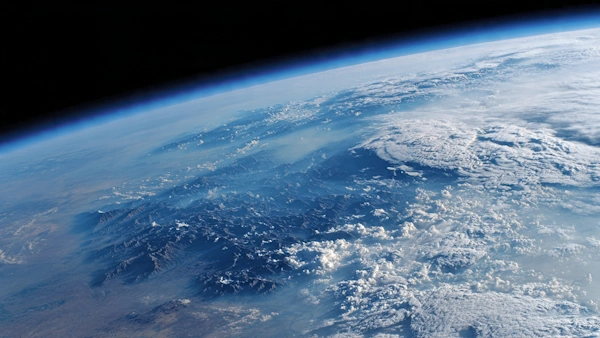
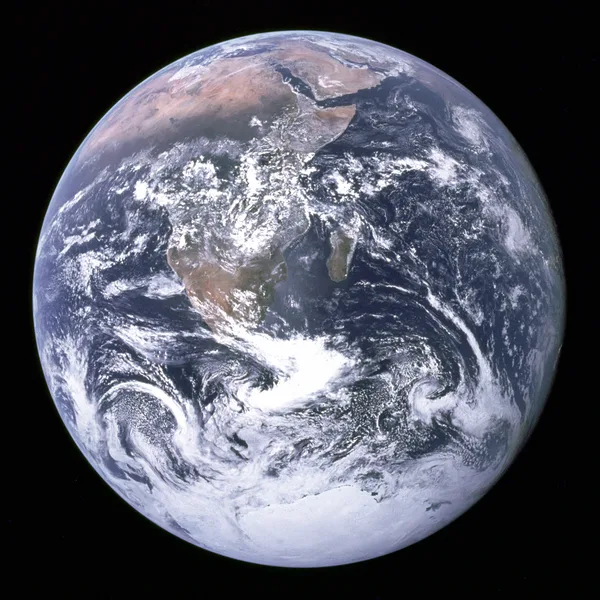
- Photographs from Space: The most direct evidence comes from thousands of photographs showing Earth as a round planet.
Physical evidence
- Gravity measurements: Gravity’s strength varies slightly at different locations on Earth, consistent with an oblate spheroid shape.
- Aircraft and ship navigation: Long-distance travel routes account for Earth’s curvature, proving Earth round through practical applications.
- Satellite orbits: Artificial satellites orbit Earth in patterns only possible around a rounded body.
- Coriolis effect: The apparent deflection of moving objects when viewed from a rotating reference frame provides evidence of a rotating spheroid.
Modern technological evidence
- GPS Systems: Global Positioning Systems rely on satellites positioned based on Earth’s actual shape.
- Geodetic surveys: Precise land surveys account for Earth’s curvature.
- Gravitational mapping: Detailed gravitational maps show variations consistent with an oblate spheroid.
- Satellite imagery: Comprehensive imaging from multiple angles consistently shows a round Earth.
Why is Earth round?
A key question is “why is earth round and not flat” or “is earth round because of gravity?” The answer lies primarily in gravity.
Gravity’s influence
Large massive bodies like Earth are shaped by gravity, which pulls matter equally from all directions toward the center of mass. For any sufficiently large body, gravity forces matter into the most efficient shape – a sphere.
The physical principle is straightforward: in a non-rotating body, gravity pulls all mass as close as possible to the center, and the shape that minimizes the average distance of mass from the center is a sphere.
- If you have a massive mountain on a square planet, gravity will pull that high point down until it is level.
- Over millions of years, gravity smooths out high spots and fills in low spots. The only shape where every point on the surface is equidistant from the center is a Sphere.
Role of rotation
Earth’s rotation explains why Earth isn’t a perfect sphere. The rotational force creates a slight bulging at the equator, forming the oblate spheroid shape. Without rotation, Earth would be closer to a perfect sphere.
Material properties
Earth’s partially molten interior allows it to behave as a fluid over geological time scales, responding to gravitational and rotational forces. Rocky planets like Earth have enough plasticity to achieve hydrostatic equilibrium, taking on a rounded shape.
Comparison with other celestial bodies
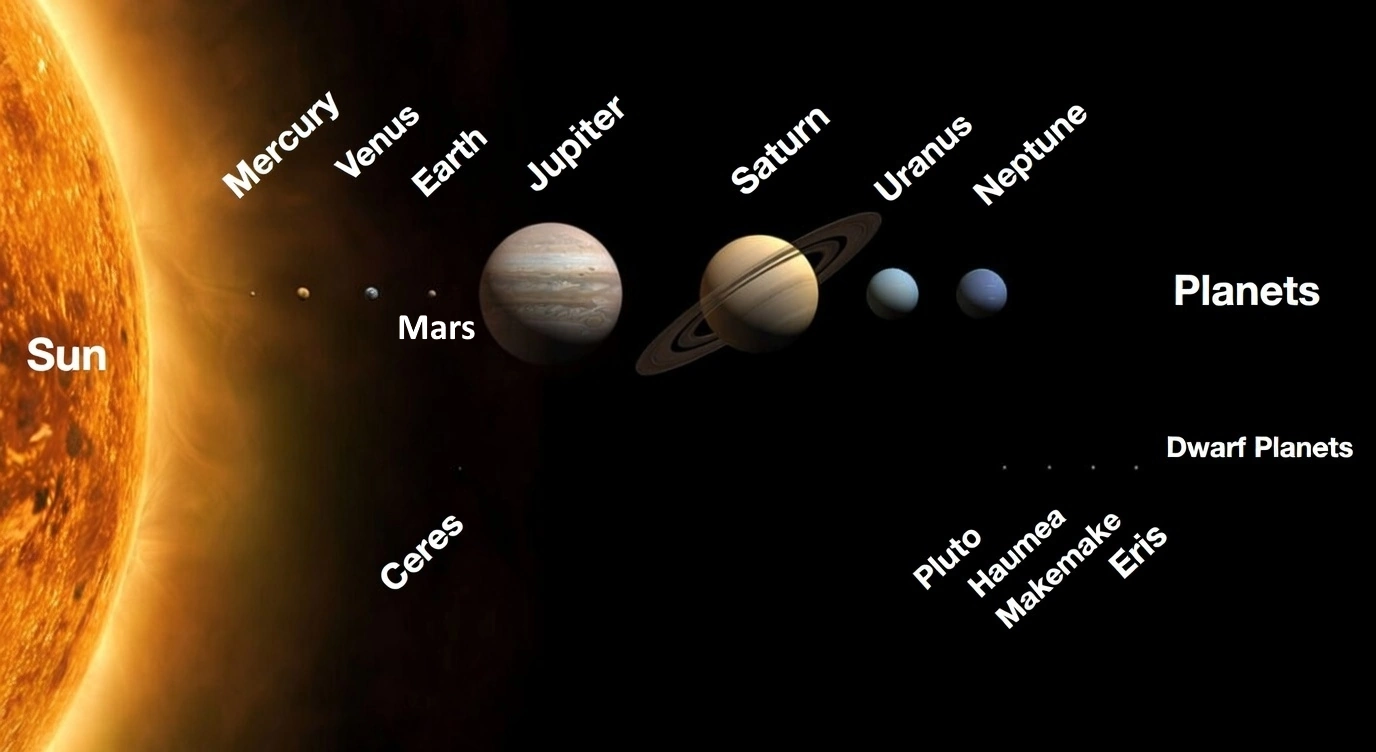
This rule only applies to massive objects (Planets, Stars, Large Moons).
Small objects—like asteroids (e.g., Eros or Itokawa)—don’t have enough gravity to crush themselves into a ball. That is why asteroids look like potatoes or rubber ducks.
Historical figures who proved Earth is round
Aristotle (384-322 BCE)
Aristotle compiled multiple lines of evidence for Earth’s sphericity, including:
- The circular shadow during lunar eclipses
- The changing appearance of constellations when traveling north or south
- The disappearance of ships over the horizon
Eratosthenes (276-194 BCE)
Eratosthenes not only understood Earth was round but calculated its circumference with remarkable accuracy using shadows in different locations.
Ptolemy (100-170 CE)
Ptolemy’s “Almagest” further refined understanding of Earth as a sphere at the center of the universe, influencing astronomy for over a millennium.
Al-Biruni (973-1048)
The Persian scholar measured Earth’s circumference using trigonometry and the height of a mountain.
Ferdinand Magellan & Juan Sebastián Elcano (1519-1522)
Though Magellan died during the journey, his expedition completed the first circumnavigation of Earth, providing empirical proof of its roundness.
Isaac Newton (1642-1727)
Newton’s work on gravity explained why large celestial bodies become spherical and predicted Earth’s equatorial bulge due to rotation.
Geodetic Surveys (18th-19th centuries)
Precise measurements in the 18th and 19th centuries confirmed Earth’s oblateness, with the polar diameter about 43 km less than the equatorial diameter.
Is round Earth a theory?
In everyday language, “theory” often implies uncertainty or speculation, but in science, a theory is a well-substantiated explanation backed by evidence and repeated testing.
The spherical Earth is not merely a theory but an established fact supported by overwhelming evidence from multiple fields. It would be more accurate to say that our knowledge of why Earth is spheroidal is explained by the theory of gravity.
Unlike genuine scientific controversies where multiple legitimate explanations compete, there is no credible scientific debate about Earth’s basic shape. The evidence is so comprehensive that Earth’s roundness is considered a fact, much like the existence of atoms or the circulation of blood.
Addressing flat Earth claims
Despite overwhelming evidence, some people continue to claim Earth is flat. Modern “Flat Earth” beliefs gained renewed attention in the internet age but remain rejected by the scientific community.
Common flat Earth claims and their rebuttals include:
| Claim | Response |
|---|---|
| “We can’t feel Earth’s curvature or motion” | At human scales, Earth’s curvature is too subtle to notice directly, and its consistent motion doesn’t produce sensations of movement. |
| “The horizon appears flat” | Earth’s large size makes curvature difficult to detect from ground level, but it becomes visible from greater heights and with proper measurement tools. |
| “Water always finds its level” | On a gravitational body, “level” means equidistant from the center of mass, creating a curved, not flat, surface. |
| “Photographs from space are manipulated” | Consistent images from numerous countries, private companies, and amateur high-altitude balloons all show a curved Earth. |
Educational importance
Understanding Earth’s shape is foundational to many scientific disciplines:
- Geography and Navigation: Accurate maps, GPS, and navigation depend on understanding Earth’s true shape.
- Astronomy: Earth’s position and properties are key to understanding our place in the solar system.
- Physics: Earth’s shape demonstrates principles of gravity and rotational physics.
- Environmental Science: Climate patterns, ocean currents, and wind systems are influenced by Earth’s shape and rotation.
- History of Science: The development of understanding Earth’s shape showcases scientific method and human ingenuity across cultures and centuries.
Summary of Key Terms
- Oblate Spheroid: A sphere that is squashed at the poles and swollen at the equator.
- Circumference: The distance around the Earth (approx 40,000 km).
- Geodesy: The science of measuring Earth’s shape and gravity.
- Centrifugal Force: The apparent force pushing outward due to rotation.
🎓 Quiz: The Shape of the Earth
1. What is the scientifically correct term for Earth’s shape?
- A) Perfect Sphere
- B) Oval
- C) Oblate Spheroid
- D) Geodesic Dome
👉 Click to check answer
It is slightly flattened at the poles and bulging at the equator.
2. Who was the first person to calculate Earth’s circumference using shadows?
- A) Aristotle
- B) Eratosthenes
- C) Magellan
- D) Newton
👉 Click to check answer
He used the difference in shadow angles between two cities in Egypt.
3. Why does the Earth bulge at the equator?
- A) Because of the ocean tides
- B) Because of the rotation (Centrifugal Force)
- C) Because it is hotter there
- D) Because of the Moon’s gravity
👉 Click to check answer
The spin pushes mass outward, creating a 43 km difference in diameter.
4. Why are small asteroids potato-shaped instead of round?
- A) They spin too fast
- B) They are made of different rocks
- C) They lack enough gravity to crush themselves into a sphere
- D) They are broken pieces of planets
👉 Click to check answer
You need a massive amount of gravity to force rock into a fluid-like sphere.
5. Which ancient observation proved Earth was round during an eclipse?
- A) The Moon turned red
- B) The shadow on the Moon was always curved
- C) The stars disappeared
- D) The tides stopped
👉 Click to check answer
Only a sphere casts a circular shadow from every angle.
Sources & References
- Aristotle (350 BCE) On the Heavens. Translated by J.L. Stocks, 1922. Oxford: Clarendon Press.
- Eratosthenes (c. 240 BCE) ‘On the Measurement of the Earth’. In Strabo’s Geography, Book II. Available at: https://penelope.uchicago.edu/Thayer/E/Roman/Texts/Strabo/2A*.html (Accessed: 28 February 2026).
- Hargreaves, R. (2007) A brief history of circumnavigations. London: Constable & Robinson.
- International Earth Rotation and Reference Systems Service (2023) Earth Orientation Parameters. Available at: https://www.iers.org/IERS/EN/DataProducts/EarthOrientationData/eop.html (Accessed: 28 February 2026).
- National Aeronautics and Space Administration (2024) Earth Fact Sheet. Available at: https://nssdc.gsfc.nasa.gov/planetary/factsheet/earthfact.html (Accessed: 28 February 2026).
- National Geographic Society (2022) Geodesy: The Science of Measuring Earth. Available at: https://www.nationalgeographic.org/encyclopedia/geodesy/ (Accessed: 28 February 2026).
- Newton, I. (1687) Philosophiæ Naturalis Principia Mathematica. London: Jussu Societatis Regiae ac Typis Josephi Streater.
- Roller, D.W. (2010) Eratosthenes’ Geography: Fragments Collected and Translated. Princeton: Princeton University Press.