Schrödinger’s Cat: The Famous Feline That Changed Physics
Imagine for a second: a cat sits inside a sealed box, and according to the strange rules of quantum physics, it is both alive and dead at the same time.
Sound impossible? Welcome to one of science’s most famous thought experiments, dreamed up by Austrian physicist Erwin Schrödinger in 1935. It remains the most popular way to explain the bizarre reality of the quantum world.

In this lesson, we will open the box to understand the paradox, the setup, and why scientists are still arguing about that cat today.
[INTERACTIVE TOOL: THE QUANTUM BOX]
Schrödinger's Cat
A Quantum Superposition SimulatorExperiment: Click “Start.” The box blurs (Superposition). Click “Open.” The reality snaps to either Alive or Dead. Is it truly random?
Part 1: The Setup That Started It All
Schrödinger wasn’t actually interested in cats when he created this puzzle. He was frustrated. He wanted to critique how physicists were interpreting quantum mechanics—the bizarre set of rules that govern the tiniest particles in our universe.
To show how ridiculous these interpretations could get, he imagined a diabolical contraption.
Inside a steel box, you would find a cat alongside some rather unpleasant company:
- A Geiger counter.
- A hammer.
- A flask of poison.
- A tiny bit of radioactive material.
How the deadly machine works:
If the radioactive atom decays (which quantum mechanics says has a 50% chance of happening in an hour), the Geiger counter detects it. This triggers the hammer to break the flask, releasing poison gas that kills the cat.
If the atom doesn’t decay, the cat lives.
The Twist:
The weirdness comes from quantum mechanics itself. According to the prevailing interpretation at the time, the radioactive atom exists in what scientists call “Superposition” – it is both decayed and not decayed simultaneously until someone measures it.
Following this logic to its absurd conclusion, Schrödinger argued: The cat would also be in superposition: both dead and alive until someone opens the box to check.
Part 2: What Quantum Mechanics Actually Says
To understand why Schrödinger’s scenario seems so weird, we need to grasp a few key ideas about the quantum world. At the scale of atoms and subatomic particles, reality behaves nothing like our everyday experience suggests.
Imagine flipping a coin, but instead of landing heads or tails, it somehow lands both ways at once. That is essentially what particles do in the quantum realm.
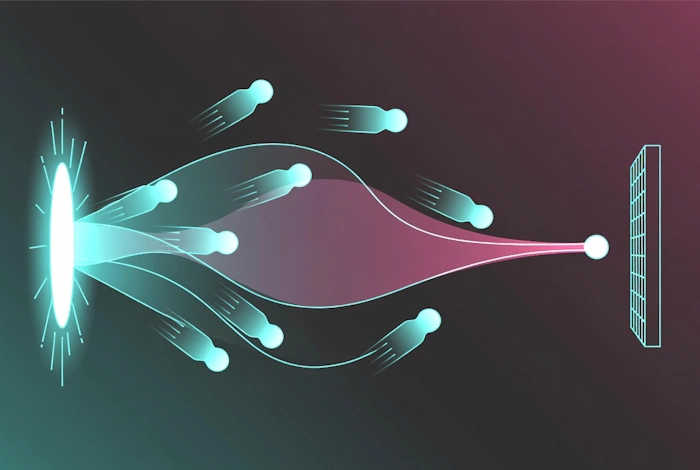
- An electron can spin in multiple directions simultaneously.
- A photon can travel through several paths at the same time.
This isn’t just theoretical – scientists observe these effects in laboratories around the world.
The Mystery of Measurement
The mystery deepens when we try to measure these quantum states. The moment we observe a particle, it “chooses” one specific state, collapsing from its multiple possibilities into a single reality.
- Before measurement: The particle exists in a ghostly combination of all possible states.
- After measurement: It becomes definite and concrete.
This process, called Wave Function Collapse, happens instantaneously and fundamentally changes the system being observed. It is as if reality itself is undecided until we force it to pick a side.
Part 3: The Real Point of the Paradox
Schrödinger wasn’t trying to prove that cats could be zombie-like creatures existing between life and death. Instead, he wanted to highlight what he saw as a major problem with quantum mechanics: it seemed to suggest that large, everyday objects could exist in the same weird superposition states as tiny particles.
Most physicists at the time subscribed to the Copenhagen Interpretation, developed by Niels Bohr and Werner Heisenberg. This view essentially said that quantum objects don’t have definite properties until measured, and asking what they’re “really” doing beforehand makes no sense.
Schrödinger found this deeply unsatisfying. He used his cat to show how strange this interpretation becomes when applied to macroscopic (large) objects.
The Fundamental Question:
The thought experiment reveals a massive puzzle: Where exactly does the quantum world end and the classical world begin? Why do we never see everyday objects in superposition, even though they are made of quantum particles that regularly exist in multiple states?
Part 4: Modern Solutions and Interpretations
Decades of research have provided several answers to Schrödinger’s puzzle, though physicists still debate which explanation is correct.
1. Decoherence (The Environment is Watching)
The most widely accepted solution involves Decoherence.
Large objects like cats interact constantly with their environment – air molecules, radiation, vibrations. These interactions destroy quantum superposition almost instantly.
In simple terms: The cat’s quantum states become “entangled” with countless environmental particles. The environment effectively “measures” the system, forcing it into a definite state long before anyone opens the box.
2. The Many-Worlds Interpretation
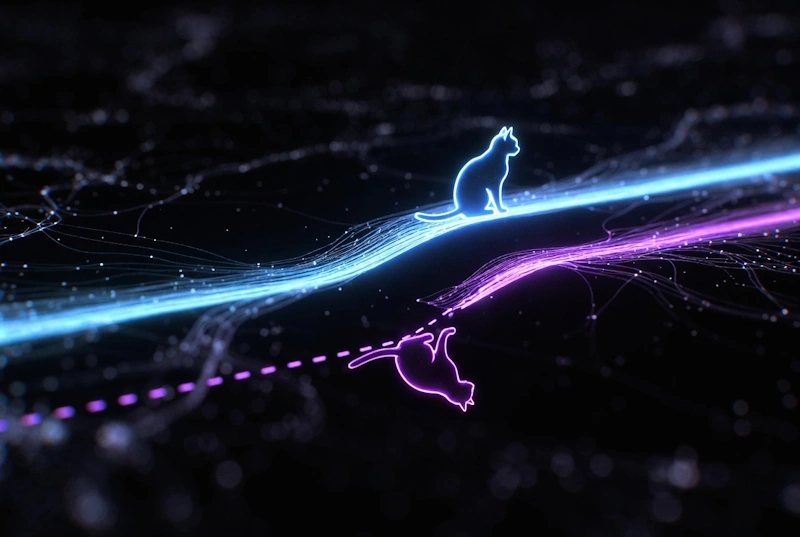
Another approach suggests that both possibilities actually occur – in parallel universes.
- When the radioactive atom faces its 50-50 choice, reality splits.
- In one universe (dimension), the atom decays and it means that the cat dies.
- In another, it doesn’t decay and the cat lives.
- We only experience one branch of this cosmic fork in the road.
3. Consciousness?
Some interpretations propose that consciousness plays a special role in collapsing wave functions, though this view has fallen out of favor among most physicists. Others suggest that the wave function never actually collapses – we just lose track of the quantum information as it spreads throughout the environment.
Part 5: What is Beyond Physics?
Schrödinger’s cat has transcended its origins as a physics thought experiment to become a cultural icon. The phrase “Schrödinger’s cat” now describes any situation where something exists in an uncertain state until revealed – like election results before polls close or job applications before interviews.
But the real impact lies in how this paradox pushed physics forward. It forced scientists to think more carefully about measurement, reality, and the boundary between quantum and classical behavior. This deeper understanding has led to revolutionary technologies we use today:
- Quantum Computers: Rely on particles existing in superposition to perform calculations impossible for traditional computers.
- Quantum Cryptography: Uses the weird properties of quantum measurement to create unbreakable codes.
- MRI Scanners: Exploit quantum effects in atomic nuclei to image the body.
The Cat’s Legacy
Nearly ninety years after Schrödinger first imagined his unfortunate feline, the paradox continues to generate new insights. Scientists now create “Schrödinger’s cat” states with everything from individual atoms to relatively large molecules.
Fun Fact: The Aluminum Drum
In 2021, researchers even demonstrated superposition with objects visible to the naked eye – tiny aluminum drums that vibrated and didn’t vibrate simultaneously.
These experiments help us understand exactly how and why superposition disappears as objects get larger and more complex. They are pushing the boundaries of quantum technology, bringing us closer to computers powerful enough to revolutionize medicine, materials science, and artificial intelligence.
Schrödinger probably never imagined that his attempt to ridicule quantum mechanics would become one of its most enduring symbols. The cat in the box reminds us that reality at its deepest level operates by rules that challenge our intuition and stretch our imagination.
🎓 Quiz: The Schrödinger Paradox
1. Why did Erwin Schrödinger create this thought experiment?
- A) To prove cats have nine lives
- B) To show how ridiculous the Copenhagen Interpretation was
- C) To invent the first Quantum Computer
- D) To study radioactive decay
👉 Click to check answer
He thought the idea of a cat being dead and alive was absurd.
2. What triggers the poison in the box?
- A) A timer
- B) The cat stepping on a button
- C) The decay of a radioactive atom
- D) A scientist pressing a remote
👉 Click to check answer
This links the quantum world (atom) to the macro world (cat).
3. According to the “Many Worlds” interpretation, what happens when you open the box?
- A) The cat disappears
- B) Reality splits into two timelines (one alive, one dead)
- C) The cat chooses to be alive
- D) Time stops
👉 Click to check answer
Both outcomes happen, but in separate universes.
4. What concept explains why we don’t see zombie cats in real life?
- A) Decoherence
- B) Gravity
- C) Relativity
- D) String Theory
👉 Click to check answer
Interactions with air and the environment “measure” the object instantly, destroying superposition.
5. In 2021, what object did scientists successfully put into superposition?
- A) A Virus
- B) A Tiny Aluminum Drum
- C) A Frog
- D) A Computer Chip
👉 Click to check answer
It vibrated and stood still at the same time, visible to the naked eye.
Sources & References
- Schrödinger, E. (1935). “The Present Situation in Quantum Mechanics”. Die Naturwissenschaften. (English Translation via American Philosophical Society).
Link: https://www.jstor.org/stable/986572 - Faye, J. (2019). “Copenhagen Interpretation of Quantum Mechanics”. The Stanford Encyclopedia of Philosophy.
Link: https://plato.stanford.edu/entries/qm-copenhagen/ - Zurek, W. H. (2003). “Decoherence and the transition from quantum to classical”. Physics Today. (Hosted by Los Alamos National Laboratory).
Link: https://arxiv.org/abs/quant-ph/0306072 - Vaidman, L. (2021). “Many-Worlds Interpretation of Quantum Mechanics”. The Stanford Encyclopedia of Philosophy.
Link: https://plato.stanford.edu/entries/qm-manyworlds/ - Teufel, J.D., et al. (2021). “Direct observation of deterministic macroscopic entanglement”. Science, 372(6542). (Source for the aluminum drums experiment).
Link: https://www.nist.gov/news-events/news/2021/05/nist-team-directs-quantum-entanglement-macroscale